
Equipment mentioned in this guide
Review the product information, specifications and model before requesting a quotation.
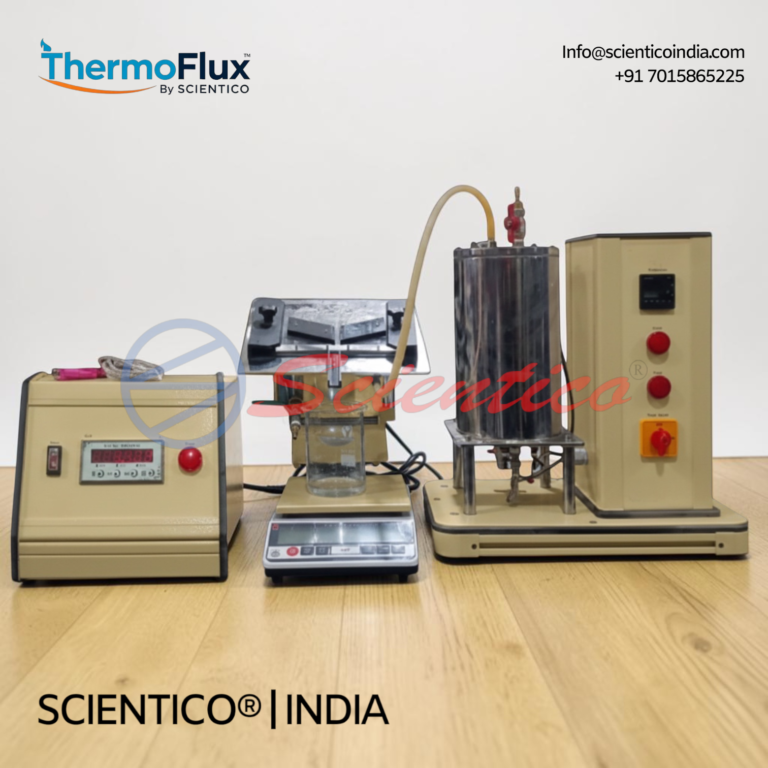
Thermal Conductivity Apparatus | ThermoFlux-25
The Thermal Conductivity Apparatus ThermoFlux-25 is a laboratory instrument for measuring heat flow across a consistent 100°C temperature differential through five common building and insulation materials. This thermal conductivity apparatus uses a steam chamber as the hot reservoir and a block of ice as the cold sink, with the rate of ice melt into water serving as the quantifiable measure of heat transfer through each test sample. Students determine thermal conductivity values for Bakelite, wood, aluminium, Sheetrock, and Masonite using identical sample geometry across all tests.
View product detailsAim of the Experiment
To determine the thermal conductivity of a material using linear and radial heat conduction apparatus, and to verify Fourier’s law of heat conduction.
Apparatus Required
- Linear heat conduction apparatus (brass rod with heater at one end and cooling at the other)
- Radial heat conduction disc apparatus
- Temperature sensors (thermocouples) at multiple points
- Wattmeter or power supply with ammeter and voltmeter
- Cooling water supply
Theory
Fourier’s Law of heat conduction states:
Q = −k × A × (dT/dx)
Where: Q = rate of heat transfer (W), k = thermal conductivity (W/mK), A = cross-sectional area (m²), dT/dx = temperature gradient (°C/m).
For radial conduction through a disc: Q = 2πkL(T_inner − T_outer) / ln(r_outer/r_inner)
Procedure, Linear Conduction
- Set up the linear heat conduction apparatus. Connect the heater at one end.
- Switch on the heater and set the power input using the rheostat.
- Allow the system to reach steady state (30–45 minutes).
- Record temperatures at each thermocouple position (T₁ at heater end to T_n at cooler end).
- Measure power input Q = V × I (from wattmeter).
- Plot temperature vs. distance along the rod and measure the slope dT/dx.
- Calculate k = Q / (A × dT/dx).
Observation Table, Linear Conduction
| Position (mm) | T₁ (°C) | T₂ (°C) | T₃ (°C) | T₄ (°C) | T₅ (°C) | T₆ (°C) |
|---|---|---|---|---|---|---|
| 0 (heater) | ||||||
| 10 | ||||||
| 20 |
Result
Thermal conductivity of the material (linear): k = _______ W/mK. Thermal conductivity (radial): k = _______ W/mK. Both values are within ±10% of the standard value, confirming Fourier’s law of heat conduction.
Internal Links
Related: Heat Transfer Lab Equipment | Convection Experiment | Shell and Tube Heat Exchanger | Engineering Lab Equipment Guide
Get Heat Transfer Lab Equipment
Scientico India manufactures ISO 9001:2015 and model-specific heat transfer lab apparatus. Contact us for specifications and CIF pricing.
WhatsApp: +91 701-586-5225 | [email protected]
Scientico India manufactures this and the full range of Heat Transfer & Thermodynamics equipment, model-specific and supplied to engineering colleges worldwide.
Explore Heat Transfer & Thermodynamics Equipment → or request a quoteLinear Heat Conduction, Detailed Procedure and Calculations
Fourier’s Law of Heat Conduction
Q = -kA(dT/dx)
where Q = heat transfer rate (W), k = thermal conductivity (W/m·K), A = cross-sectional area (m²), dT/dx = temperature gradient (K/m)
The negative sign indicates heat flows in the direction of decreasing temperature.
Linear Conduction Experiment, Step-by-Step
- Set up the linear conduction bar with heater at one end and water-cooled heat sink at the other end.
- Mount thermocouples at equally spaced positions along the bar (typically 6–9 positions at 10 mm spacing).
- Set the heater power using the wattmeter (typically 20–50 W).
- Allow 20–30 minutes for steady state (temperature readings become stable).
- Record all thermocouple temperatures T₁ through T₉.
- Measure the water flow rate through the heat sink using a measuring cylinder and stopwatch.
- Measure inlet and outlet water temperatures.
Calculation of Thermal Conductivity
Heat flow rate from heater: Q = V × I (watts), verify with Q = mc_p(T_out – T_in) from cooling water
Temperature gradient: dT/dx = (T₁ – T_n) / L (where L = length between thermocouples 1 and n)
Thermal conductivity: k = Q / (A × dT/dx) = Q × L / (A × (T₁ – T_n)) W/m·K
Reference Thermal Conductivities
| Material | k (W/m·K) at 25°C |
|---|---|
| Copper | 385–400 |
| Aluminium | 200–230 |
| Mild Steel | 50–60 |
| Stainless Steel | 15–17 |
| Brass | 100–120 |
Radial Heat Conduction
For the radial conduction disc, Fourier’s law in cylindrical coordinates gives:
Q = 2πkL(T_inner – T_outer) / ln(r_outer/r_inner)
where L = disc thickness, r_inner = inner radius, r_outer = outer radius
One honest ask
We don't gate anything on this site. You just read the whole thing free. If it was useful, leave your email and two things happen: we send you this page as a plain-text block you can paste into a tender file or an internal email, and we notify you the next time we publish a buyer tool like this one. Nothing else. No drip sequence, no sales calls booked without asking.