
The core conduction convection radiation difference is the mechanism and the medium: conduction transfers heat through direct molecular contact in solids (no bulk motion), convection transfers heat by the bulk movement of a fluid, and radiation transfers heat as electromagnetic waves that need no medium at all. Each mode is governed by its own law, Fourier’s law for conduction, Newton’s law of cooling for convection, and the Stefan-Boltzmann law for radiation.
Equipment mentioned in this guide
Review the product information, specifications and model before requesting a quotation.
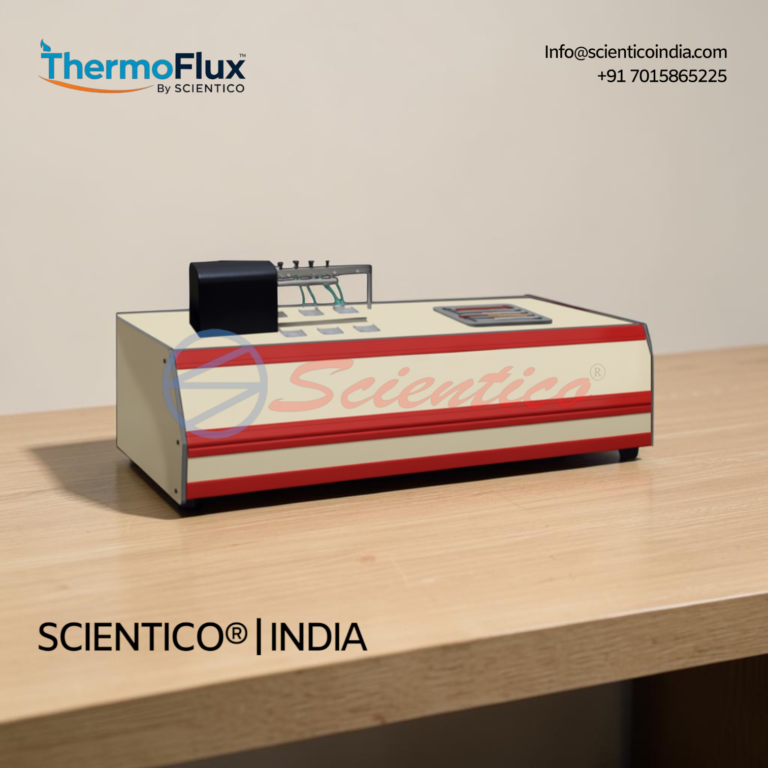
Heat Conduction and Convection | ThermoFlux – 7106
The Heat Conduction and Convection ThermoFlux – 7106 is a laboratory apparatus designed for basic experiments on heat conduction and convection, two of the three fundamental forms of heat transfer. Six interchangeable metal samples, each functioning as a cooling fin, are heated at one end and dissipate heat through conduction along their length and convection to the surrounding air.
View product details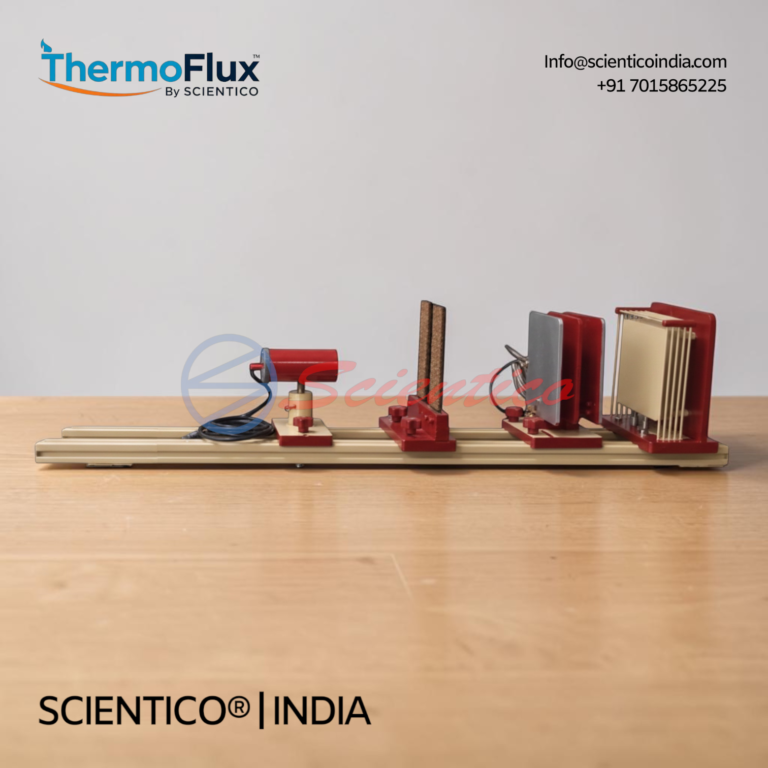
Radiation Heat Transfer Module | ThermoFlux – 7049/3
The Radiation Heat Transfer Module ThermoFlux - 7049/3 is a laboratory module for demonstrating and verifying the fundamental laws governing thermal radiation heat transfer. This radiation heat transfer module provides an electrically heated radiant source rated at 300 W with a maximum temperature of approximately 460°C, a set of seven metal specimens across three materials, and an aperture plate assembly for structured experimental investigation. Students verify the inverse square law, Stefan-Boltzmann Law, Kirchhoff's Law, emissivity, absorptivity, and geometric view factor relationships through direct measurement.
View product details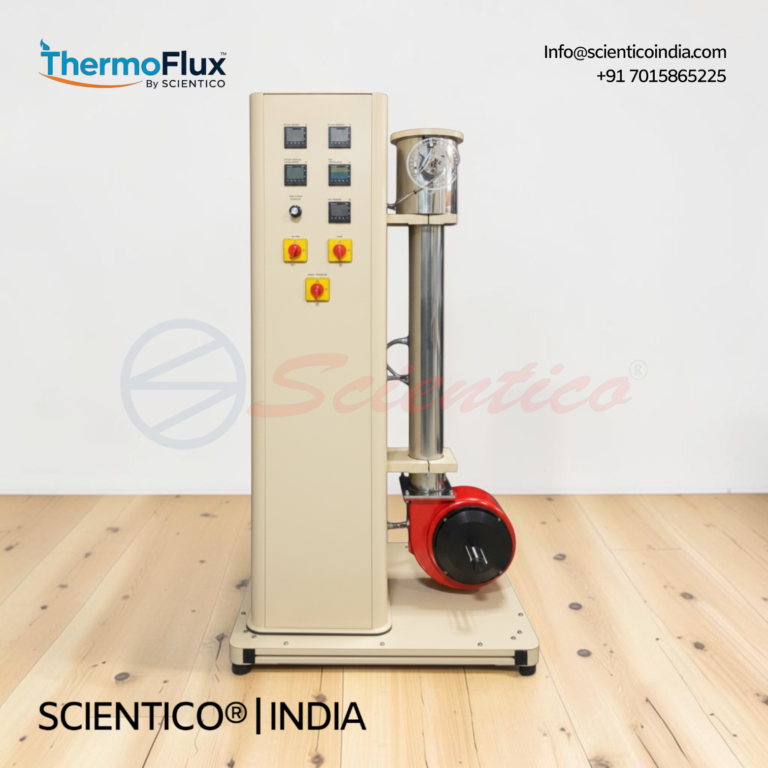
Combined Convection and Radiation ThermoFlux – 7073
The Combined Convection and Radiation ThermoFlux – 7073 is a small-scale laboratory accessory designed to introduce students to the principles of combined convection and radiation heat transfer from a horizontal heated cylinder. The unit operates in both free convection and forced convection modes, enabling analysis of the combined effects at varying surface temperatures and air velocities.
View product detailsWhat are the three modes of heat transfer?
Heat always flows from a higher temperature to a lower temperature, but it can travel by three physically distinct routes. Understanding which mode dominates in a given system lets students size heat exchangers, insulation, fins, and furnaces correctly.
- Conduction, energy passes from molecule to molecule (and via free electrons in metals) within a stationary material. Dominant in solids.
- Convection, energy is carried away by a moving fluid (liquid or gas) sweeping past a surface. Requires a fluid in motion.
- Radiation, energy is emitted as electromagnetic waves from any surface above absolute zero. Works across a vacuum.
How does conduction work?
Conduction is heat flow through a material without any bulk movement of that material. It is described by Fourier’s law of heat conduction:
Q = -kA (dT/dx)
- Q = rate of heat transfer (W)
- k = thermal conductivity of the material (W/m·K)
- A = cross-sectional area normal to heat flow (m²)
- dT/dx = temperature gradient along the direction of flow (K/m)
The negative sign shows that heat flows in the direction of decreasing temperature. Metals such as copper and aluminium have high k and conduct readily; insulators such as asbestos, cork, and air have low k. Conduction is the governing mode in furnace walls, composite slabs, and lagged pipes.
How does convection work?
Convection is heat transfer between a solid surface and an adjacent moving fluid. It is quantified by Newton’s law of cooling:
Q = hA (Ts − T∞)
- h = convective heat transfer coefficient (W/m²·K)
- A = surface area in contact with the fluid (m²)
- Ts = surface temperature (K or °C)
- T∞ = bulk fluid temperature far from the surface (K or °C)
Convection comes in two forms. In natural (free) convection, fluid motion arises from density differences caused by heating, as in a vertical heated plate in still air. In forced convection, an external device such as a pump or fan drives the fluid, giving a much larger h and higher heat transfer rates. The coefficient h is not a fixed material property; it depends on fluid velocity, fluid properties, geometry, and flow regime.
How does radiation work?
Radiation is the emission of thermal energy as electromagnetic waves and is the only mode that needs no intervening medium, it is how the Sun heats the Earth across empty space. Net radiant exchange between a surface and its surroundings follows the Stefan-Boltzmann law:
Q = εσA (T14 − T24)
- ε = emissivity of the surface (dimensionless, 0 to 1; 1 for a black body)
- σ = Stefan-Boltzmann constant = 5.67 × 10⁻⁸ W/m²·K4
- A = surface area (m²)
- T1, T2 = absolute temperatures of the surface and surroundings (K)
Because the rate depends on the fourth power of absolute temperature, radiation grows very rapidly with temperature and becomes the dominant mode in furnaces, boilers, and high-temperature equipment. Temperatures must always be in kelvin here, never in degrees Celsius.
Conduction vs convection vs radiation: comparison table
| Property | Conduction | Convection | Radiation |
|---|---|---|---|
| Mechanism | Molecular contact, free electrons | Bulk fluid motion | Electromagnetic waves |
| Medium required | Yes (mainly solids) | Yes (a fluid) | No (works in vacuum) |
| Governing law | Fourier’s law | Newton’s law of cooling | Stefan-Boltzmann law |
| Equation | Q = -kA (dT/dx) | Q = hA (Ts − T∞) | Q = εσA (T14 − T24) |
| Key parameter | k (W/m·K) | h (W/m²·K) | ε, σ (W/m²·K4) |
| Temperature dependence | Linear in gradient | Linear in ΔT | Fourth power of absolute T |
| Typical example | Heat through a furnace wall | Air over a heated plate | Sun heating the Earth |
Can all three modes happen at once?
Yes. Most real systems combine them. A hot pipe in a room loses heat by conduction through its wall and insulation, by convection to the surrounding air, and by radiation to the cooler walls simultaneously. Engineers add the relevant terms, often combining convection and radiation into a single surface heat loss, to model the total. This is why students must be able to separate and quantify each mode independently before combining them.
How is heat transfer shown and measured in a teaching lab?
In an engineering heat-transfer laboratory, each mode is isolated on a dedicated apparatus so students can verify the governing law experimentally:
- Conduction, a linear or radial heat conduction unit measures the temperature gradient along a metal bar or disc; plotting temperature against distance and applying Fourier’s law yields the thermal conductivity k.
- Convection, natural and forced convection apparatus (a heated cylinder or pin-fin array with a variable-speed fan) lets students record surface and air temperatures and calculate the convective coefficient h from Newton’s law of cooling.
- Radiation, a Stefan-Boltzmann apparatus or emissivity-measurement unit heats a target surface and measures radiant flux against the fourth-power temperature relationship to confirm σ and determine surface emissivity ε.
Running these experiments side by side gives students a direct, measured feel for why conduction, convection, and radiation behave so differently, and turns the three equations from textbook formulas into verified results.
Scientico India manufactures ISO 9001:2015 and model-specific heat-transfer and thermodynamics teaching equipment, exported to 30+ countries since 1993. Explore the full range on our Thermodynamics Lab Equipment page.
Frequently Asked Questions
What is the main difference between conduction, convection, and radiation?
Conduction transfers heat by direct molecular contact within a stationary material (mainly solids), convection transfers heat through the bulk motion of a fluid, and radiation transfers heat as electromagnetic waves that require no medium and can travel through a vacuum.
Which law governs each mode of heat transfer?
Conduction follows Fourier’s law, Q = -kA(dT/dx); convection follows Newton’s law of cooling, Q = hA(Ts – T-infinity); and radiation follows the Stefan-Boltzmann law, Q = epsilon-sigma-A(T1^4 – T2^4), with temperatures in kelvin.
What is the difference between natural and forced convection?
In natural convection, fluid motion is driven by buoyancy from density differences caused by heating. In forced convection, an external device such as a pump or fan moves the fluid, producing a higher convective coefficient h and greater heat transfer rates.
Why does radiation not need a medium?
Radiation transfers energy as electromagnetic waves emitted by any surface above absolute zero. These waves travel through empty space, which is why the Sun heats the Earth across the vacuum of space, unlike conduction and convection.
How is each heat transfer mode measured in a teaching lab?
Conduction is measured on a linear or radial conduction unit to find thermal conductivity k, convection on natural/forced convection apparatus to find the coefficient h, and radiation on a Stefan-Boltzmann apparatus to verify the fourth-power law and surface emissivity.
One honest ask
We don't gate anything on this site. You just read the whole thing free. If it was useful, leave your email and two things happen: we send you this page as a plain-text block you can paste into a tender file or an internal email, and we notify you the next time we publish a buyer tool like this one. Nothing else. No drip sequence, no sales calls booked without asking.