
Aim of the Experiment
To determine the metacentric height of a floating body and to verify the theoretical relationship between the metacentric height and the angle of heel.
Equipment mentioned in this guide
Review the product information, specifications and model before requesting a quotation.
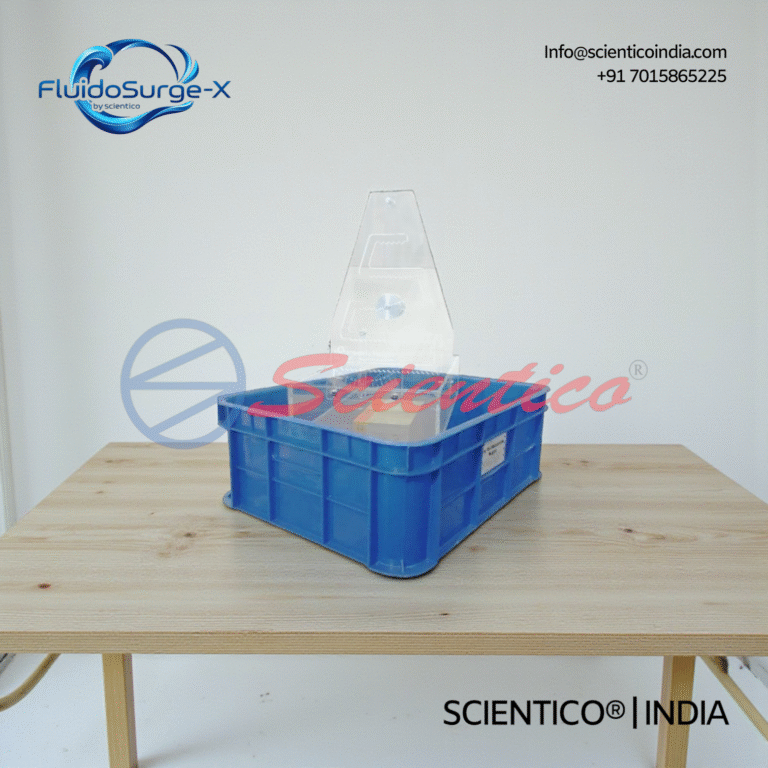
Metacentric Height Apparatus | FluidoSurgeX 108
The Metacentric Height Apparatus FluidoSurgeX 108 is designed for the experimental determination of the metacentric height of a floating body, a fundamental concept in naval architecture and fluid mechanics. The apparatus demonstrates the stability conditions of floating vessels and the relationship between the centre of buoyancy, centre of gravity, and metacentre.
View product detailsApparatus Required
- Metacentric height apparatus (pontoon with adjustable jockey weight)
- Measuring scale and plumb bob
- Water tank
- Weights (jockey)
- Protractor or angle scale
Theory
The metacentric height (GM) is a measure of the initial static stability of a floating body. When a floating body is tilted through a small angle (θ), the buoyant force acts through the new centre of buoyancy. The point at which the vertical line through the new buoyant force intersects the original vertical axis is called the metacentre (M). GM is the distance from the centre of gravity (G) to the metacentre (M).
Formula: GM = (w × x) / (W × tan θ)
Where: w = jockey weight (N), x = distance of jockey from centre, W = total weight of pontoon + jockey (N), θ = angle of heel.
Procedure
- Fill the water tank to a sufficient depth to allow the pontoon to float freely.
- Place the pontoon on water and check that it floats in the upright position.
- Note the initial position of the plumb bob (zero reading).
- Place the jockey weight at a known distance x from the centre of the pontoon.
- Record the angle of heel θ from the plumb bob scale.
- Repeat for different jockey positions (both sides).
- Calculate GM using the formula for each reading.
- Compare experimental GM with the theoretical value: GM = I/V − BG, where I = second moment of area of waterplane, V = volume of displacement, BG = distance between B and G.
Observation Table
| Sr. No. | Jockey Distance x (m) | Angle of Heel θ (°) | tan θ | GM Experimental (m) |
|---|---|---|---|---|
| 1 | 0.05 | |||
| 2 | 0.10 | |||
| 3 | 0.15 |
Result
The metacentric height (GM) of the floating body = _______ m (experimental). Theoretical GM = _______ m. The experimental and theoretical values are within acceptable limits, confirming the stability characteristics of the floating body.
Precautions
- Ensure the pontoon is floating freely without touching the tank walls.
- Take readings only after the pontoon has reached a stable position.
- Avoid disturbing the water surface during measurement.
Internal Links
Related resources: Fluid Mechanics Lab Equipment | Bernoulli’s Theorem Experiment | Pipe Friction Experiment | Civil Engineering Lab Equipment List
Get Fluid Mechanics Lab Equipment
Scientico India manufactures ISO 9001:2015 and model-specific lab apparatus. Contact us for specifications and CIF pricing.
Scientico India manufactures this and the full range of Fluid Mechanics Lab equipment, model-specific and supplied to engineering colleges worldwide.
Explore Fluid Mechanics Lab Equipment → or request a quoteSpecify stability apparatus around the shift-of-weight method
The practical requires a floating body whose heel angle can be observed as a known transverse mass is moved through a measured distance. Tank geometry, water depth, mass positions and angle indication must allow the calculation method in the laboratory worksheet.
What to confirm before requesting a quotation
- Confirm pontoon geometry, total mass and movable-weight range.
- Identify the heel-angle scale or measurement method.
- List tank, plumb line, weights, rails and levelling provisions.
- State filling, draining, floor-space and safe-handling requirements.
For an international order, also state the quantity, destination, electrical supply, documentation, installation or training needs and requested delivery basis. Treat catalogue information as a starting point; the current model page, datasheet and written quotation must confirm the exact configuration.
Metacentric height apparatus: geometry, weights and observations
One honest ask
We don't gate anything on this site. You just read the whole thing free. If it was useful, leave your email and two things happen: we send you this page as a plain-text block you can paste into a tender file or an internal email, and we notify you the next time we publish a buyer tool like this one. Nothing else. No drip sequence, no sales calls booked without asking.