
Process Engineering Lab Equipment: Complete Setup Guide for B.Tech and M.Tech Chemical Engineering
A chemical engineering process lab is the most complex and capital-intensive lab in a technical university. It involves large-scale equipment that demonstrates industrial unit operations at bench or pilot scale, distillation, absorption, heat exchange, fluid mechanics, mass transfer, and process control. Setting up this lab correctly, with equipment that can run the full curriculum and satisfy accreditation requirements, requires a more systematic planning approach than most other engineering labs. This guide covers the full equipment requirement, the key specifications to specify in your BOQ, and what AICTE/NBA and ABET assessors look for.
Equipment mentioned in this guide
Review the product information, specifications and model before requesting a quotation.
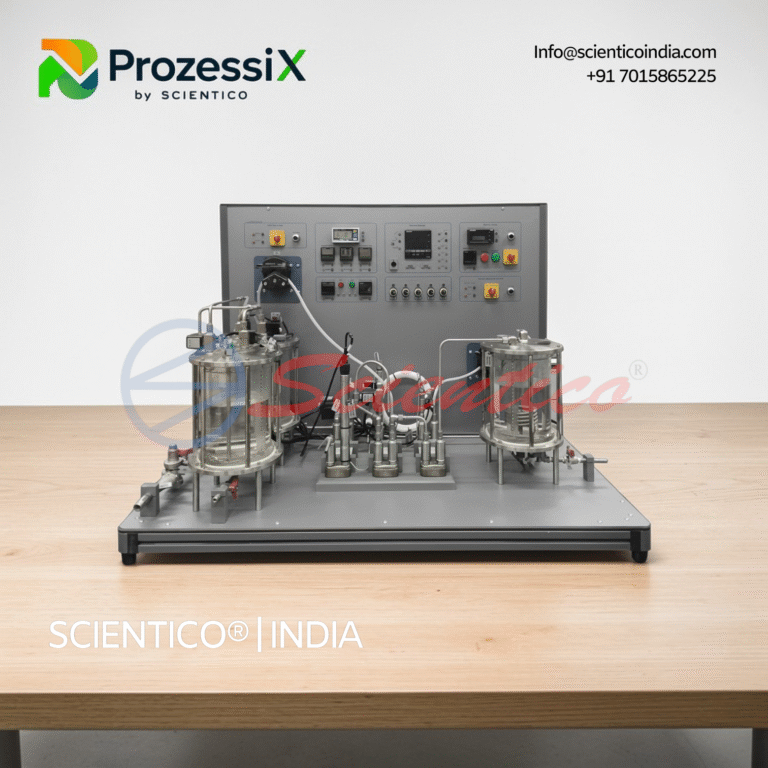
Process Plant Trainer | ProzessiX PX-03
The Process Plant Trainer is a fully integrated miniature industrial process system designed to study measurement, dynamics, and advanced process control strategies. It replicates real plant behavior, including multivariable interactions, dead time effects, and stability challenges.
View product details
Service Unit for Chemical Reactors | ReaktiLabX – 07
The Service Unit for Chemical Reactors ReaktiLabX - 07 is the supply unit for six separate reactors, providing the core support infrastructure for a chemical production facility. This Service Unit for Chemical Reactors mounts the reactor under study using two pins, with hydraulic hoses linking the reactor and supply unit together for simple installation. It regulates temperature, pumps reactants, and monitors conductivity across different reactor types.
View product detailsCore Process Engineering Lab Equipment, B.Tech Chemical Engineering
The AICTE model curriculum for B.Tech Chemical Engineering specifies the following lab experiments, each requires dedicated apparatus:
| Apparatus | Experiments Covered | Key Specification |
|---|---|---|
| Distillation Column (Sieve/Packed Bed) | Distillation efficiency, reflux ratio, tray efficiency, McCabe-Thiele analysis | Borosilicate glass column, 50–100mm dia, 4–8 stages minimum |
| Absorption Column | CO₂/air absorption, packing height, mass transfer coefficient (KGa) | 50–75mm diameter, 600mm packing height, glass or acrylic construction |
| Extraction Column (Liquid-Liquid) | Liquid-liquid extraction efficiency, distribution coefficient | 25–50mm diameter, Oldshue-Rushton or pulsed column design |
| Fluidized Bed Dryer | Drying rate, moisture content measurement, particle classification | 100mm bed diameter, variable air velocity |
| Rotary Dryer | Drying kinetics, heat and mass balance | 150mm drum diameter, variable rpm, temperature control |
| Evaporator (Single/Double Effect) | Evaporation rate, steam economy, BPR calculations | Steam heated, 2-litre evaporation capacity minimum |
| Filtration Unit (Plate and Frame / Leaf) | Filter medium resistance, filtration rate, cake compressibility | Pressure filtration to 2 bar |
| Mixer-Settler | Solvent extraction, mass transfer in agitated systems | 250ml settler volume, variable impeller speed |
| Centrifuge (Lab scale) | Separation efficiency, centrifugal force, Sigma factor | 3000 rpm minimum, 250ml capacity |
| Flow Measurement Apparatus (various meters) | Orifice, Venturi, Rotameter, Pitot calibration | Same as standard fluid mechanics hydraulic bench |
| Heat Exchanger Trainer (Shell-and-Tube + Double Pipe) | LMTD, NTU-effectiveness, heat duty, fouling factors | Counter/parallel flow switching, digital temperature readout |
| Process Control Trainer (PID) | PID controller tuning, closed-loop response, Ziegler-Nichols method | Temperature or flow control loop, PC/software interface |
This list represents a minimum 12-station process lab. For an NBA-compliant lab with a 30-student batch (maximum 5 students per station), you need 6 stations for the primary experiment apparatus, with the remaining apparatus at 2–3 stations each. Full configuration for a 30-student batch requires approximately 18–24 apparatus units, depending on experiment rotation scheduling. See our process engineering lab equipment guide for a full catalogue of available apparatus.
M.Tech Chemical Engineering, Advanced Process Lab Equipment
M.Tech programmes require research-grade apparatus beyond the undergraduate curriculum. Advanced process lab additions for postgraduate programmes:
- Spray Dryer, inlet air temperature to 300°C, 1.5 kg/hr water evaporation capacity minimum, for advanced drying research
- Reactive Distillation Column, jacketed glass column with catalyst packing, for esterification or transesterification studies
- Computational Fluid Dynamics (CFD) Lab, software licences for ANSYS Fluent or COMSOL; pairs with physical apparatus for model validation
- Membrane Separation Unit, ultrafiltration or nanofiltration module, for water treatment or pharmaceutical research
- Pilot-Scale Bioreactor, stirred tank, 2–10 litre working volume, pH/DO monitoring, for bioprocess engineering programmes
- Gas Chromatograph, for product analysis from distillation and reaction experiments
NBA and ABET Requirements for Chemical Engineering Process Labs
NBA evaluates chemical engineering labs under Programme Specific Criteria 5 (Laboratory Facilities). The assessment checks that lab equipment supports the outcomes mapped in the programme’s CO-PO matrix. For a B.Tech Chemical Engineering programme, the lab outcomes that process equipment directly supports include:
- CO-PO 5: Ability to use modern tools and equipment for unit operations
- CO-PO 4: Ability to conduct experiments and analyse results using mass and energy balance
- CO-PO 3: Design of unit operations within realistic constraints
ABET General Criterion 6 requires that laboratories “support the attainment of student outcomes.” For chemical engineering programmes, this means demonstrating in the SAR that each CO is supported by specific lab experiments, and that the apparatus for those experiments is operational. See our full guide to NBA and ABET lab equipment requirements for the documentation structure needed for both frameworks.
Space and Utility Requirements for a Process Engineering Lab
Process engineering apparatus is physically larger and requires more services than most other engineering lab equipment. Before procurement, confirm your lab space can support:
| Apparatus Type | Typical Floor Space | Services Required |
|---|---|---|
| Distillation Column | 1.5 x 1.5 m + overhead clearance (2.5m height) | 230V single-phase power; water supply and drain; ventilation |
| Absorption Column | 1.0 x 1.0 m + overhead (2.0m height) | 230V power; compressed air or CO₂ supply; drain |
| Shell-and-Tube Heat Exchanger | 1.5 x 0.8 m | 230V power; hot and cold water supply; drain |
| Fluidized Bed Dryer | 0.8 x 0.8 m | 230V power; adequate ventilation |
| Process Control Trainer | 0.8 x 0.6 m table-top | 230V power; PC interface (USB or Ethernet) |
| Full 30-student process lab | Minimum 120 sq.m | Dedicated power panel; emergency ventilation; eyewash station |
Process engineering labs require compressed air supply (for control valve trainers and gas absorption columns), adequate drain capacity for water used in continuous-flow experiments, and forced ventilation for any distillation or solvent extraction experiments. These utility requirements should be confirmed with your facilities team before finalising the equipment procurement BOQ. See our guide to preparing a BOQ for lab equipment procurement for how to capture utility requirements in the tender document.
Budget Planning for a Process Engineering Lab
Process engineering apparatus is significantly more expensive per unit than standard mechanical engineering lab equipment, due to the complexity of the apparatus and the materials (borosilicate glass, PTFE fittings, instrumentation). Typical indicative cost ranges:
| Apparatus | Indicative Cost Range (USD CIF, per unit) |
|---|---|
| Distillation Column (glass, sieve tray) | $3,000 – $8,000 |
| Absorption Column | $2,500 – $6,000 |
| Liquid-Liquid Extraction Column | $2,000 – $5,000 |
| Fluidized Bed Dryer | $3,000 – $7,000 |
| Evaporator (single effect) | $2,500 – $5,500 |
| Process Control Trainer (PID) | $2,000 – $5,000 |
| Shell-and-Tube Heat Exchanger | $1,500 – $3,500 |
A complete process engineering lab for a 30-student B.Tech Chemical Engineering batch, covering all AICTE experiment requirements, with calibration documentation and installation, typically costs USD 60,000 – 120,000 CIF, depending on the number of stations and specification grade. model-specific process engineering apparatus from India offers significant cost advantages without compromising compliance. See our full engineering lab equipment cost guide for methodology on building a procurement budget.
Get a Process Engineering Lab Quotation from Scientico India
Scientico India’s ProzessiX process engineering range covers the full B.Tech and M.Tech Chemical Engineering curriculum, distillation, absorption, extraction, drying, evaporation, filtration, and process control. All apparatus is model-specific and supplied with calibration certificate, experiment manual, and warranty documentation.
Email [email protected] with your institution name, country, programme, student batch size, and accreditation body. We return a full BOQ with CIF pricing, HS codes, and installation requirements within 48 hours. See our quality certifications page and FAQ for documentation and export process details.
Get Specifications & Pricing
Scientico India manufactures model-specific, ISO 9001:2015-compliant process engineering apparatus for universities and institutions. Contact us for full specifications, pricing, and documentation.
WhatsApp: +91 701-586-5225 | [email protected] | FAQ, Shipping, Payment & Warranty
Get Specifications & Pricing
Scientico India manufactures model-specific, ISO 9001:2015-compliant process engineering apparatus for universities and institutions. Contact us for full specifications, pricing, and documentation.
WhatsApp: +91 701-586-5225 | [email protected] | FAQ, Shipping, Payment & Warranty
Scientico India manufactures model-specific, ISO 9001:2015 laboratory equipment, exported to 30+ countries since 1993. Request a model-specific CIF proforma invoice after technical review.
View Engineering Lab Equipment →Request a QuoteLooking for the apparatus itself? See our chemical engineering lab equipment manufacturer page covering unit operations, reactors and process control trainers.
One honest ask
We don't gate anything on this site. You just read the whole thing free. If it was useful, leave your email and two things happen: we send you this page as a plain-text block you can paste into a tender file or an internal email, and we notify you the next time we publish a buyer tool like this one. Nothing else. No drip sequence, no sales calls booked without asking.