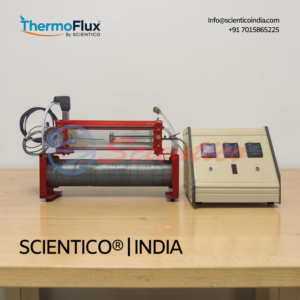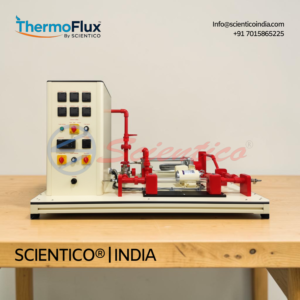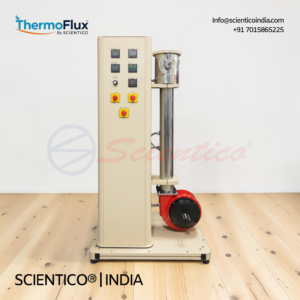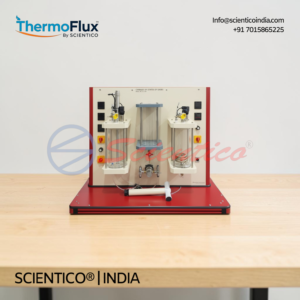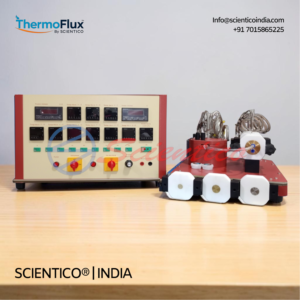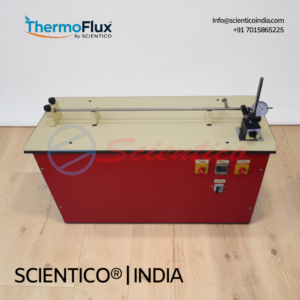

Nozzle Pressure Distribution ThermoFlux – 7103
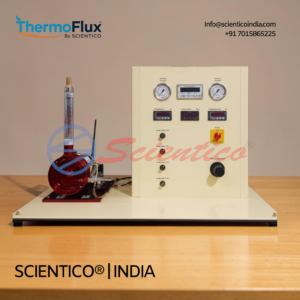
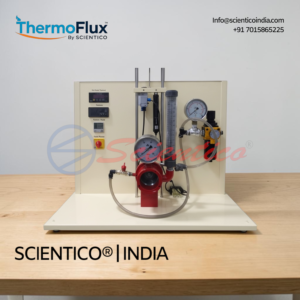
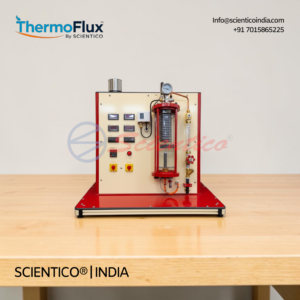
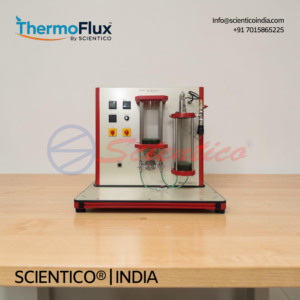
Nozzle Pressure Distribution ThermoFlux – 7103 is a laboratory apparatus for studying nozzle pressure distributionin convergent and de Laval (convergent-divergent) nozzles using air as the compressible working fluid.
Three interchangeable brass nozzles with pressure measurement points are included: one convergent nozzle and two de Laval nozzles with short and long extensions. Upstream pressure is adjustable via a compressed air regulator (0 to 8.6 bar, max. 10 bar supply). Back pressure is controlled by a needle valve on the flow meter. Air consumption is approximately 5 g/s.
Temperature is measured across -100 to 400°C. Pressure is recorded at 10 measuring points (-1 to 9 bar). Flow rate is measured up to 25 m³/h. Instruments include a manometer, digital temperature display (upstream and downstream), and rotameter. The unit demonstrates subsonic and supersonic flow, shock waves, and the choking effect at the critical pressure ratio.
Optional DAQ software in the National Instruments LabVIEW environment enables PC-based data acquisition on any Windows system. Supplied by SCIENTICO India with an instructional manual.
The Nozzle Pressure Distribution ThermoFlux – 7103 is a laboratory apparatus for measuring pressure curves in convergent and convergent-divergent (de Laval) nozzles and for studying the actual flow of compressible fluids. The unit demonstrates nozzle pressure distribution across subsonic, supersonic, and shock wave velocity ranges using air as the working fluid.
Three interchangeable brass nozzles are provided: one convergent nozzle and two de Laval nozzles with short and long nozzle extensions. The unit also demonstrates the choking effect, where the mass flow rate ceases to increase upon reaching the critical pressure ratio.
Product Overview
The Nozzle Pressure Distribution ThermoFlux – 7103 uses compressed air as the working compressible fluid. Air flows through a selected nozzle and is accelerated, with the nozzle pressure distribution recorded in the direction of flow over several measuring points. The air pressure upstream and downstream of the nozzle can be independently adjusted.
A compressed air regulator with a control range of 0 to 8.6 bar adjusts the upstream supply pressure. A needle valve on the flow meter adjusts the back pressure downstream of the nozzle. The unit accepts a maximum compressed air supply of 10 bar with an approximate air consumption of 5 g/s.
Three brass nozzles with pressure measurement points are included: one convergent nozzle for subsonic investigations, one de Laval nozzle with a short nozzle extension, and one de Laval nozzle with a long nozzle extension for supersonic and shock wave studies. Instruments include a manometer and a digital temperature display upstream and downstream of the nozzle, as well as a rotameter for flow measurement.
Temperature is measured across the range -100 to 400°C. Pressure is measured at 10 points across the range -1 to 9 bar. Flow rate is measurable up to 25 m³/h. Optional DAQ software in the National Instruments LabVIEW environment enables PC-based data recording, storage, and analysis.
Nozzle Pressure Distribution ThermoFlux – 7103: Technical Specifications
| Parameter | Value |
|---|---|
| Working Fluid | Air (compressible) |
| Compressed Air Supply: Maximum | 10 bar |
| Air Consumption | Approx. 5 g/s |
| Compressed Air Regulator Control Range | 0 to 8.6 bar |
| Back Pressure Control | Needle valve on the flow meter |
| Nozzles Included | 3 brass nozzles with pressure measurement points |
| Nozzle 1 | Convergent nozzle |
| Nozzle 2 | De Laval nozzle, short nozzle extension |
| Nozzle 3 | De Laval nozzle, long nozzle extension |
| Nozzle Material | Brass |
| Temperature Measurement Range | -100 to 400°C |
| Pressure Measurement | 10 x measuring points, range: -1 to 9 bar |
| Flow Rate Measurement Range | Up to 25 m³/h |
| Instruments | Manometer, digital temperature display (upstream and downstream), rotameter |
| Software | Optional DAQ software (National Instruments LabVIEW environment) |
| Software Compatibility | Any Windows environment |
Technical Data
Air Supply
| Parameter | Value |
|---|---|
| Compressed Air: Maximum | 10 bar |
| Air Consumption | Approx. 5 g/s |
Compressed Air Regulator
| Parameter | Value |
|---|---|
| Control Range | 0 to 8.6 bar |
Nozzles
| Nozzle | Detail |
|---|---|
| Material | Brass (all 3 nozzles) |
| Nozzle 1 | De Laval nozzle, short nozzle extension |
| Nozzle 2 | De Laval nozzle, long nozzle extension |
| Nozzle 3 | Convergent nozzle |
Measuring Ranges
| Parameter | Range |
|---|---|
| Temperature | -100 to 400°C |
| Pressure | 10 x -1 to 9 bar |
| Flow Rate | Up to 25 m³/h |
Key Features
- Apparatus Type: nozzle pressure distribution trainer for compressible fluid flow studies
- Working Fluid: air
- Nozzles Included: 3 interchangeable brass nozzles with pressure measurement points
- Nozzle Types: 1 convergent nozzle, 1 de Laval nozzle (short extension), 1 de Laval nozzle (long extension)
- Nozzle Material: brass
- Compressed Air Supply: Maximum: 10 bar
- Air Consumption: approx. 5 g/s
- Compressed Air Regulator: control range 0 to 8.6 bar
- Back Pressure Control: needle valve on the flow meter
- Temperature Measurement Range: -100 to 400°C
- Pressure Measurement: 10 measuring points, range: -1 to 9 bar
- Flow Rate Measurement: up to 25 m³/h
- Instruments: manometer, digital temperature display (upstream and downstream), rotameter
- Velocity Ranges Studied: subsonic, supersonic, and shock wave
- Choking Effect: demonstrated at critical pressure ratio
- PC Data Transfer: optional direct transfer to PC
- Software: optional DAQ software, National Instruments LabVIEW environment, Windows compatible
Experiments
- Pressure curve in de Laval nozzles
- Short nozzle extension
- Long nozzle extension
- Pressure curve in convergent nozzles
- Connection between inlet pressure and mass flow rate, or exit pressure and mass flow rate
- How pressure drop in the nozzle affects the temperature
- Determining the critical pressure ratio (Laval pressure ratio)
- Demonstration of the choking effect
- Proof of shock waves
Construction and Design
The Nozzle Pressure Distribution ThermoFlux – 7103 is designed around a compressed air supply system with three interchangeable brass nozzles, each fitted with pressure measurement points along the flow direction.
Upstream pressure is set using a compressed air regulator with a control range of 0 to 8.6 bar. The maximum supply pressure is 10 bar, with an approximate air consumption of 5 g/s. A needle valve on the flow meter controls back pressure downstream of the nozzle. This dual adjustment capability enables independent setting of upstream and downstream pressures, which is essential for full nozzle pressure distribution characterisation across subsonic, supersonic, and shock wave regimes.
Three brass nozzles are supplied: one convergent nozzle for subsonic range investigations and two de Laval nozzles (combining convergent and divergent contours) with short and long nozzle extensions for supersonic and shock wave studies. All nozzles include pressure measurement points along the flow path, enabling the full pressure curve to be recorded in the direction of flow.
Instrumentation includes a manometer, a digital temperature display for upstream and downstream positions, and a rotameter for flow rate measurement. Temperature is measured across -100 to 400°C. Pressure is measured at 10 points over the range -1 to 9 bar. Flow rate is measurable up to 25 m³/h.
Software (Optional): ThermoFlux – 7103
DAQ software is specially designed in the National Instruments LabVIEW environment to measure and calculate results from the apparatus. The software is optional. When software is used, a set of electronic sensors is included. The software is compatible with any Windows environment.
Scope of Delivery
- 1 experimental unit
- 1 instructional manual
Optional Accessories
- DAQ software package (ThermoFlux – 7103, National Instruments LabVIEW environment, Windows compatible), supplied with electronic sensors
Q: What nozzles are included with the Nozzle Pressure Distribution ThermoFlux – 7103?
A: Three interchangeable brass nozzles are included, each with pressure measurement points: one convergent nozzle for subsonic investigations, one de Laval nozzle with a short nozzle extension, and one de Laval nozzle with a long nozzle extension for supersonic and shock wave studies.
Q: What is the choking effect and how does this unit demonstrate it?
A: The choking effect occurs when the mass flow rate through a nozzle stops increasing upon reaching the critical pressure ratio (Laval pressure ratio). The unit demonstrates this by adjusting the upstream and downstream pressures using the compressed air regulator and needle valve, allowing the critical condition to be reached and observed directly.
Q: What are the compressed air supply requirements for this apparatus?
A: The unit requires a compressed air supply with a maximum pressure of 10 bar. Air consumption is approximately 5 g/s. The on-board compressed air regulator has a control range of 0 to 8.6 bar.
Q: What parameters are measured in the nozzle pressure distribution experiments?
A: The unit measures temperature (-100 to 400°C), pressure at 10 measuring points (range: -1 to 9 bar), and flow rate (up to 25 m³/h). Instruments include a manometer, digital temperature display upstream and downstream of the nozzle, and a rotameter.
Q: Is PC-based data acquisition available for the ThermoFlux – 7103?
A: Yes, as an optional feature. An optional DAQ software package developed in the National Instruments LabVIEW environment enables PC-based data recording and analysis. The software is compatible with any Windows environment and is supplied with a set of electronic sensors.
Need Assistance? We're Here to Help!
Connect with our team for product specifications, pricing, and customized solutions for your institution or project.