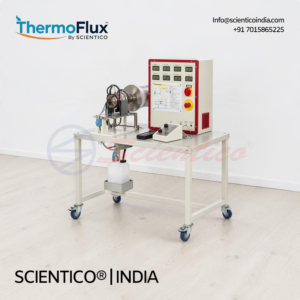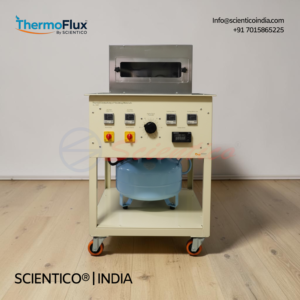

Thermal Expansion Apparatus | ThermoFlux-26
The Thermal Expansion Apparatus ThermoFlux-26 is a dilatometer-based laboratory instrument for determining the linear thermal expansion of brass, copper, and aluminium as a function of temperature. This thermal expansion apparatus supplies three 500 mm expansion rods, one per material, heated by a 2-litre, 500 W to 1,000 W heating system. A digital dial gauge (0 to 20 mm range, 0.01 mm resolution) measures rod elongation at each temperature step. Optional LABVIEW-based DAQ software with electronic sensors is available for automated data acquisition, compatible with any Windows operating system.
The Thermal Expansion Apparatus ThermoFlux-26 is a precision laboratory instrument for determining the linear thermal expansion of brass, copper, and aluminium as a function of temperature. This thermal expansion apparatus uses a dilatometer method with a digital dial gauge to measure dimensional change in 500 mm expansion rods across three materials. Students investigate the direct relationship between temperature change, material properties, and change in length.
Product Overview
The ThermoFlux-26 is designed for quantitative measurement of linear expansion in metallic rods subjected to controlled temperature variation. Three expansion rods, one each in brass, copper, and aluminium, are each 500 mm in length. Temperature is applied via a heating system with a 2-litre tank capacity and a heating power range of 500 W to 1,000 W. Dimensional change is measured using a digital dial gauge with a range of 0 to 20 mm and a resolution of 0.01 mm, providing precise tracking of rod elongation at each temperature step.
The apparatus supports determination of linear expansion coefficients for each material, investigation of the relationship between change in length and overall rod length, and study of equilibrium spacing and thermal capacity. Results are obtained directly from the dial gauge readings against measured temperature.
An optional DAQ software package, developed in the National Instruments LABVIEW environment, is available for automated data acquisition and analysis. When the software option is selected, a set of electronic sensors is included. The software is compatible with any Windows operating system.
Thermal Expansion Apparatus ThermoFlux-26, Technical Specifications
| Parameter | Value |
|---|---|
| Model | ThermoFlux-26 |
| Expansion Rod Quantity | 3 |
| Expansion Rod Length | 500 mm each |
| Expansion Rod Materials | Brass, copper, aluminium |
| Heating Tank Capacity | 2 litres |
| Heating Power | 500 W to 1,000 W |
| Dial Gauge Type | Digital |
| Dial Gauge Range | 0 to 20 mm |
| Dial Gauge Resolution | 0.01 mm |
| Optional Software | National Instruments LABVIEW, Windows compatible |
| Scope of Delivery | 1 experimental module, 1 set of tubes, 1 digital gauge, 1 instruction manual |
Technical Data
Expansion Rods
| Parameter | Value |
|---|---|
| Quantity | 3 |
| Length | 500 mm |
| Materials | Brass, copper, aluminium |
Heating System
| Parameter | Value |
|---|---|
| Tank Capacity | 2 litres |
| Heating Power | 500 W to 1,000 W |
Dial Gauge
| Parameter | Value |
|---|---|
| Type | Digital |
| Measurement Range | 0 to 20 mm |
| Resolution | 0.01 mm |
Key Features
- Expansion Rod Materials: Brass, copper, and aluminium, one rod per material
- Expansion Rod Length: 500 mm each
- Heating System: 2-litre tank, 500 W to 1,000 W heating power
- Thermal Expansion Apparatus Measurement: Digital dial gauge, 0 to 20 mm range, 0.01 mm resolution
- Method: Dilatometer-based linear expansion measurement as a function of temperature
- Optional Software: National Instruments LABVIEW DAQ software, Windows compatible, electronic sensors included when selected
Experiments
- Determine the linear expansion of brass, copper, and aluminium as a function of temperature using a dilatometer
- Investigate the relationship between change in length and overall length
- Study of linear expansion
- Study of equilibrium spacing
- Study of thermal capacity
Construction and Design
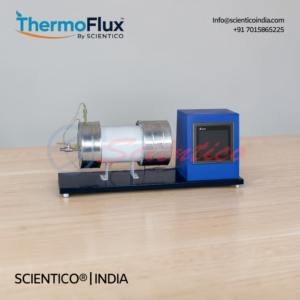
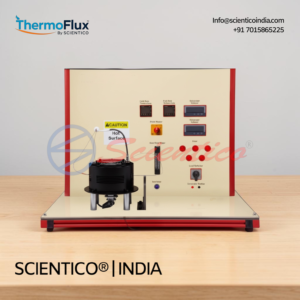
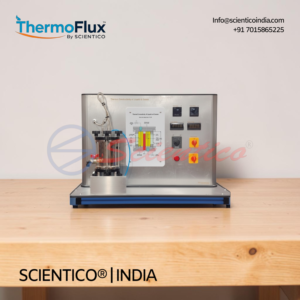
The Thermal Expansion Apparatus ThermoFlux-26 is built around a dilatometer arrangement accommodating three interchangeable expansion rods. Each rod is 500 mm in length and is supplied in one of three materials: brass, copper, and aluminium. The heating system uses a 2-litre tank with a heating power range of 500 W to 1,000 W to raise rod temperature in a controlled manner. Elongation is measured directly by a digital dial gauge with a 0 to 20 mm range and 0.01 mm resolution, capturing precise dimensional change at each temperature point. This thermal expansion apparatus supports systematic comparison of expansion behaviour across all three materials using the same measurement geometry and rod length.
Software
ThermoFlux-26 DAQ Software (Optional)
The optional software for this thermal expansion apparatus is developed in the National Instruments LABVIEW environment. It measures and calculates experimental results automatically. A set of electronic sensors is included when the software option is selected. The software is compatible with any Windows operating system.
Scope of Delivery
- 1 experimental module
- 1 set of tubes
- 1 digital gauge
- 1 instruction manual
Q1: Which materials are tested with the ThermoFlux-26 thermal expansion apparatus?
Three expansion rods are supplied, one each in brass, copper, and aluminium, each 500 mm in length. Linear expansion is determined for each material as a function of temperature using the dilatometer method.
Q2: What is the measurement resolution of the dial gauge?
The digital dial gauge has a measurement range of 0 to 20 mm and a resolution of 0.01 mm, enabling precise tracking of small dimensional changes in each rod.
Q3: What is the heating capacity of the system?
The heating system has a 2-litre tank capacity and operates at a heating power between 500 W and 1,000 W.
Q4: Is data acquisition software available for the ThermoFlux-26?
Yes. Optional DAQ software developed in the National Instruments LABVIEW environment is available. It measures and calculates experimental results and is compatible with any Windows operating system. A set of electronic sensors is included with the software option.
Q5: What experiments can students perform with this apparatus?
Students can determine linear expansion coefficients for brass, copper, and aluminium as a function of temperature, investigate the relationship between change in length and total rod length, and study equilibrium spacing and thermal capacity, all using the same dilatometer setup.
Need Assistance? We're Here to Help!
Connect with our team for product specifications, pricing, and customized solutions for your institution or project.