
The core stress vs strain difference is this: stress is the internal resisting force per unit area that develops inside a material when an external load is applied, while strain is the resulting deformation expressed as the ratio of change in dimension to original dimension. In short, stress is the cause (force-based, measured in pascals) and strain is the effect (geometry-based and dimensionless). They are linked together by the material’s elastic properties.
Equipment mentioned in this guide
Review the product information, specifications and model before requesting a quotation.

Strain Gauge Trainer | FortiTestX-28
The Strain Gauge Trainer FortiTestX-28 is a dedicated laboratory unit for introducing students to the fundamentals of strain gauge measurement across tension, bending, and torsion loading conditions. This strain gauge trainer covers bridge-type sensor connection, signal amplification, and the conversion of raw electrical output to mechanical strain and force values. It provides hands-on experience with three steel test specimens, each fitted with four strain gauge measurement sites.
View product details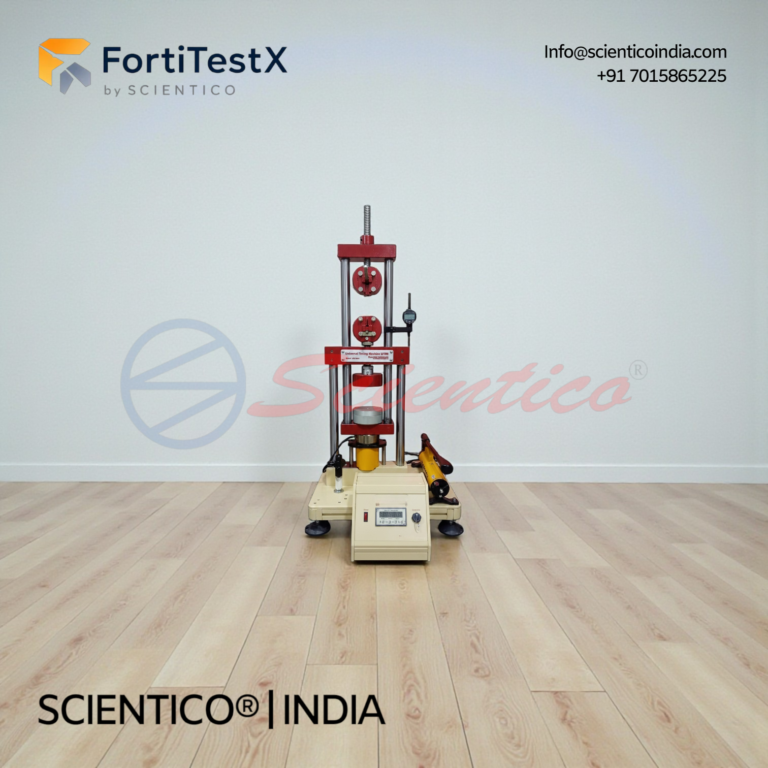
Universal Testing Machine 30kN | FortiTestX – 16
Universal Testing Machine 30kN FortiTestX 16 is a benchtop strength of materials lab equipment unit designed for tensile, compressive, bending, and elongation testing of metallic and non-metallic specimens using a hand-operated hydraulic system requiring no external power supply. This Universal Testing Machine 30kN generates test forces up to 30 kN through a hydraulic system, displaying load on a large dynamometer gauge with trailing pointer and measuring elongation via a dial gauge with 0.01 mm graduation. The FortiTestX 16 accepts a comprehensive range of standard and optional accessories for shear, cupping, spring, and Brinell hardness testing, making it a complete universal testing machine 30kN strength of materials lab equipment unit for undergraduate engineering and materials science programmes.
View product detailsWhat is stress?
Stress (σ) is the load distributed over the cross-sectional area resisting it. For an axial load it is defined as:
σ = F / A
where F is the applied force in newtons (N) and A is the cross-sectional area in square metres (m²). The SI unit is the pascal (Pa = N/m²); in engineering practice values are usually quoted in MPa or N/mm² (1 MPa = 1 N/mm²).
Types of stress
- Tensile stress, pulls the material apart (positive).
- Compressive stress, pushes the material together (negative).
- Shear stress (τ), acts parallel to the cross-section, τ = F/A.
What is strain?
Strain (ε) is the measure of deformation, defined as the change in length divided by the original length:
ε = ΔL / L₀
Because it is a ratio of two lengths, strain is dimensionless (it has no units). It is often expressed as a percentage, in microstrain (µε), or as mm/mm.
Types of strain
- Tensile / compressive (normal) strain, change in length per unit length.
- Shear strain (γ), angular distortion measured in radians.
- Lateral strain, contraction perpendicular to the load, linked to the axial strain by Poisson’s ratio (ν).
What is the difference between stress and strain?
The clearest way to separate the two concepts is to compare them side by side across the attributes that matter to a materials engineer.
| Attribute | Stress (σ) | Strain (ε) |
|---|---|---|
| Definition | Internal resisting force per unit area | Deformation per unit original dimension |
| Formula | σ = F / A | ε = ΔL / L₀ |
| SI unit | Pascal (Pa = N/m²); commonly MPa / N/mm² | Dimensionless (no unit); often % or µε |
| Nature | Cause, applied loading effect | Effect, geometric response |
| Measured by | Load cell / force ÷ measured area | Extensometer or strain gauge |
| Quantity type | Force-based (intensity of load) | Displacement-based (relative change) |
| Can exist without load? | No, requires applied or residual force | Residual strain can remain after unloading |
| Graph axis (convention) | Vertical (Y-axis) | Horizontal (X-axis) |
How are stress and strain related?
Within the elastic region, stress and strain are directly proportional. This is Hooke’s Law:
σ = E × ε
The constant of proportionality E is the modulus of elasticity (Young’s modulus), expressed in the same units as stress (typically GPa). A higher E means a stiffer material that strains less for a given stress. For shear, the equivalent relationship is τ = G × γ, where G is the modulus of rigidity.
The stress-strain curve
Plotting stress (Y-axis) against strain (X-axis) for a ductile material such as mild steel gives the characteristic curve with these key points:
- Proportional limit, the upper end of the straight line where Hooke’s Law holds.
- Elastic limit, the maximum stress from which the material fully recovers on unloading.
- Yield point, where permanent (plastic) deformation begins; upper and lower yield points are visible in mild steel.
- Ultimate tensile strength (UTS), the peak stress the specimen sustains.
- Fracture point, where the specimen finally breaks, often after necking.
The slope of the initial straight portion equals Young’s modulus. The area under the curve represents the strain energy absorbed (toughness) per unit volume.
Engineering vs true stress-strain
Engineering stress uses the original cross-sectional area (A₀), so the curve appears to drop after UTS as the specimen necks. True stress uses the instantaneous area, and therefore keeps rising until fracture. For most teaching and design work the engineering curve is used.
How are stress and strain demonstrated in a teaching lab?
In a Strength of Materials laboratory, the relationship is demonstrated directly on a Universal Testing Machine (UTM). A standard specimen is clamped between grips and loaded in tension while:
- a load cell records the applied force F, from which stress is calculated as F/A₀;
- an extensometer or strain gauge measures elongation ΔL to compute strain ΔL/L₀;
- the machine plots the stress-strain curve, letting students read off yield strength, UTS, % elongation and Young’s modulus.
Complementary experiments, torsion testing (shear stress vs shear strain), hardness testing, deflection of beams and spring testing, let students verify Hooke’s Law and Poisson’s ratio across different loading modes. Together these build an intuitive, measurable understanding of how real materials respond to load.
Scientico India, an ISO 9001:2015 and model-specific manufacturer and exporter of engineering and science lab equipment since 1993, supplies UTMs, torsion machines and related instruments to engineering colleges and universities worldwide. Explore the full range of Strength of Materials Lab Equipment.
Frequently Asked Questions
What is the main difference between stress and strain?
Stress is the internal resisting force per unit area produced by an applied load (measured in pascals, σ = F/A), while strain is the resulting deformation per unit original dimension (dimensionless, ε = ΔL/L₀). Stress is the cause; strain is the effect.
Does strain have units?
No. Strain is the ratio of change in dimension to original dimension, so the units cancel out and it is dimensionless. It is often expressed as a percentage, in mm/mm, or in microstrain (µε).
How are stress and strain related?
Within the elastic region they are directly proportional, following Hooke’s Law: σ = E × ε, where E is Young’s modulus (the modulus of elasticity). The slope of the linear part of the stress-strain curve equals E.
What is the difference between engineering and true stress-strain?
Engineering stress and strain use the original cross-sectional area and gauge length, so the curve drops after the ultimate tensile strength due to necking. True stress-strain uses the instantaneous area and keeps rising until fracture.
How is the stress-strain relationship measured in a lab?
On a Universal Testing Machine: a load cell records force (giving stress) and an extensometer or strain gauge records elongation (giving strain). The machine plots the stress-strain curve to determine yield strength, ultimate tensile strength and Young’s modulus.
One honest ask
We don't gate anything on this site. You just read the whole thing free. If it was useful, leave your email and two things happen: we send you this page as a plain-text block you can paste into a tender file or an internal email, and we notify you the next time we publish a buyer tool like this one. Nothing else. No drip sequence, no sales calls booked without asking.