
Aim: To determine the mechanical properties of a mild steel specimen under tensile load using a Universal Testing Machine (UTM), including ultimate tensile strength, yield strength, percentage elongation, and percentage reduction in area.
Equipment mentioned in this guide
Review the product information, specifications and model before requesting a quotation.
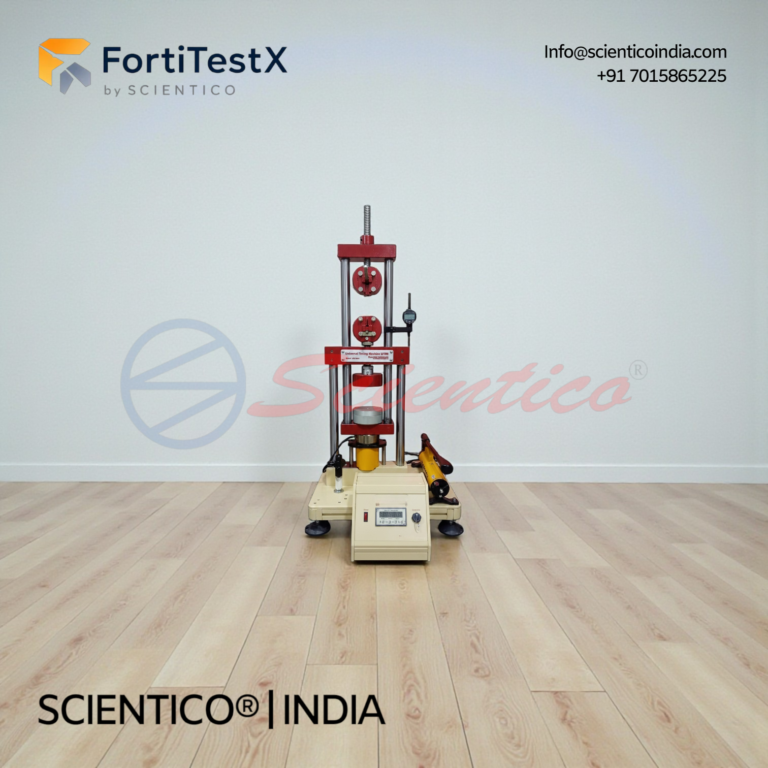
Universal Testing Machine 30kN | FortiTestX – 16
Universal Testing Machine 30kN FortiTestX 16 is a benchtop strength of materials lab equipment unit designed for tensile, compressive, bending, and elongation testing of metallic and non-metallic specimens using a hand-operated hydraulic system requiring no external power supply. This Universal Testing Machine 30kN generates test forces up to 30 kN through a hydraulic system, displaying load on a large dynamometer gauge with trailing pointer and measuring elongation via a dial gauge with 0.01 mm graduation. The FortiTestX 16 accepts a comprehensive range of standard and optional accessories for shear, cupping, spring, and Brinell hardness testing, making it a complete universal testing machine 30kN strength of materials lab equipment unit for undergraduate engineering and materials science programmes.
View product details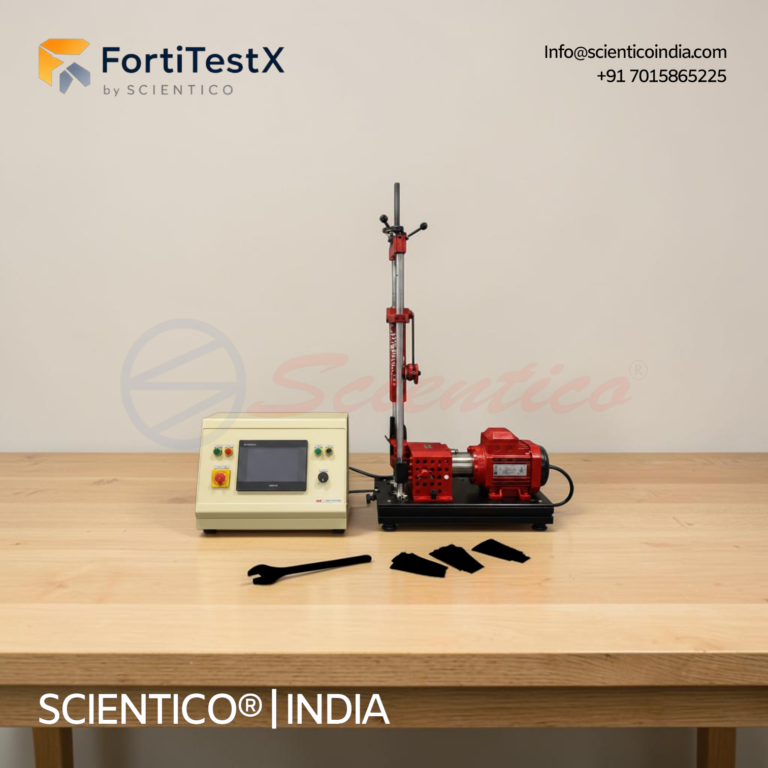
Fatigue Testing Machine | FortiTestX – 22
Fatigue Testing Machine FortiTestX 22 is a benchtop strength of materials lab equipment unit designed for fatigue strength testing of cylindrical metal specimens under cyclic bending load using a rotating cantilever configuration. This Fatigue Testing Machine clamps a revolving metal test bar at one end, applies a controlled point force via a spring balance and moveable plain bearing, and subjects the specimen to a sinusoidal bending stress cycle until fracture, with automatic shutdown triggered by a stop switch integrated into the bearing. The FortiTestX 22 includes an 8-digit electronic load cycle and revolutions counter with contactless inductive speed sensor, making it a complete fatigue testing machine strength of materials lab equipment unit for undergraduate materials testing and failure analysis programmes.
View product detailsApparatus Required
- Universal Testing Machine (UTM), 40 kN, 100 kN, or 200 kN capacity
- Standard tensile test specimens (mild steel, IS 1608 standard)
- Vernier caliper (for measuring specimen dimensions)
- Extensometer (optional, for accurate strain measurement)
- Divider and scale (for marking gauge length)
Theory
A stress-strain curve (engineering) for mild steel shows distinct regions: Elastic zone (stress proportional to strain, Hooke’s Law), Yield point (sudden elongation at constant stress), Strain hardening (stress increases again with strain), Ultimate Tensile Strength (UTS), peak stress on the curve, Necking, and Fracture. Mild steel exhibits a clear upper and lower yield point.
Procedure
- Measure the gauge length (L₀) and diameter (d₀) of the specimen using vernier caliper. Mark gauge points with divider.
- Fix the specimen in the UTM grips. Ensure axial alignment to avoid bending stresses.
- Set the load and extension pointers to zero. Apply tensile load at a steady rate (1–2 mm/min for steel).
- Record the load and corresponding extension at regular intervals (every 0.5 kN up to yield; every 1 kN thereafter).
- Note the yield point load (sudden drop in load pointer or distinct yield plateau).
- Continue loading until fracture. Record the maximum (ultimate) load.
- Remove the broken specimen. Fit the two halves together and measure the final gauge length (Lf) and the minimum diameter at the neck (df).
Calculations
Original cross-sectional area: A₀ = π d₀² / 4
Yield Stress: σy = Yield Load / A₀ (MPa)
Ultimate Tensile Strength: UTS = Maximum Load / A₀ (MPa)
Fracture Stress (engineering): σf = Fracture Load / A₀ (MPa)
% Elongation: = (Lf – L₀) / L₀ × 100
% Reduction in Area: = (A₀ – Af) / A₀ × 100 (Af = π df² / 4)
Young’s Modulus: E = Stress / Strain in the elastic region (GPa)
Frequently Asked Questions
What is the difference between yield strength and ultimate tensile strength?
Yield strength (σy) is the stress at which a material begins to deform plastically, it marks the end of elastic behaviour. Ultimate tensile strength (UTS) is the maximum stress the material can withstand before necking begins. For mild steel, UTS is typically 400–520 MPa and yield strength is 250–350 MPa.
What does percentage elongation indicate?
Percentage elongation measures ductility, the ability of a material to deform plastically before fracture. A higher % elongation means a more ductile material. Mild steel typically shows 20–25% elongation. Brittle materials like cast iron show less than 2% elongation.
Why does mild steel show a distinct yield point in the stress-strain curve?
Mild steel (low-carbon steel) contains dissolved nitrogen and carbon atoms that pin dislocation movement in the crystal lattice. When sufficient stress is applied to unpin the dislocations, sudden plastic flow occurs, producing the characteristic upper and lower yield point seen in the stress-strain diagram.
Get Strength of Materials Lab Equipment
Scientico India manufactures ISO 9001:2015 and model-specific strength of materials testing machines. Contact us for specifications and pricing.
Scientico India manufactures this and the full range of Strength of Materials equipment, model-specific and supplied to engineering colleges worldwide.
Explore Strength of Materials Equipment → or request a quote