
Vibration analysis is a core subject in mechanical engineering — covered under Theory of Machines, Mechanical Vibrations, and Machine Dynamics. This guide covers the essential vibration analysis lab equipment required for B.Tech and M.Tech mechanical engineering departments, with setup recommendations and experiment coverage.
Why Vibration Labs Are Required (AICTE / VTU / JNTU)
AICTE guidelines for B.Tech mechanical engineering programmes require a dedicated Dynamics and Vibration Lab or Theory of Machines Lab covering free, forced, and damped vibration experiments. VTU, JNTU, Anna University, and other affiliating universities mandate specific experiments in their practical syllabi — all of which require vibration test apparatus.
For NBA accreditation (Criterion 3: Programme Specific Outcomes and Criterion 4: Infrastructure), the vibration laboratory must contain calibrated apparatus capable of performing the experiments defined in the university’s practical manual. CE-certified and ISO 9001:2015 equipment is the documentation standard expected in NBA SAR (Self-Assessment Report) submissions.
Essential Vibration Analysis Lab Equipment
| Equipment | Vibration Type Covered | Key Experiments |
|---|---|---|
| Vibration Test Rig (Free and Forced) | Free, forced, undamped, damped | Natural frequency, amplitude-frequency response, resonance |
| Torsional Vibration Apparatus | Torsional vibration (single/two-rotor) | Natural frequency of torsional vibration, node position |
| Dynamic Balancing Machine | Rotational imbalance | Static and dynamic balancing of rotating masses |
| Whirling of Shaft Apparatus | Lateral vibration / whirling | Critical speed of shaft, whirling phenomenon |
| Spring Mass Damper System | Single degree of freedom — free and forced | Damping ratio, logarithmic decrement, resonance frequency |
| Motorised Gyroscope | Gyroscopic effects | Gyroscopic couple, precession, angular motion |
| Beam Vibration Apparatus (Cantilever/Simply Supported) | Transverse vibration | Natural frequency of beams, mode shapes |
| Accelerometer and Data Acquisition Unit | Signal acquisition and FFT analysis | Frequency spectrum analysis, vibration monitoring |
Dynamic Balancing: The Most Used Vibration Apparatus
The dynamic balancing machine is the most practically important vibration lab apparatus. It demonstrates static and dynamic imbalance in rotating machinery — a concept directly applicable to turbines, engines, and rotating shafts in industry. Scientico India’s dynamic balancing machine uses a stroboscope and phase reference for precision balancing of masses at multiple planes.
See the complete dynamic balancing machine experiment procedure including calculations and observations.
Vibration Lab Setup: Key Considerations
Space: A standard vibration lab requires a minimum 30–40 sq. m with vibration-isolated flooring (concrete slab preferred) to prevent cross-interference between apparatus. Heavy rotating equipment like the dynamic balancing machine should be bolted to the floor.
Power supply: Most vibration apparatus requires single-phase 230V AC supply. The motorised gyroscope and forced vibration rig may require variable frequency drives (VFD) for speed control — confirm with equipment specification sheets.
Experiments covered: A complete vibration lab with the apparatus listed above covers all standard B.Tech experiments including: free undamped vibration, free damped vibration, forced vibration with and without damping, resonance observation, torsional vibration (one and two-rotor systems), whirling of shafts, static and dynamic balancing, and gyroscopic couple demonstration. See the vibration experiment procedure guide for detailed write-ups.
Frequently Asked Questions
What is the difference between a vibration test rig and a dynamic balancing machine?
A vibration test rig (spring-mass-damper system) demonstrates the behaviour of a vibrating system under free and forced conditions — measuring amplitude, frequency, and damping. A dynamic balancing machine focuses on rotating machinery, identifying and correcting mass imbalance to eliminate vibration caused by unequal mass distribution.
Is vibration lab equipment part of Theory of Machines or a separate lab?
It depends on the university. Most Indian affiliating universities (VTU, JNTU, Anna University, RGPV) combine Theory of Machines and Vibrations into a single lab. Some M.Tech programmes maintain a separate Machine Dynamics / Vibrations lab. Scientico supplies equipment for both arrangements.
Does Scientico supply CE-certified vibration lab equipment?
Yes. All Scientico vibration technology equipment carries CE marking (European conformity) and is manufactured under ISO 9001:2015 quality management system. Test certificates and calibration reports are provided with each unit for NBA and NAAC accreditation documentation.
Request a Vibration Lab Quotation
Scientico India manufactures ISO 9001:2015 and CE-certified vibration analysis lab equipment for mechanical engineering departments. Contact us for specifications and pricing.
Scientico India manufactures CE-certified, ISO 9001:2015 laboratory equipment — exported to 60+ countries since 1993. Get a CIF proforma invoice within 24 hours.
View Engineering Lab Equipment →Request a QuoteLab Equipment Featured in This Guide
Manufactured in-house by Scientico India — ISO 9001:2015 & CE certified, exported to 60+ countries. Request a CIF quote within 24 hours.
 Commercial Refrigeration Training Unit | PolarX – 604View details & get quote →
 Drag Coefficients Apparatus | FluidoSurge-X 180View details & get quote →
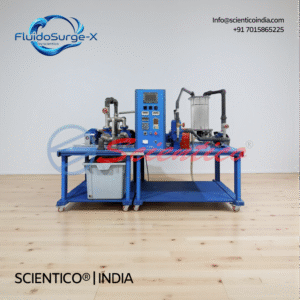 Multi Pump Test Rig with 4 Pumps | FluidoSurge-X 345View details & get quote →
 Flow Over Weirs Apparatus with Weir Tank | FluidoSurgeX 107View details & get quote →
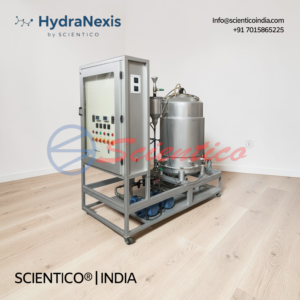 Anaerobic Water Treatment Pilot Plant – HydraNexis HNX 04View details & get quote →
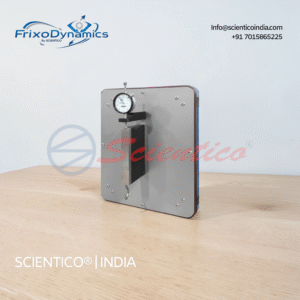 Rubber Shear Apparatus | FrixoDynamics FX-500View details & get quote →