
A heat-exchanger service unit and a working heat-exchanger experiment are not the same purchase. Scientico’s ThermoFlux-7108 service unit supplies and controls hot and cold water for interchangeable heat-exchanger modules. Its product page expressly says that the base cannot be used for an experiment on its own: at least one compatible module must be ordered separately. A BOQ that lists only “ThermoFlux-7108 heat exchanger” could therefore arrive without the part students need to run their practical. This guide turns the syllabus, service base and selected modules into an itemised, testable quotation.
Equipment mentioned in this guide
Review the product information, specifications and model before requesting a quotation.
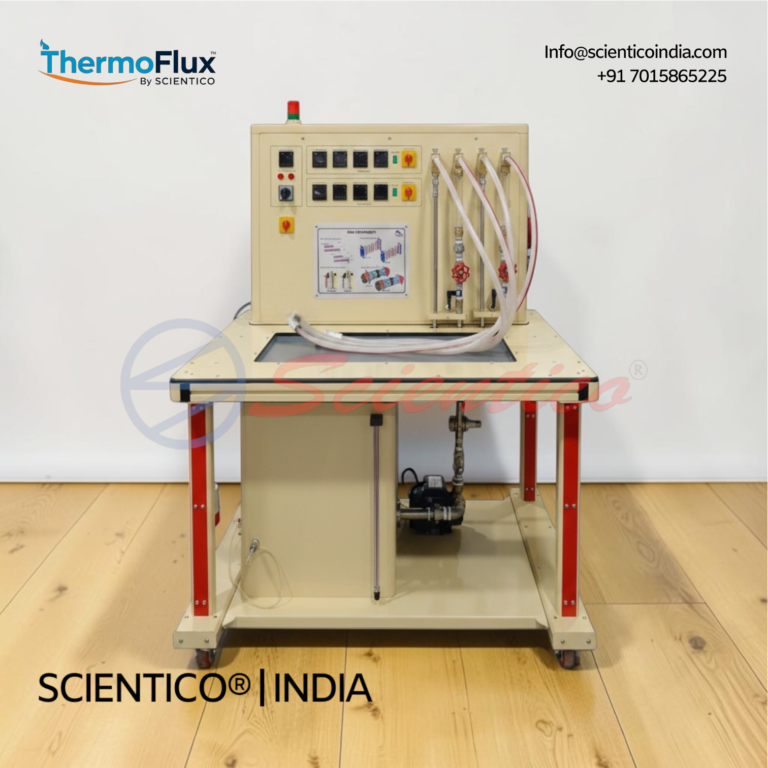
Heat Exchanger Service Unit | ThermoFlux – 7108
The Heat Exchanger Service Unit ThermoFlux - 7108 is a bench-mounted experimental control unit designed to provide hot and cold water circuits for the investigation and comparison of multiple heat exchanger types under parallel flow and counter flow conditions. This heat exchanger service unit is compatible with up to four interchangeable heat exchanger modules, plate type, concentric tube, shell and tube, and jacketed vessel, enabling systematic study of thermal energy transfer, mean heat transfer coefficients, and temperature curve plotting across different exchanger designs and flow configurations.
View product details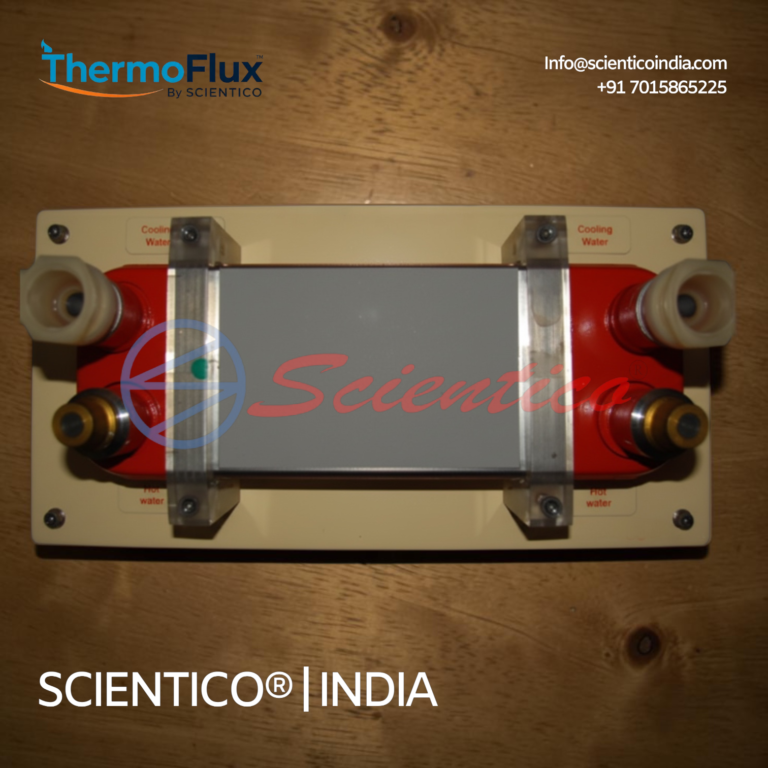
Plate Type Heat Exchanger | ThermoFlux – 7108/1
The Plate Type Heat Exchanger ThermoFlux - 7108/1 is a laboratory heat transfer unit for studying heat exchange between hot and cold water through a plate heat exchanger under parallel flow and counter flow configurations. This plate type heat exchanger features stainless steel sealed plates, an anodized aluminium structure, and a front panel with a process diagram matching the real unit layout. Hot and cold water temperatures are measured at both inlet and outlet, with a pump for hot water circulation and a cold water valve for flow type selection.
View product details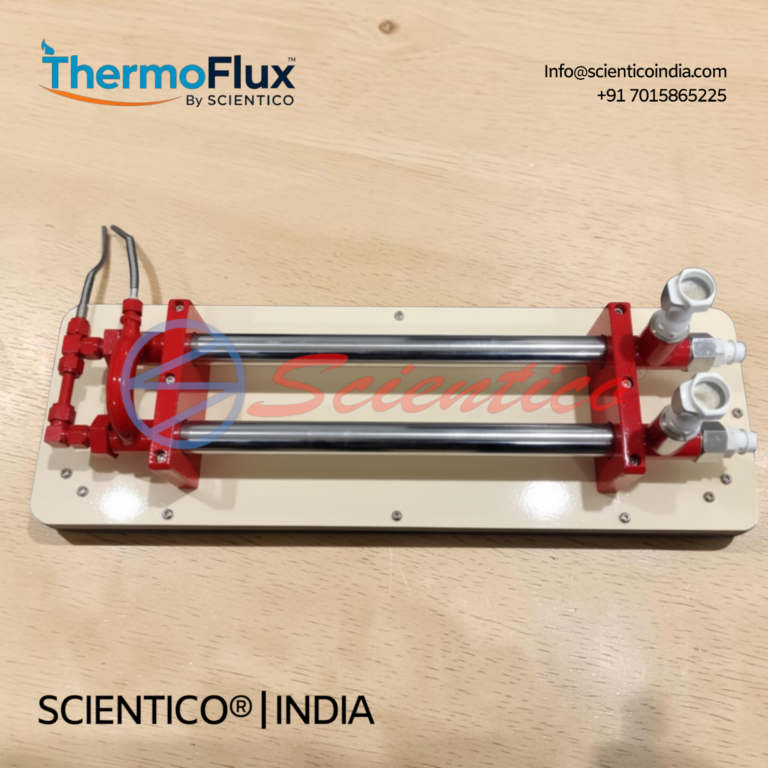
Concentric Tube Heat Exchanger | ThermoFlux – 7108/2
The Concentric Tube Heat Exchanger ThermoFlux - 7108/2 is a laboratory unit designed to study heat transfer through a concentric tube configuration under parallel flow and counter flow conditions. This concentric tube heat exchanger consists of two copper concentric tubes with hot water circulating through the internal tube and cold water circulating through the annular space, with K-type thermocouple sensors at multiple measurement points including inlet, outlet, and midpoint locations for both fluid streams.
View product details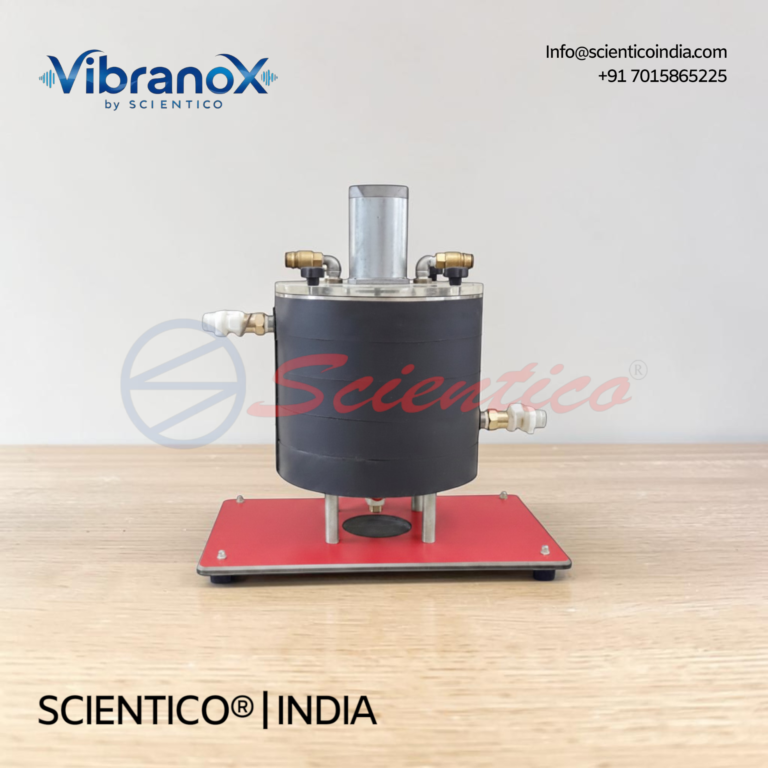
Jacketed Vessel Coil Type Heat Exchanger ThermoFlux | ThermoFlux-7108/4
The Jacketed Vessel Coil Type Heat Exchanger ThermoFlux-7108/4 is a laboratory heat transfer unit for studying thermal exchange between hot water flowing through a surrounding jacket and cold water contained within an inner vessel. This jacketed vessel coil type heat exchanger supports both continuous supply and batch process operation, with temperature measurement at the inlet and outlet of both the hot and cold water sides. The anodized aluminium structure with PVC, stainless steel, and brass water contact parts ensures corrosion-resistant, durable construction for repeated laboratory use.
View product detailsSpecify the experiments before selecting modules
List the required practicals in teaching terms. For parallel-flow and counter-flow temperature curves, one suitable exchanger module may be enough. To compare construction types, students need at least two different modules and enough teaching time to connect, stabilise and record each configuration. The base page names four optional choices: plate type (7108-01), concentric tube (7108-02), shell and tube (7108-03), and jacketed vessel with stirrer and coil (7108-04). State the chosen module or modules as separate BOQ lines with quantities. If the programme requires comparison of plate and shell-and-tube behaviour, do not assume one module can demonstrate both geometries.
The general heat-exchanger selection article explains common exchanger types. The plate-exchanger experiment guide addresses procedure and calculations. This page owns the narrower procurement question: exactly what equipment, connections, instrumentation and documents must be included for a modular ThermoFlux-7108 laboratory station to work on arrival.
Resolve the model references in writing
There is a catalogue-reference detail buyers should not skip. The service-base page calls its optional modules 7108-01 to 7108-04. Separate Scientico product records for a plate unit labelled 7108/1, a concentric-tube unit labelled 7108/2, and a jacketed-vessel unit labelled 7108/4 use a different suffix style. Some of those pages describe complete apparatus or their own operating services. Do not assume a slash-numbered product is the same deliverable as a hyphen-numbered add-on. Ask Scientico for a current model map, photographs and a bill of materials that show precisely which module connects to the 7108 base and what is included with each line.
Require the quote to name the base and every module separately, identify compatible hose fittings and sensor connections, and state whether any shared parts are duplicated or omitted. This prevents a procurement team from comparing a base-plus-module offer with a standalone unit as though they were identical.
Check what the service base actually supplies
The published 7108 base record describes a 50–60 L stainless-steel hot-water tank, four 1.5 kW electric heaters (6 kW total), PID temperature regulation, a 0.75 HP centrifugal pump, and separate hot- and cold-water flowmeters with published 1–7 L/min ranges. It lists seven K-type thermocouples in total: one associated with the temperature controller and six for system measurement. The base includes four flexible connecting tubes. Treat these as the current page’s equipment description, then ask for the offered wiring and instrument schedule.
Cold water comes from laboratory mains or an optional chilling unit according to the base page. State the site’s supply temperature, pressure, flow, drain and electrical service; ask whether a chiller is needed for the experiment. The base has a pressure-regulation valve listed at 0.6 bar and level switches intended to protect the heater against dry running. Request the operating and safety instructions for the selected base-and-module combination. A room drawing should show bench space, hose reach, access to the drain and a safe place to swap modules after the system cools.
Separate displayed readings from the DAQ option
Panel indicators are described on the product record. PC transmission over USB or Ethernet uses an optional ThermoFlux-7108SW LabVIEW-based data-acquisition package; the page says electronic sensors accompany that option. If students must export time series, calculate temperature difference from recorded channels or compare runs across modules, put the DAQ option in the BOQ. Ask for the channel list, file format, connection method, supported computer environment, licence scope and software demonstration at handover. If manual readings are sufficient, record that decision so an optional software price does not hide inside a quote for the base unit.
For each selected module, request a labelled diagram of inlet and outlet points, the temperature-measurement positions, supplied fittings and the safe steps for reversing flow. The base page says parallel and counter flow are selected by reversing water connections. Acceptance should therefore include a supervised connection change and a reading from each required sensor, with the system at agreed safe conditions. Where a module requires an additional instrument or a different connection, it should appear as a separate line before the order is placed.
Copy-ready BOQ and acceptance brief
“Quote a ThermoFlux-7108 heat-exchanger service base with [named module types and quantities] for [course and group count]. State the exact current model codes and whether each module is an add-on or complete standalone unit. Include the base tank, heaters, pump, hot- and cold-water flowmeters, thermocouples, hoses, module fittings, controls and protection. Quote any chiller and DAQ package separately. Provide a process diagram, electrical and water/drain requirements, module-change procedure, manuals, calibration/check documents, installation and training scope, warranty and spares route. Mark all exclusions and deviations.” Use the laboratory RFQ checklist for destination, tender reference and handover fields.
At receipt, reconcile the base, every ordered module, connectors and documents against the signed schedule. Run one agreed parallel-flow and one counter-flow demonstration for each required module, recording inlet and outlet readings without promising a particular heat-transfer coefficient before test conditions are defined. If the curriculum asks for a comparison, confirm that the delivered set can actually be switched and measured within a class session. Browse the thermodynamics equipment range for related apparatus, then request a ThermoFlux-7108 base-and-module quotation with your experiment list and site utilities.
One honest ask
This article and public product information are available to browse without an account. To open a product datasheet, complete the contact form shown with its download link. If this article was useful, leave your email and two things happen: we send you this page as a plain-text block you can paste into a tender file or an internal email, and we notify you the next time we publish a buyer tool like this one. Nothing else. No drip sequence, no sales calls booked without asking.