
If you are equipping a BTech civil engineering lab, the universal testing machine is not optional. It is the single rig that carries the biggest share of your Strength of Materials practicals, and if you cut corners on it, NBA reviewers notice. I have spec’d these for polytechnics and engineering colleges since the mid-2000s, and the mistakes are usually the same: wrong capacity, wrong grips, no calibration paperwork. This page is the buying view for a civil UG programme specifically, not a generic brochure. Start with our strength of materials lab equipment category if you want the full range first.
The short version: for a BTech civil intake of 60 students, you want a 400 kN or 600 kN electro-hydraulic UTM with digital load readout, computerised data logging optional but strongly recommended, and grips for round bars, flat specimens, and compression platens for concrete cubes. That single machine covers roughly 70 percent of the SoM practical syllabus. Everything else is peripherals.
Equipment mentioned in this guide
Review the product information, specifications and model before requesting a quotation.
Universal Hardness Tester
The Universal Hardness Tester manufactured by Scientico India combines Brinell, Vickers, and Rockwell hardness testing methods in a single machine. The machine uses interchangeable indenters and a built-in optical measuring system for Brinell/Vickers measurements, with direct-reading digital display for Rockwell hardness.
View product details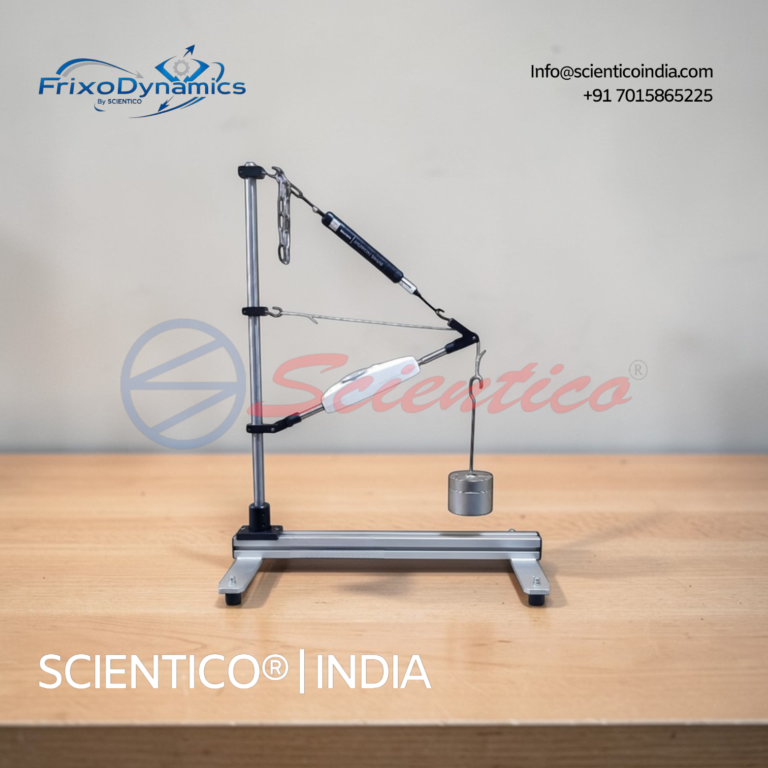
Forces in a Jib Crane Apparatus | FrixoDynamics FX-510
The SCIENTICO FrixoDynamics FX-510 Forces in a Jib Crane Apparatus is a wall-mounted experimental unit designed for the study of force distribution in a two-member jib crane structure. It enables students to measure compressive and tensile forces in the jib and tie members directly using an integrated force gauge and spring balance, and to compare those measured values against theoretical predictions derived from the triangle of forces and polygon of forces methods. The jib inclination and tie angle are adjustable, allowing a range of geometric configurations to be tested. Manufactured by SCIENTICO, the FX-510 is suitable for supply to engineering institutions and distributors worldwide.
View product detailsBTech Civil Engineering syllabus, where the universal testing machine fits
Across AICTE model curriculum and most autonomous BTech civil syllabi, the Strength of Materials lab (usually 3rd or 4th semester, 2 credits, roughly 30 contact hours of practicals) lists tension test on mild steel and HYSD bar, compression test on cast iron and concrete, bending test on wooden beam or mild steel bar, and shear test on mild steel. Every one of those runs on a universal testing machine. Not a Brinell tester, not a torsion rig, the UTM.
Beyond SoM, the same machine gets pulled into the Concrete Technology lab (7-day and 28-day cube tests, split tensile on cylinders) and, if your programme runs a Materials Testing elective in 5th or 6th semester, tensile bar-lot testing for site QA. So the UTM is not just one lab paper. It touches three, and if a student ever does a final-year project on rebar behaviour or fibre-reinforced concrete, the same UTM shows up in their thesis lab hours. Plan accordingly.
Specifications that matter for BTech Civil Engineering
- Capacity: 400 kN minimum for a UG civil lab. 600 kN if you have any intention of testing 150 mm concrete cubes at 40+ MPa (a cube at 40 MPa needs 900 kN, so honestly for concrete you want 1000 kN, but many colleges keep concrete cube testing on a separate CTM and use the UTM for steel only). Decide that split before you buy.
- Load accuracy: Class 1 as per IS 1828 or ASTM E4, meaning ±1 percent of indicated load from 20 percent of range upward. Do not accept Class 2 for a graded programme.
- Ram stroke: 200 mm minimum. Bending tests on 500 mm span specimens eat stroke faster than freshers expect.
- Grips: Wedge grips for round specimens 6 to 40 mm and flat specimens up to 40 mm width. Compression platens 160 mm diameter. Bending attachment with adjustable rollers.
- Readout: Digital load indicator with peak-hold. Add a PC interface with load-vs-elongation graphing if the budget allows. Reviewers love seeing a graph in the student record book instead of a hand-drawn curve from a dial.
- Standards on paper: Machine built to IS 1828 / ISO 7500-1, calibration certificate traceable to NABL under ISO 17025, manufacturer under ISO 9001:2015, documentation reviewed per model if you are procuring for a foreign-collab campus.
Common mistakes BTech Civil Engineering colleges make when buying a universal testing machine
1. Buying too small on capacity to save money. I have seen 100 kN UTMs bought for civil labs. HYSD Fe 500 rebar of 20 mm diameter yields at roughly 157 kN and breaks near 200 kN. Your 100 kN machine cannot even reach yield on a common site bar. You just made the SoM tension experiment impossible. Do not do this.
2. Ignoring the calibration certificate. NBA and NAAC peer teams ask for calibration traceability. If your supplier hands you a machine with only an in-house calibration sticker, that is a finding. Insist on a NABL-accredited calibration certificate at handover, and budget for recalibration every 12 months.
3. No thought to floor loading. A 600 kN electro-hydraulic UTM weighs 1800 to 2400 kg. If your lab is on the first floor of an old building, get the structural check done before the crate arrives. I have watched a UTM sit crated for two months while the college retrofitted a plinth.
4. Skipping the extensometer. The tension test practical in most BTech civil syllabi expects the student to report yield stress, ultimate stress, and percentage elongation. Percentage elongation you can measure with a scale on a broken specimen. Yield strain, modulus of elasticity, proof stress on non-yielding steel, you need an extensometer. It is a small add-on. Buy it with the UTM, not two years later.
5. Not asking about spares. Hydraulic seals, load cell, and the digital indicator are the three things that fail. Ask for a spares kit at time of order. Sourcing them later takes weeks and your practicals stall.
How the Scientico universal testing machine fits BTech Civil Engineering
Scientico builds electro-hydraulic UTMs in 400, 600, and 1000 kN capacities out of the Ambala plant, machine bodies to IS 1828, load cells traceable, digital indicator standard with optional PC interface. If your primary use is steel tension and bending with occasional concrete cube work up to 900 kN, look at the 1000 kN configuration. For a pure steel-focused SoM lab, 600 kN is the honest sweet spot. Related bench-testing peripherals in the same lab, look at the universal hardness tester for the hardness practical, and the forces in a jib crane apparatus for the statics of structures papers. If you are budgeting a full civil lab from scratch, our engineering college equipment guide lays out a typical BOM.
Compliance, NBA / NAAC / AICTE requirements
NBA Tier-1 and Tier-2 UG accreditation for BTech civil looks at three things when they inspect the SoM lab: is the equipment adequate for the sanctioned intake (yes, one 400+ kN UTM for a batch of 60 with two batches per week is defensible), is calibration current and traceable, and is the equipment logbook maintained. AICTE lab norms just require the equipment to exist and be functional, but NBA and NAAC dig deeper. A UTM with a NABL calibration certificate, an equipment history card on the wall, and a stock of consumables (specimens, grip inserts) passes cleanly. A UTM with an expired sticker fails. That is the whole story. For a comparison of standards you can cite in your equipment justification note, see ASTM E10 and IS 1500 for the paired hardness rig.
Ordering and delivery for BTech Civil Engineering labs
Standard commercial terms: ex-works Ambala, or FOR-destination inside India with GST invoice for GEM / institutional buyers. For overseas civil programmes, we ship FOB Mundra or CIF nearest port, sea transit adds weeks depending on destination, and we handle the export documentation. Lead time on a 600 kN UTM is typically several weeks of production plus dispatch. The practical implication: if your semester starts in July, place the PO by April. If it starts in January, order by October. Colleges that place orders in the same month practicals begin end up running the first three weeks on paper problems, and students notice. Installation and one-day operator training is included in-India, optional add-on for overseas. For a related budgeting reference on comparable rigs see the universal testing machine India price guide and universal hardness tester buyers guide.
Get a quote for your BTech civil lab
Send us your intake, floor plan constraints, and whether you need concrete cube capacity, and I will come back with a specific configuration and a PI within two working days. WhatsApp +91-9034-****** or use the contact form. Mention BTech civil so the quote lands on the right desk.
Frequently Asked Questions
What capacity universal testing machine do I need for a BTech civil engineering lab?
400 kN is the practical minimum, 600 kN is the honest sweet spot for a steel-focused Strength of Materials lab. Go to 1000 kN only if the same UTM will also handle 150 mm concrete cube testing at 40+ MPa. Anything below 400 kN cannot reach yield on common HYSD Fe 500 rebar, which makes the syllabus tension test physically impossible.
Does the Scientico UTM come with a NABL-traceable calibration certificate?
Yes. Machines are built to IS 1828 / ISO 7500-1 and dispatched with a calibration certificate traceable under ISO 17025. NBA and NAAC peer teams ask for this at inspection, so it is standard on our institutional dispatches, not an extra.
How long is the lead time from PO to installation for an Indian college?
Typically several weeks of production plus dispatch and installation for a 600 kN UTM. If your semester starts in July, place the PO by April. Same for January semesters, place by October. Same-month orders end up delayed into the semester.
Can one UTM cover Strength of Materials, Concrete Technology, and Materials Testing labs?
Yes for steel and bending work across all three. For concrete cube testing at high strengths you either size up to 1000 kN or keep a separate compression testing machine. Most colleges I have spec’d keep the UTM at 600 kN for steel and add a dedicated CTM for concrete.
Do you supply overseas BTech-equivalent programmes in Africa or the Gulf?
Yes. We ship FOB Mundra or CIF nearest port with full export documentation, documentation reviewed per model units where required, and remote commissioning support. Regulators we routinely document to include NUC, CUE, TCU, MOHE, and CAA depending on country.
One honest ask
We don't gate anything on this site. You just read the whole thing free. If it was useful, leave your email and two things happen: we send you this page as a plain-text block you can paste into a tender file or an internal email, and we notify you the next time we publish a buyer tool like this one. Nothing else. No drip sequence, no sales calls booked without asking.