
Heat Conduction and Convection ThermoFlux – 7106
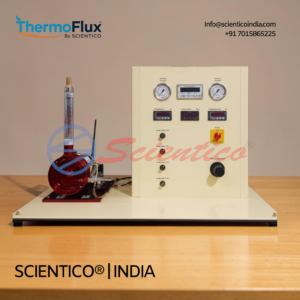
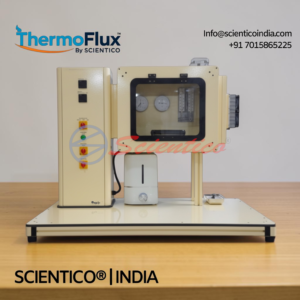
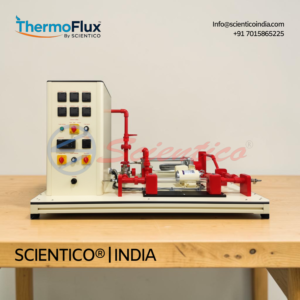
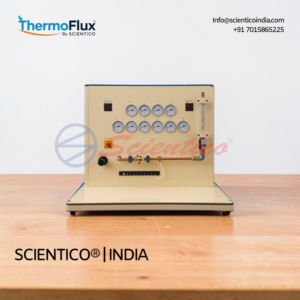
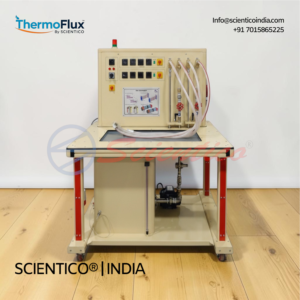
Heat Conduction and Convection ThermoFlux – 7106 is a laboratory apparatus for fundamental experiments on heat conduction and convection using six interchangeable metal cooling fin samples of different materials and lengths.
Two long samples (copper, steel; 154 mm, 48.4 cm²) and four short samples (copper, aluminium, brass, steel; 104 mm, 32.6 cm²) are heated at one end by a 30 W heater (temperature limit: 160°C). Six continuously adjustable fans (max. 40 m³/h, 14,400 min⁻¹, 8 W each) provide forced air flow for free and forced convection comparison.
Eight temperature sensors cover -100 to 400°C. Flow velocity is measured 0 to 10 m/s. Heating power is controlled 0 to 30 W. Microprocessor-based instrumentation is fully integrated in the housing. Temperatures, heating power, and air velocity are displayed and controlled via software. Optional DAQ software in the National Instruments LabVIEW environment supports PC-based data acquisition on any Windows system.
Supplied by SCIENTICO India with an instruction manual.
The Heat Conduction and Convection ThermoFlux – 7106 is a laboratory apparatus designed for basic experiments on heat conduction and convection, two of the three fundamental forms of heat transfer. Six interchangeable metal samples, each functioning as a cooling fin, are heated at one end and dissipate heat through conduction along their length and convection to the surrounding air.
Six fans below the sample provide continuously adjustable forced air flow, enabling comparison between free convection with still air and forced convection with flowing air. The effect of different materials and different sample lengths on heat transfer can be directly compared. Microprocessor-based instrumentation is integrated into the housing; heating power and fan speed are controlled and displayed via software.
Product Overview
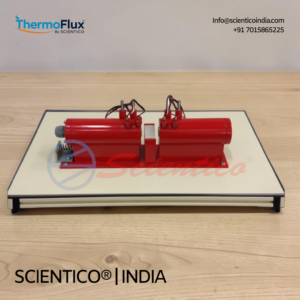
The Heat Conduction and Convection ThermoFlux – 7106 centres on six metal samples: two long samples (copper and steel) with a heat-dissipating length of 154 mm and a heat transfer area of 48.4 cm², and four short samples (copper, aluminium, brass, and steel) with a heat-dissipating length of 104 mm and a heat transfer area of 32.6 cm².
Each sample is placed on a heater rated at 30 W with a temperature limit of 160°C. The sample is heated at one end; heat is conducted along its length and dissipated to the environment, replicating the behaviour of a cooling fin. Six fans with a maximum flow rate of 40 m³/h, nominal speed of 14,400 min⁻¹, and a power consumption of 8 W per fan provide adjustable forced air flow around the sample, enabling heat conduction and convection experiments under both free and forced convection conditions.
Eight temperature sensors measure temperatures across the range -100 to 400°C. Flow velocity is measured from 0 to 10 m/s. Heating power is measured and controlled over 0 to 30 W. All measured values, including temperatures, heating power, and air velocity, are displayed in the software. The integrated microprocessor-based instrumentation requires no additional external devices or error-prone wiring. Optional DAQ software in the National Instruments LabVIEW environment enables PC-based data acquisition on any Windows system.
Heat Conduction and Convection ThermoFlux – 7106: Technical Specifications
| Parameter | Value |
|---|---|
| Apparatus Type | Heat conduction and convection trainer using metal cooling fin samples |
| Total Samples Included | 6 (2 long, 4 short) |
| Long Samples: Materials | Copper, steel |
| Long Samples: Heat-Dissipating Length | 154 mm |
| Long Samples: Heat Transfer Area | 48.4 cm² |
| Short Samples: Materials | Copper, aluminium, brass, steel |
| Short Samples: Heat-Dissipating Length | 104 mm |
| Short Samples: Heat Transfer Area | 32.6 cm² |
| Heater: Heating Power | 30 W |
| Heater: Temperature Limitation | 160°C |
| Fans | 6 fans, continuously adjustable |
| Fan: Max. Flow Rate | 40 m³/h |
| Fan: Nominal Speed | 14,400 min⁻¹ |
| Fan: Power Consumption | 8 W |
| Temperature Measurement Range | 8 x -100 to 400°C |
| Flow Velocity Measurement Range | 0 to 10 m/s |
| Heating Power Measurement Range | 0 to 30 W |
| Temperature Sensors | 5 (as stated in specifications) |
| Instrumentation | Microprocessor-based, integrated in housing |
| Software | Optional DAQ software (National Instruments LabVIEW environment) |
| Software Compatibility | Any Windows environment |
Technical Data
Heater
| Parameter | Value |
|---|---|
| Heating Power | 30 W |
| Temperature Limitation | 160°C |
Long Samples (2x)
| Parameter | Value |
|---|---|
| Materials | Copper, steel |
| Length Dissipating Heat | 154 mm |
| Heat Transfer Area | 48.4 cm² |
Short Samples (4x)
| Parameter | Value |
|---|---|
| Materials | Copper, aluminium, brass, steel |
| Length Dissipating Heat | 104 mm |
| Heat Transfer Area | 32.6 cm² |
Fans (6x)
| Parameter | Value |
|---|---|
| Max. Flow Rate | 40 m³/h |
| Nominal Speed | 14,400 min⁻¹ |
| Power Consumption | 8 W |
Measuring Ranges
| Parameter | Range |
|---|---|
| Flow Velocity | 0 to 10 m/s |
| Temperature | 8 x -100 to 400°C |
| Heating Power | 0 to 30 W |
Key Features
- Apparatus Type: heat conduction and convection trainer using metal cooling fin samples
- Total Samples: 6 interchangeable metal samples (2 long, 4 short)
- Long Samples: copper and steel, 154 mm heat-dissipating length, 48.4 cm² heat transfer area
- Short Samples: copper, aluminium, brass, and steel, 104 mm heat-dissipating length, 32.6 cm² heat transfer area
- Heater Rating: 30 W, temperature limitation 160°C
- Fans: 6 fans, continuously adjustable flow rate
- Fan: Max. Flow Rate: 40 m³/h
- Fan: Nominal Speed: 14,400 min⁻¹
- Fan: Power Consumption: 8 W
- Convection Modes: free convection (still air) and forced convection (flowing air)
- Temperature Measurement: 8 x -100 to 400°C
- Flow Velocity Measurement: 0 to 10 m/s
- Heating Power Measurement: 0 to 30 W
- Instrumentation: microprocessor-based, integrated in housing, no additional external devices required
- Software Display: temperatures, heating power, and air velocity displayed in software
- Software: optional DAQ software, National Instruments LabVIEW environment, Windows compatible
Experiments
- Effect of heat conduction and convection on heat transfer
- Effect of free and forced convection on heat transfer
- Calculate convective heat transfers
- Effect of different materials on heat conduction
- Effect of sample length on heat transfer
Construction and Design
The Heat Conduction and Convection ThermoFlux – 7106 is built around a heater on which interchangeable metal samples are placed. Each sample is heated at one end. Heat is conducted along the sample length and dissipated to the surrounding air, replicating the behaviour of a cooling fin.
Six interchangeable samples are provided: two long samples (copper and steel) with a heat-dissipating length of 154 mm and a heat transfer area of 48.4 cm², and four short samples (copper, aluminium, brass, and steel) with a heat-dissipating length of 104 mm and a heat transfer area of 32.6 cm². This range of materials and lengths enables direct experimental comparison of heat conduction and convection performance across different geometries and thermal conductivities.
Six fans are positioned below the sample. The fans deliver a maximum flow rate of 40 m³/h at a nominal speed of 14,400 min⁻¹, consuming 8 W each. Fan flow rate is continuously adjustable, conveying air flow evenly around the sample for both free convection (still air) and forced convection (flowing air) experiments. The heater is rated at 30 W with a temperature limitation of 160°C.
Eight temperature sensors cover the range -100 to 400°C. Flow velocity is measured over 0 to 10 m/s. Heating power is controlled and measured over 0 to 30 W. Microprocessor-based instrumentation is fully integrated into the housing, eliminating the need for additional external devices or error-prone wiring. Temperatures, heating power, and air velocity are all displayed via the software interface.
Software (Optional): ThermoFlux – 7106
DAQ software is specially designed in the National Instruments LabVIEW environment to measure and calculate results from the apparatus. The software is optional. When software is used, a set of electronic sensors is included. Heating power and flow velocity of the air flow are adjusted and displayed via the software. The software is compatible with any Windows environment.
Scope of Delivery
- 1 experimental unit
- 1 instruction manual
Optional Accessories
- DAQ software package (ThermoFlux – 7106, National Instruments LabVIEW environment, Windows compatible), supplied with electronic sensors
Q: What metal samples are included with the Heat Conduction and Convection ThermoFlux – 7106?
A: Six interchangeable metal samples are included. Two long samples (copper and steel) have a heat-dissipating length of 154 mm and a heat transfer area of 48.4 cm². Four short samples (copper, aluminium, brass, and steel) have a heat-dissipating length of 104 mm and a heat transfer area of 32.6 cm².
Q: How does the unit demonstrate both free and forced convection?
A: Six continuously adjustable fans are positioned below the sample. When the fans are off, the sample dissipates heat to still air, demonstrating free convection. When the fans are on, air flow is conveyed evenly around the sample, demonstrating forced convection. Flow velocity is adjustable and measured over 0 to 10 m/s.
Q: What is the heater specification for this heat conduction and convection apparatus?
A: The heater has a heating power of 30 W and a temperature limitation of 160°C. Heating power is continuously adjustable over 0 to 30 W and is displayed and controlled via the software.
Q: What parameters are measured and displayed by the unit?
A: The unit measures temperature (8 x -100 to 400°C), flow velocity (0 to 10 m/s), and heating power (0 to 30 W). All values are displayed via the software interface. The integrated microprocessor-based instrumentation requires no additional external devices.
Q: Is PC-based data acquisition available for the ThermoFlux – 7106?
A: Yes, as an optional feature. Optional DAQ software developed in the National Instruments LabVIEW environment enables PC-based data acquisition and control of heating power and fan speed. The software is compatible with any Windows environment and is supplied with a set of electronic sensors.
Need Assistance? We're Here to Help!
Connect with our team for product specifications, pricing, and customized solutions for your institution or project.