
Equipment mentioned in this guide
Review the product information, specifications and model before requesting a quotation.
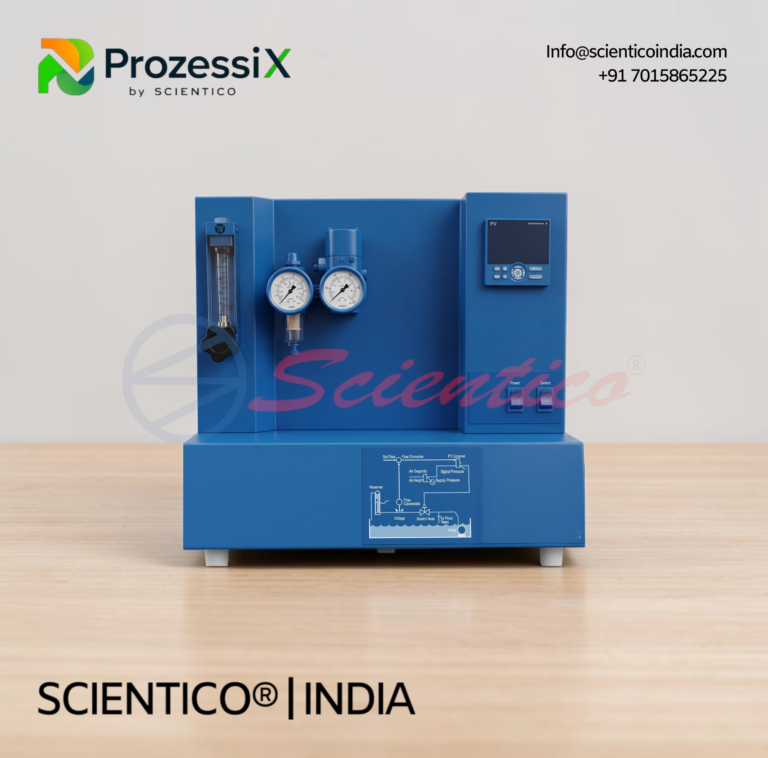
Flow Control Trainer | Prozessi PX 15
The Flow Control Trainer, Prozessi PX 15, is designed for understanding the basic principles of flow control using a complete pneumatic and electronic control loop. This Flow Control Trainer allows students to study open loop and closed loop control, tuning methods, and SCADA based monitoring of water flow.
View product details
On-Grid Solar Energy with Storage | RVX-005
The On-Grid Solar Energy with Storage RVX-005 is a grid-tied solar power training system that combines grid-connected solar panels with battery storage capabilities. It demonstrates solar energy generation, excess energy storage, and live interaction with the main electrical grid.
View product details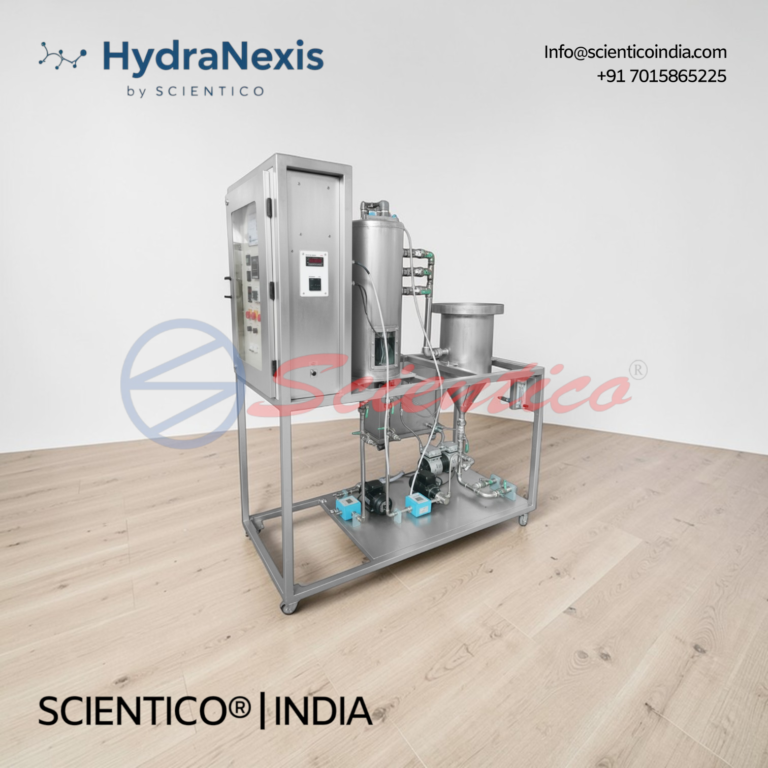
Aerobic Water Treatment Pilot Plant – HydraNexis HNX 06
Product OverviewThe HydraNexis HNX 06 pilot plant is based on the conventional single-stage activated sludge process, consisting of an oxidation (aeration) reactor followed by a secondary settler. Raw water containing dissolved organic matter is pumped into the oxidation reactor, where aerobic microorganisms biodegrade organic pollutants using dissolved oxygen supplied through air diffusion.
View product details
Absorption Refrigeration Trainer | PolarX – 504
The Absorption Refrigeration Trainer PolarX - 504 is a laboratory unit designed to demonstrate the fundamental operation of an absorption refrigeration system using an ammonia-water solution as the working medium and hydrogen as an auxiliary gas. This absorption refrigeration trainer includes an evaporator, absorber, boiler with bubble pump, and condenser as its primary components, with an adjustable electric heater at the evaporator as the cooling load and digital displays for temperature and power measurement across the refrigeration circuit.
View product details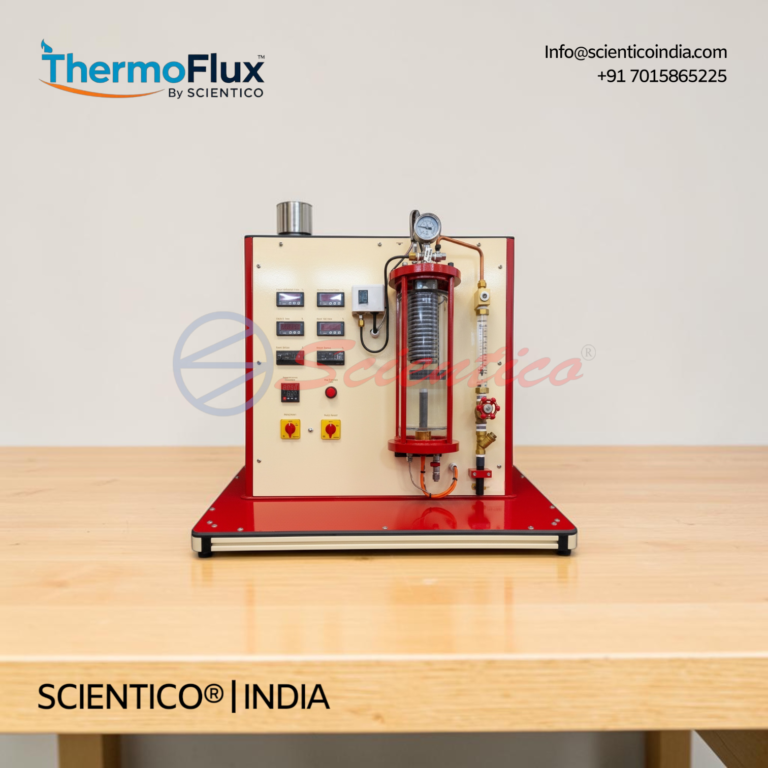
Boiling Heat Transfer Apparatus | ThermoFlux – 7051
The Boiling Heat Transfer Apparatus ThermoFlux - 7051 is a bench-mounted experimental unit designed to enable visual demonstration and quantitative measurement of convective, nucleate, and film boiling heat transfer modes in a transparent pressure vessel. This boiling heat transfer apparatus allows students to determine heat flux, surface heat transfer coefficients, and critical heat flux at pressures up to 2 bar above atmospheric, supported by integrated instrumentation for temperature, pressure, power, and cooling water flow rate measurement.
View product details
Air Flow Impulse Turbine | ThermoFlux – 7095
The Air Flow Impulse Turbine ThermoFlux - 7095 is a standalone table-top laboratory unit designed to enable students to investigate the performance of a single-stage axial flow impulse turbine using compressed air. This air flow impulse turbine is equipped with a belt brake dynamometer, force sensor torque measurement, proximity switch speed measurement, and digital instrumentation for pressure, temperature, mass flow, speed, and torque across a full range of operating conditions.
View product detailsQatar: a small market that specifies like a large one
Qatar buys laboratory and engineering teaching equipment in a pattern that catches out suppliers used to volume markets. There are relatively few institutions, so there are relatively few tenders. But each tender tends to be broad in scope, evaluated in detail by academic staff rather than only by a purchasing officer, and judged on whether the supplier will still be answerable for the equipment several years after handover.
If you sell into the Gulf for long enough you learn that Qatar rewards precision and punishes vagueness. A bid with a strong price and a thin technical file loses to a bid that answers the specification clause by clause. That is the single most useful thing I can tell an exporter approaching this market for the first time.
The buying landscape, described plainly
Higher and technical education in Qatar sits across a few distinct segments, and each one procures differently. Nothing below implies any relationship with the bodies named. They are simply parts of the landscape a supplier should understand.
| Segment | Who typically holds the budget | Laboratory categories that recur |
|---|---|---|
| Universities with engineering, science and foundation programmes, including branch campuses of foreign universities | Institutional procurement office, sometimes a shared campus authority acting for several entities | Strength of materials, fluid mechanics, thermodynamics and heat transfer, electrical machines, control and instrumentation, general physics and chemistry |
| Technical, vocational and applied science institutions | Institution procurement, often with a parent or sponsoring body approving the technical scope | Workshop technology, applied mechanics, refrigeration and air conditioning, hydraulics and pneumatics, electrical trades training |
| Schools sector under the Ministry of Education and Higher Education | Central tendering covering many schools at once | School physics, chemistry and biology laboratories, general science apparatus, laboratory furniture and safety items |
| Training centres attached to industry, including energy, utilities and construction employers | Corporate or joint venture procurement, frequently with its own vendor registration | Process control rigs, materials testing, metrology, demonstration units tied to a specific competency framework |
Two structural facts shape everything else. First, most institutional purchases route through a locally registered supplier, so an Indian or European manufacturer usually appears in the bid as the named manufacturer behind a local bidder rather than as the bidder. Second, engineering instruction is largely in English, so English manuals and English clause references are the norm rather than a concession.
Why laboratory provision is a repeating line item, not a one-off
Buyers new to this category assume a lab is bought once. It is not. The recurring drivers are consistent across the Gulf, and I see the same pattern in the UAE market and in Kuwait, with a rougher version of it in Iraq.
- New programme launches. A new degree or diploma stream needs its practical provision in place before the first cohort, not after.
- Accreditation cycles. Programmes seeking or renewing international accreditation must show that stated learning outcomes are actually attainable with the equipment on the floor. The mechanics of that are covered in the note on ABET laboratory requirements for Gulf universities.
- Intake growth. One tensile machine for a class of sixty produces a queue, not a practical class. Capacity, not capability, is what usually forces the second purchase.
- Replacement and consumables. Load cells drift, specimens run out, heaters fail. This is a steady annual spend that rarely appears in the original capital case.
What a bid has to contain to survive technical evaluation
Technical evaluation in this market is usually a scored exercise carried out before price is opened. The committee is looking for reasons to declare a bid non responsive. Give them none.
| Evaluation stage | What the committee actually checks | What sinks bids |
|---|---|---|
| Eligibility | Local registration, trade licence, tax position, any required vendor registration with the buying entity | The manufacturer bids directly with no locally registered partner and is set aside without the technical file being read |
| Manufacturer standing | Authorisation to bid, quality system certification, years in the category, export footprint | A missing or wrongly worded authorisation letter. Get the wording right using the manufacturer authorisation form guide |
| Clause by clause compliance | A compliance sheet that answers every specification line with comply, partially comply or deviate, plus a page reference into the technical file | A brochure attached in place of a compliance sheet, or the word comply with nothing behind it |
| Technical substantiation | Datasheets, dimensioned drawings, electrical schedules, standards referenced by number, calibration documentation, safety features | Ranges quoted without accuracy or resolution, no mention of the test standard the apparatus is built around |
| After sales | Installation and commissioning scope, training scope, spares availability, named support contact | Support described in adjectives instead of obligations |
If you are the institution rather than the bidder, invert this table. It is your checklist for what to demand, and it is also your defence when a low bidder is later unable to deliver. Vetting the manufacturer behind the local bidder matters more than most buyers realise, and the questions worth asking are set out in the manufacturer due diligence guide.
Specifying a method, not a machine
The most common defect I see in Gulf tender documents is a specification copied out of one manufacturer’s catalogue. Dimensions to the millimetre, a proprietary control interface, a frame described exactly as one brand builds it. The intent is usually innocent. The effect is that only one product can comply, competition collapses, and any losing bidder with a grievance has a straightforward challenge to make.
The fix is to specify what the apparatus must be able to demonstrate and measure, then let the market propose how.
| Restrictive clause, written around a machine | Defensible clause, written around a method |
|---|---|
| Universal testing machine with dual column frame, 1,062 mm test space and the supplier’s proprietary software suite | Machine capable of tension, compression and transverse testing on standard specimens, stated capacity, stated force accuracy class, daylight sufficient for the specimen lengths listed, software exporting load and extension data in a readable format |
| Concrete cube testing machine, model reference as per attached brochure | Compression machine with capacity and platen sizes suitable for the cube and cylinder sizes in use, rate of loading controllable within the range required by the referenced test method |
| Fluid mechanics bench with the manufacturer’s colour scheme and accessory port layout | Self contained hydraulic bench with stated flow and head range, sump capacity, and mounting provision for the listed accessory experiments, flow measurement method stated by the bidder |
| Rockwell hardness tester, model number given | Bench hardness tester covering the stated scales, with test blocks and indenters, conforming to the referenced hardness standard, resolution and repeatability stated |
Two supporting documents make this practical. The first is the specification writing guide, which shows how to build a clause set that is open but not loose. The second is the IS and ASTM standards reference, which lets you name the test method rather than the machine. Naming a standard is the single cleanest way to keep a tender competitive and still get the apparatus you actually need.
If you are assembling a scope from scratch, the mechanical engineering laboratory list and the civil engineering laboratory list are useful starting inventories to edit down against your own syllabus.
Import, documentation and conformity
Handle conformity carefully and honestly. Requirements change, they differ by product category, and no exporter should assert them from a distance. Confirm the current conformity requirements for the Qatari market with your importer or with a recognised conformity assessment body before you commit to a delivery schedule or price a certificate into a bid. That instruction is not a hedge. It is what a competent freight and compliance conversation looks like at the start of a project rather than at the port.
On classification, laboratory teaching and demonstration apparatus commonly falls under HS heading 9023, which covers instruments and models designed for demonstrational purposes. Treat that as a starting point only and confirm the correct classification for your specific articles with your own customs broker, because accessories, instruments and furniture within the same order can fall elsewhere.
| Document | Issued by | Why it matters on arrival |
|---|---|---|
| Commercial invoice | Exporter | Values, terms of sale and description must match the packing list and the bill of lading exactly |
| Packing list | Exporter | Case by case contents, weights and dimensions. This is what the consignee uses to check for shortages before signing |
| Bill of lading or air waybill | Carrier or forwarder | Title and release. Errors here delay clearance more often than anything else |
| Certificate of origin | Chamber of commerce in the country of export | Origin evidence, and frequently a tender requirement in its own right |
| Test, inspection and calibration records | Manufacturer | Handed to the institution at commissioning and referenced in the acceptance certificate |
| Declaration or conformity documentation, where applicable to the article | Manufacturer, and any body engaged by the importer | Scope varies by product. Confirm what your articles require before shipment |
The full sequence, including who prepares what and in what order, is covered in the export documentation guide. Importers approaching an Indian manufacturer for the first time will also want the India sourcing guide for importers, which deals with inspection, packing standards and payment structure.
Who does what: local partner and Indian manufacturer
Almost every institutional supply in Qatar involves two parties. Problems arise when neither has written down which one owns a given obligation. Settle it before the bid, not after the crates land.
| Obligation | Normally the local partner | Normally the manufacturer in India |
|---|---|---|
| Bid submission, bonds, local registration | Yes | Supports with authorisation and technical file |
| Customs clearance and inland delivery | Yes | Supplies documents and packing declarations |
| Site survey, services readiness, positioning | Yes | Supplies layouts, utility requirements and foundation notes |
| Installation and commissioning labour | Usually, with manufacturer support | Commissioning procedure, remote or attending support as agreed |
| Technician and faculty familiarisation | Delivers locally where trained to | Provides the training content and can attend where contracted |
| Warranty administration and first line response | Yes | Second line diagnosis and replacement parts |
| Spares holding | Should hold fast moving items locally | Manufactures and supplies against the agreed list |
Distributors evaluating whether this category is worth carrying should read the distributor and dealership page, and institutions or training providers wanting equipment carrying their own identity should look at OEM and private label manufacturing.
What the institution should insist on, whoever supplies
This part is deliberately supplier neutral. Write these into the contract whether you buy from India, Europe, China or a local assembler.
- Installation and commissioning as a defined scope, with a signed acceptance test showing each unit ran through at least one full experiment on site.
- Technician familiarisation, delivered to the people who will actually run the lab, not only to the faculty member who signed the requisition. Ask for it to be recorded.
- Manuals in English, covering operation, experiment procedures, safety, maintenance intervals and an exploded parts view with part references. A manual without part references is not a manual, it is a leaflet.
- Calibration documentation, with the type of certificate stated explicitly. There is a real difference between a factory calibration certificate issued by the manufacturer and a certificate from an accredited laboratory. Both have their place. Confusing them causes arguments at audit. The calibration and maintenance schedule guide sets out how to plan the recurring cycle.
- A spares route in writing, listing consumables, wear items and long lead components, with the ordering channel named. The spares and after sales page covers how to build that list before signing rather than after a failure.
On procurement mechanics, confirm the current public procurement route in that market with the buying entity or your local partner. Routes and portals change, and a supplier who assumes will eventually assume wrong.
Planning the laboratory itself
An institution in Doha standing up a new engineering programme faces the same sequence as one anywhere else, only with a tighter calendar because the academic year and the tender calendar rarely line up neatly.
| Phase | Decision to close | Common failure |
|---|---|---|
| Curriculum mapping | Which practicals each module requires, and the group size per session | Buying by catalogue category rather than by experiment list |
| Capacity sizing | Units per experiment based on cohort size and timetable slots | One of everything, then a queue and an unusable practical class |
| Services and layout | Power phases and loads, drainage, compressed air, extraction, bench heights, floor loading | Equipment arriving before three phase supply or drainage exists |
| Procurement | Specification set, evaluation criteria, contract terms including support | Specifications copied from a brochure, then challenged |
| Installation and handover | Acceptance testing, training, document handover | Handover signed on delivery rather than on demonstrated function |
Two companions to this: the new laboratory setup timeline and checklist for sequencing, and the budget planning guide by student intake for sizing the capital case honestly against cohort numbers. Browsing the engineering training equipment range is useful once the experiment list exists, and certification documents sit on the quality certifications page with technical literature on the downloads page.
Where Scientico fits, stated plainly
Scientico is a manufacturer and exporter of laboratory and engineering teaching and demonstration equipment, with its own works in Ambala, Haryana, India, established in 1993 and supplying to more than sixty countries. It exports from India. There is no local entity, office, warehouse or subsidiary in Qatar, and I would rather say so directly than let a buyer discover it during a commissioning dispute.
What that means in practice is straightforward. A Qatari institution buying the range will normally do so through a locally registered supplier who handles the bid, clearance, installation and first line support, with the works in India behind that partner on technical documentation, spares and second line diagnosis. Where an institution prefers to import directly, that is possible too, and the responsibilities in the table above simply shift.
The quality position is equally plain. The works operates an ISO 9001:2015 certified quality management system, and CE conformity documentation is available on applicable models. The certificates supplied with equipment are factory calibration certificates issued by the manufacturer. Scientico is not ISO/IEC 17025 accredited and not NABL accredited, and factory calibration should never be presented in a bid as though it were accredited calibration. If a specification demands accredited calibration, that has to be arranged through an accredited laboratory, and it is better to say so at bid stage than to be found out at audit.
Pricing is quote based against a scope, because a teaching laboratory is a list of experiments and group sizes rather than a shopping basket, and a number without that list is guesswork. A first meeting in Doha usually opens with ahlan wa sahlan, though the drawings, manuals and certificates that ship with the equipment are in English.
If you are an institution building an experiment list, or a Qatar based supplier who needs a manufacturer to stand behind a bid with a proper technical file, send the syllabus or the tender document and you will get a scoped response rather than a brochure. Contact Scientico with your experiment list, cohort size and required delivery window.
One honest ask
We don't gate anything on this site. You just read the whole thing free. If it was useful, leave your email and two things happen: we send you this page as a plain-text block you can paste into a tender file or an internal email, and we notify you the next time we publish a buyer tool like this one. Nothing else. No drip sequence, no sales calls booked without asking.
GCC country page · manufacturer-direct product research
Find laboratory equipment for Qatar by product name and model
Qatar’s institutional market rewards precise, compact supplier responses. A technical institute or project team may buy fewer laboratories than a volume market, but its evaluators still need to see the exact experiment, measurement method, included instruments, utilities, manuals, acceptance checks and project responsibilities.
What buyers are actually trying to source
Search by the product name or model when the schedule is specific. Use the category route when the requirement is expressed as a laboratory, course or learning outcome. Process control, renewable energy, water treatment, refrigeration and thermal engineering are practical starting points for a Qatar equipment shortlist.
 Prozessi PX-15
Flow Control Trainer
Process control and instrumentation
View specifications & enquire → RVX-005
On-Grid Solar Energy with Storage
Grid-connected solar training
View specifications & enquire → HydraNexis HNX-06
Aerobic Water Treatment Pilot Plant
Water-treatment and environmental engineering
View specifications & enquire → PolarX-504
Absorption Refrigeration Trainer
Refrigeration and air-conditioning training
View specifications & enquire →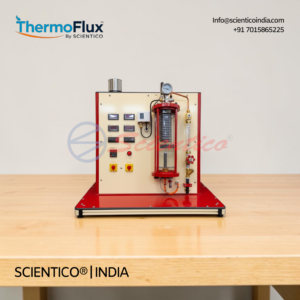 ThermoFlux-7051
Boiling Heat Transfer Apparatus
Boiling and heat-transfer study
View specifications & enquire → ThermoFlux-7095
Air Flow Impulse Turbine
Thermal and turbine experiments
View specifications & enquire →Search the full catalogue for Qatar Browse all product families
Turn a list into a quotation that can be approved
Include the end user, destination, quantities, installation site status, voltage and frequency, manuals, certificates, inspection requirement, commissioning scope and tender closing date. Contractors and distributors should identify which work they will perform locally so the manufacturer’s scope can be quoted without overlap.
- Attach the syllabus, BOQ or named apparatus list.
- Add quantity, destination, utilities and required date.
- State manuals, certificates, inspection, installation and training requirements.
- Ask for the proposed model, included accessories, exclusions and deviations.
- Review the datasheet and commercial quotation together.
Questions before you request a quote
Can Scientico review a Qatar tender before pricing?
Yes. A pre-quotation scope review helps resolve ambiguous names, missing ranges and site responsibilities.
Can I request models from several engineering disciplines together?
Yes. Group the BOQ by department and include quantities and destination in one enquiry.
Are all certifications the same for every product?
No. Request the applicable documentation for each proposed model and project requirement.
Products, documentation and commercial terms are confirmed for each written quotation. This page does not imply local stock, representation, approval, installation, shipping route or delivery timing.