Forces in Reciprocating Engines | Vibrano X – 12
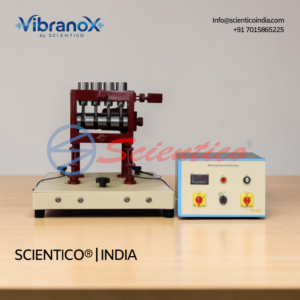
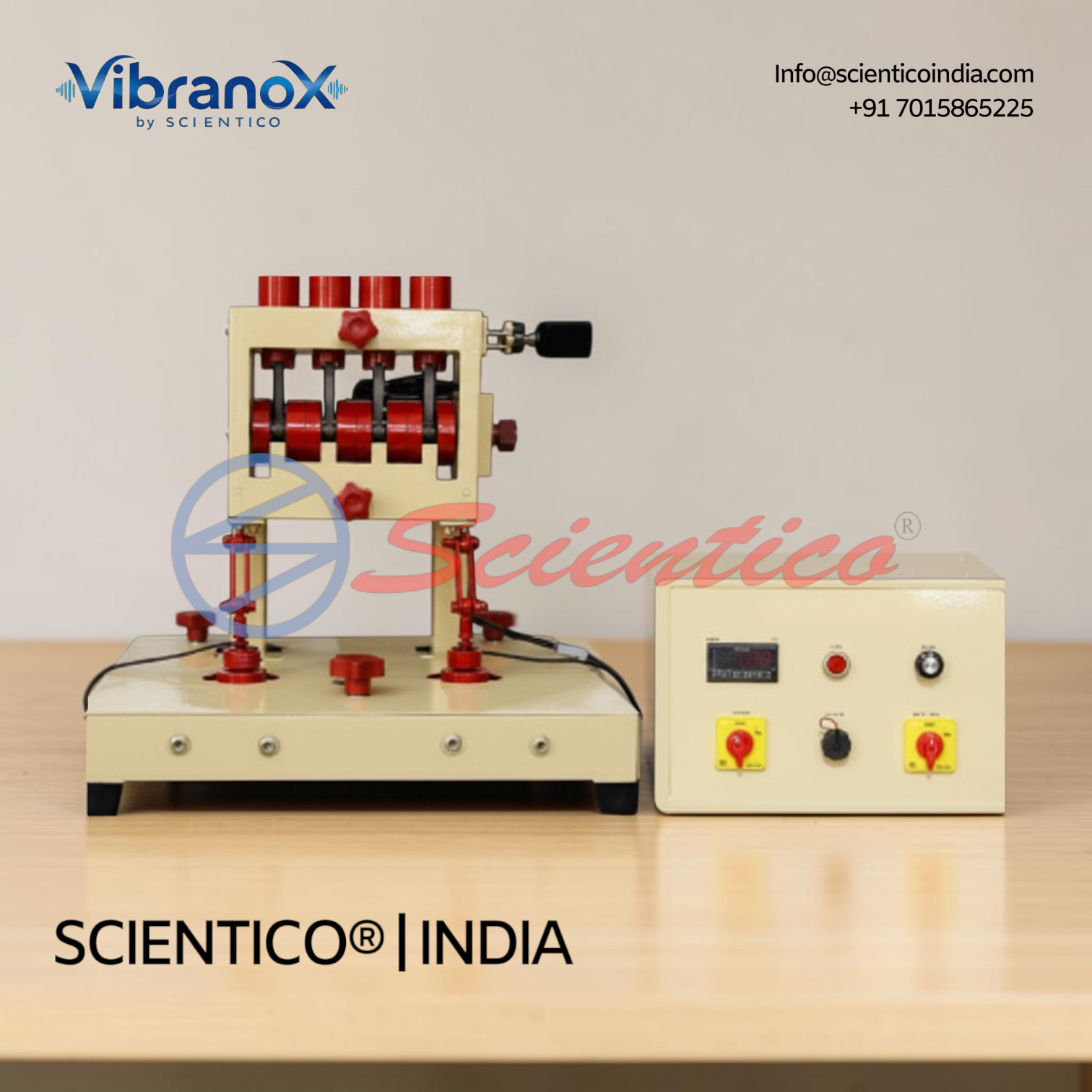
The Forces in Reciprocating Engines – Vibrano X – 12 apparatus investigates oscillating and rotating mass forces on a four cylinder model engine. It features a DC motor driven crankshaft with speed range 100~3000rpm, load cell cantilever mounting, and adjustable piston masses. This Forces in Reciprocating Engines model supports 4, 2, and 1 cylinder configurations with crank angle adjustment at 0, 90, 180 and 270°. Transparent safety covers and a nominal power output of 80W complete the anti-vibration mounted design.
The Forces in Reciprocating Engines – Vibrano X – 12 model is constructed around a four cylinder engine held on a cantilever and sturdy base. The cantilever is mounted on a vertical pillar, with the engine including crankshaft, connecting rods, pistons, and non-metallic cylinder liners. This Forces in Reciprocating Engines apparatus allows investigation of oscillating and rotating masses across multiple cylinder arrangements.
Product Overview
The model is constructed around a four cylinder engine held on a cantilever and sturdy base. The cantilever is mounted on a vertical pillar. The engine includes crankshaft, connecting rods, pistons, and non-metallic cylinder liners. The non-metallic lined cylinders prevent the need for lubrication. Different cylinder arrangements can be achieved between 4, 2 and 1.
The cantilever arrangement has a number of strain gauges (load cell) attached to measure combined bending and torsion being applied during engine running. This then allows the forces, torques and moments to be calculated. The load cells have an output to the data acquisition oscilloscope for vibration monitoring.
A DC motor drives the crankshaft between 100 and 3000rpm. The speed is electronically controlled within the unit using a precision frequency generator and digitally displayed. Each piston has the ability to have its mass adjusted by adding or removing weights. These weights are securely fixed during engine running.
Individual crank angle adjustment can be achieved with angular graduations at 0, 90, 180 and 270°. All tools, additional piston masses, connecting cables, and power leads are supplied. All rotating elements of the machine are stored away behind transparent safety covers, allowing full protection whilst ensuring visibility of the experiment and components.
A comprehensive instruction manual for students and trainer gives full details on apparatus assembly and operation as well as example results. All necessary assembly and operational tools are provided. This Forces in Reciprocating Engines apparatus is designed for detailed study of mass forces and moments across single, two, and four cylinder configurations.
Forces in Reciprocating Engines – Vibrano X – 12, Technical Specifications
| Specification | Detail |
|---|---|
| Cylinders | 4 cylinders |
| Motor Speed | 100~3000rpm |
| Nominal Power Output | 80W |
| Base | Anti-vibration mounted base |
| Mounting | Model engine mounted on load cell cantilever |
| Guarding | Cylinder block fitted with transparent front wall as guard for moving parts |
Technical Data
Engine
| Parameter | Value |
|---|---|
| No of cylinders | 4 |
| Mass of piston | 40g, Additional mass: 41g |
Crank Drive
| Parameter | Value |
|---|---|
| Mass of connecting rod | 18g |
| Centre distance of cylinders | 35mm |
| Crank radius | 15mm |
| Length of connecting rod | 70mm |
Measuring Ranges
| Parameter | Value |
|---|---|
| Speed | 100~300rpm |
| Force | 0~500N |
Key Features
- Core Function: this Forces in Reciprocating Engines apparatus investigates oscillating and rotating masses on a model engine
- Cylinders: 4 cylinders, configurable to 4, 2, or 1 cylinder arrangements
- Engine Components: crankshaft, connecting rods, pistons, non-metallic cylinder liners (lubrication-free)
- Load Measurement: strain gauges (load cell) on cantilever measure combined bending and torsion
- Drive System: DC motor, speed range 100~3000rpm, precision frequency generator control, digital display
- Piston Mass Adjustment: weights can be added or removed, securely fixed during running
- Crank Angle Adjustment: angular graduations at 0, 90, 180 and 270°
- Nominal Power Output: 80W
- Base: anti-vibration mounted base
- Safety: transparent safety covers on rotating elements for protection with visibility
- Guarding: transparent front wall on cylinder block guards moving parts
- Data Output: load cells output to data acquisition oscilloscope for vibration monitoring
- Documentation: comprehensive instruction manual with assembly, operation, and example results
Experiments
- Investigation and measurement of oscillating and rotating masses on a four cylinder model engine
- Comparison of different crank arrangements: four cylinder symmetrical
- Four cylinder unsymmetrical, two cylinder 180° crank offset, single cylinder
- Effect of adding or removing cylinder masses on forces
- The use of load cells within a model engine
- Effect of mass forces: mass forces in dependence on the speed
- Mass forces in dependence on piston mass
- First and second order mass forces
- Comparison of different configurations: 4-cylinder symmetrical (180° angle between cranks), 4-cylinder non-symmetrical (90° angle between cranks), 2-cylinder (180° angle between cranks), single cylinder
- Investigation of free mass forces and moments of a reciprocating engine
- Continuous adjustment of the angle between cranks
- Simulation of single, two or four cylinder engines
Construction and Design
The Forces in Reciprocating Engines – Vibrano X – 12 model is constructed around a four cylinder engine held on a cantilever and sturdy base. The cantilever is mounted on a vertical pillar. The engine includes a crankshaft, connecting rods, pistons, and non-metallic cylinder liners, which eliminate the need for lubrication. Different cylinder arrangements can be achieved between 4, 2, and 1 cylinders.
The cantilever carries a number of strain gauges functioning as a load cell to measure combined bending and torsion applied during engine running, enabling calculation of forces, torques, and moments. A DC motor drives the crankshaft at speeds between 100 and 3000rpm, controlled electronically using a precision frequency generator with digital display.
Each piston can have its mass adjusted by adding or removing weights, which are securely fixed during engine running. Crank angle can be individually adjusted using angular graduations at 0, 90, 180, and 270°. All rotating elements are enclosed behind transparent safety covers, providing protection while maintaining visibility of the experiment. This Forces in Reciprocating Engines apparatus mounts the model engine on a load cell cantilever with an anti-vibration base.
Scope of Delivery
- 1 experimental module
- 1 set of tools
- 1 instruction manual
Q: What does the Forces in Reciprocating Engines – Vibrano X – 12 apparatus investigate?
A: It investigates oscillating and rotating masses on a four cylinder model engine, including mass forces, torques, and moments across different crank arrangements.
Q: What cylinder configurations are possible?
A: The apparatus supports 4, 2, and 1 cylinder arrangements, including four cylinder symmetrical and non-symmetrical configurations, and two cylinder with 180° crank offset.
Q: What is the motor speed range?
A: The DC motor drives the crankshaft between 100 and 3000rpm, electronically controlled using a precision frequency generator with digital display.
Q: How is piston mass adjusted?
A: Piston mass is adjusted by adding or removing weights, which are securely fixed during engine running. The base piston mass is 40g with an additional mass of 41g.
Q: How are users protected from moving parts during operation?
A: All rotating elements are stored behind transparent safety covers, and the cylinder block is fitted with a transparent front wall as a guard, allowing full protection while maintaining visibility of the experiment.
Need Assistance? We're Here to Help!
Connect with our team for product specifications, pricing, and customized solutions for your institution or project.