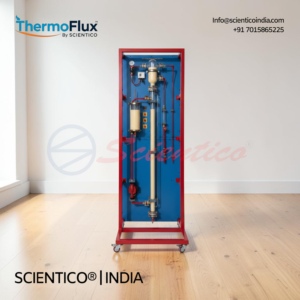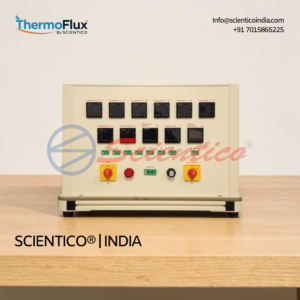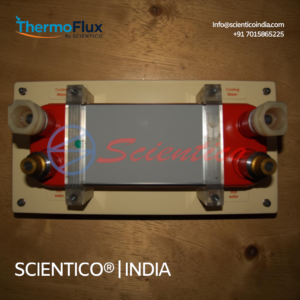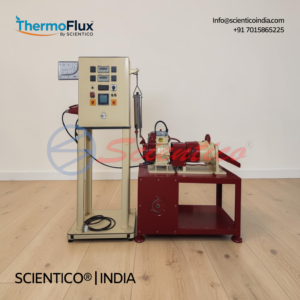

Linear Heat Conduction Module | ThermoFlux – 7049/1
The Linear Heat Conduction Module ThermoFlux – 7049/1 is a laboratory module for one-dimensional heat conduction experiments using an insulated 25 mm brass heated section (100 W) and a water-cooled brass cold section. This linear heat conduction module includes four interchangeable 30 mm test sections in brass (25 mm and 16 mm diameter), stainless steel, and aluminium, with nine thermocouples connected to the Heat Transfer Service Unit for real-time temperature display. Students measure temperature distribution, determine thermal conductivity, analyse composite wall heat transfer, investigate contact resistance, and observe unsteady-state conduction. Thermal paste and hoses are included. Operation requires the Heat Transfer Service Unit ThermoFlux – 7049.
The Linear Heat Conduction Module ThermoFlux – 7049/1 is a laboratory module for the experimental investigation of one-dimensional, steady-state and unsteady-state linear heat conduction through solid materials. This linear heat conduction module uses an insulated brass heated section, a water-cooled brass cold section, and four interchangeable test specimens instrumented with nine thermocouples to enable direct measurement of temperature distribution, thermal conductivity, contact resistance, and the Overall Heat Transfer Coefficient across single and composite material configurations. A 100 W heater provides controlled thermal input, with power measured and controlled by the Heat Transfer Service Unit.
Product Overview
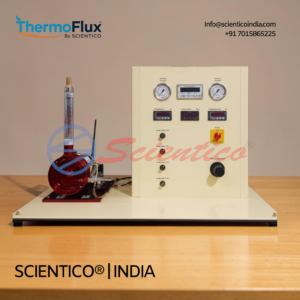
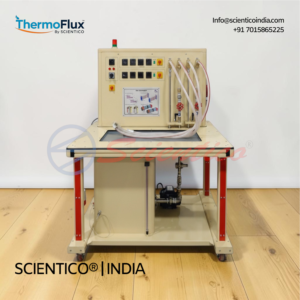
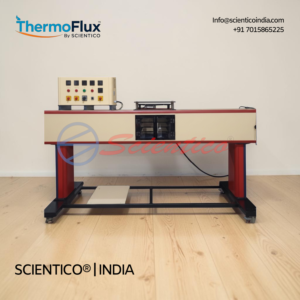
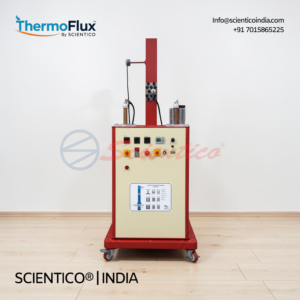
The ThermoFlux – 7049/1 consists of a cylindrical brass heated section and a matching brass cold section, each 25 mm in diameter, mounted on a bench support frame. The heated section contains a 100 W electric heater. The cold section is water-cooled using standard laboratory tap water. Both sections are fitted with three thermocouples at equal intervals along their length, providing six of the nine total measurement points. The remaining thermocouple positions are located in the interchangeable intermediate test sections.
Four interchangeable test sections are supplied, each 25 mm in diameter and 30 mm in length: a brass test section with temperature sensor array, a stainless steel test section, and an aluminium test section. A separate brass test section with a reduced diameter of 16 mm and 30 mm length is also included for cross-sectional area variation experiments. Any intermediate section can be clamped between the heated and cold ends, or the two ends can be clamped directly together. Thermal paste is supplied for interface contact optimisation.
All nine thermocouples connect directly to the Heat Transfer Service Unit, with temperature readings displayed on its digital panel meter. Heater power is controlled and measured through the same unit. This linear heat conduction module supports eight structured experiments covering steady-state and unsteady-state conduction, Fourier Rate Equation application, composite wall analysis, thermal conductivity determination for metals and poor conductors, contact resistance demonstration, cross-sectional area effects, and engineering application exploration.
The module requires the Heat Transfer Service Unit ThermoFlux – 7049 for operation.
Linear Heat Conduction Module ThermoFlux – 7049/1, Technical Specifications
| Parameter | Value |
|---|---|
| Model | ThermoFlux – 7049/1 |
| Heated Section Material | Brass |
| Heated Section Diameter | 25 mm |
| Heater Power | 100 W |
| Cold Section Material | Brass |
| Cold Section Diameter | 25 mm |
| Cold Section Cooling | Water-cooled, laboratory tap water |
| Thermocouples per End Section | 3, at equal intervals |
| Total Thermocouples | 9 |
| Thermocouple Connection | Direct to Heat Transfer Service Unit |
| Temperature Display | Digital panel meter on Heat Transfer Service Unit |
| Brass Test Section Diameter | 16 mm |
| Brass Test Section Length | 30 mm |
| Interchangeable Section Diameter | 25 mm (brass with sensor array, stainless steel, aluminium) |
| Interchangeable Section Length | 30 mm each |
| Mounting | Bench support frame |
| Required for Operation | Heat Transfer Service Unit ThermoFlux – 7049 |
| Scope of Delivery | 1 experimental module, 1 set of hoses, 1 thermal paste, 1 instruction manual |
Technical Data
Heated Section
| Parameter | Value |
|---|---|
| Material | Brass |
| Diameter | 25 mm |
| Heater Power | 100 W |
| Thermocouples | 3, at equal intervals |
| Insulation | Insulated |
Cold Section
| Parameter | Value |
|---|---|
| Material | Brass |
| Diameter | 25 mm |
| Cooling | Water-cooled, laboratory tap water |
| Thermocouples | 3, at equal intervals |
Brass Test Section (Reduced Diameter)
| Parameter | Value |
|---|---|
| Material | Brass |
| Diameter | 16 mm |
| Length | 30 mm |
Interchangeable Test Sections
| Section | Material | Diameter | Length |
|---|---|---|---|
| Brass with temperature sensor array | Brass | 25 mm | 30 mm |
| Stainless steel test section | Stainless steel | 25 mm | 30 mm |
| Aluminium test section | Aluminium | 25 mm | 30 mm |
Key Features
- Heated Section: Insulated brass, 25 mm diameter, 100 W electric heater
- Cold Section: Brass, 25 mm diameter, water-cooled from laboratory tap
- Total Thermocouples: 9, connected directly to Heat Transfer Service Unit for real-time digital display
- Thermocouple Distribution: 3 at equal intervals in heated section, 3 in cold section, with additional positions in interchangeable sections
- Linear Heat Conduction Test Sections: Four interchangeable sections: brass with sensor array (25 mm), stainless steel (25 mm), aluminium (25 mm), and reduced-diameter brass (16 mm), all 30 mm length
- Assembly Options: Intermediate section clamped between heated and cold ends, or ends clamped directly together
- Thermal Paste: Supplied for optimised interface contact
- Heater Power Control: Controlled and measured via Heat Transfer Service Unit
- Mounting: Bench support frame
- Required for Operation: Heat Transfer Service Unit ThermoFlux – 7049/1
Experiments
- Measure the temperature distribution for steady-state conduction of energy through a uniform plane wall and demonstrate the effect of changes in heat flow
- Understand the application of the Fourier Rate Equation to determine the rate of heat flow through solid materials during one-dimensional, steady flow of heat
- Measure the temperature distribution for steady-state conduction of energy through a composite plane wall and determine the Overall Heat Transfer Coefficient for heat flow through a combination of different materials
- Determine the thermal conductivity (k) of a poor thermal conductor
- Demonstrate the effect of contact resistance on thermal conduction between adjacent materials and understand the application of poor thermal conductors
- Determine the thermal conductivity (k) of a metal specimen and demonstrate that the temperature gradient is inversely proportional to the cross-sectional area for one-dimensional heat flow in a solid with constant thermal conductivity
- Observe unsteady-state conduction of heat and analyse the time required to reach stable thermal conditions
- Explore practical implications of thermal conductivity in various materials and their applications in engineering and construction
Construction and Design
The Linear Heat Conduction Module ThermoFlux – 7049/1 is assembled on a bench support frame and built around two primary sections: an insulated brass heated end and a brass cold end, each 25 mm in diameter. The heated end houses a 100 W electric heater with power controlled and measured through the Heat Transfer Service Unit. The cold end is connected to laboratory tap water for continuous cooling. Three thermocouples are embedded at equal intervals along each end section, providing six fixed measurement points across the heated and cooled boundaries.
Four interchangeable intermediate test sections are supplied for use between the two end sections. Three sections share a common 25 mm diameter and 30 mm length: a brass section with an integrated temperature sensor array, a stainless steel section, and an aluminium section. A fourth brass section with a reduced diameter of 16 mm and 30 mm length is included for cross-sectional area experiments. Any section is clamped between the heated and cold ends using the same mounting arrangement. Thermal paste is supplied to minimise contact resistance at interfaces where required by the experiment.
This linear heat conduction module accommodates nine thermocouples in total, all connecting directly to the Heat Transfer Service Unit for real-time digital temperature display. The assembly supports both single-material and composite wall configurations, allowing direct comparison of thermal conductivity across brass, stainless steel, and aluminium, as well as investigation of contact resistance, poor conductors, and unsteady-state thermal behaviour. Operation requires the Heat Transfer Service Unit ThermoFlux – 7049.
Scope of Delivery
- 1 experimental module
- 1 set of hoses
- 1 thermal paste
- 1 instruction manual
Required for Operation
- Heat Transfer Service Unit ThermoFlux – 7049
Q1: What interchangeable test sections are supplied with the ThermoFlux – 7049/1?
Four test sections are supplied. Three share a 25 mm diameter and 30 mm length: a brass section with integrated temperature sensor array, a stainless steel section, and an aluminium section. A fourth brass section with a reduced diameter of 16 mm and 30 mm length is included for cross-sectional area variation experiments.
Q2: How many thermocouples are included and where are they positioned?
Nine thermocouples are included in total. Three are embedded at equal intervals in the heated section and three at equal intervals in the cold section. Additional thermocouple positions are located within the interchangeable test sections. All nine connect directly to the Heat Transfer Service Unit for digital display.
Q3: What experiments does this linear heat conduction module support?
The module supports eight experiments covering steady-state and unsteady-state conduction, Fourier Rate Equation application, composite wall Overall Heat Transfer Coefficient determination, thermal conductivity measurement of metals and poor conductors, contact resistance demonstration, cross-sectional area effects on temperature gradient, and engineering application exploration.
Q4: What is the purpose of the thermal paste supplied with the module?
Thermal paste is used at the clamped interfaces between the heated section, the intermediate test section, and the cold section. It minimises contact resistance at material interfaces, ensuring reliable and repeatable heat flow measurements during conduction experiments.
Q5: Is additional equipment required to operate the ThermoFlux – 7049/1?
Yes. The Heat Transfer Service Unit ThermoFlux – 7049 is required for operation. It controls and measures heater power, connects to all nine thermocouples, and displays temperature readings on its digital panel meter.
Need Assistance? We're Here to Help!
Connect with our team for product specifications, pricing, and customized solutions for your institution or project.