
Aim: To determine the coefficient of discharge (Cd) for a Venturi meter, orifice meter, and rotameter, and to compare their performance characteristics for flow measurement.
Equipment mentioned in this guide
Review the product information, specifications and model before requesting a quotation.
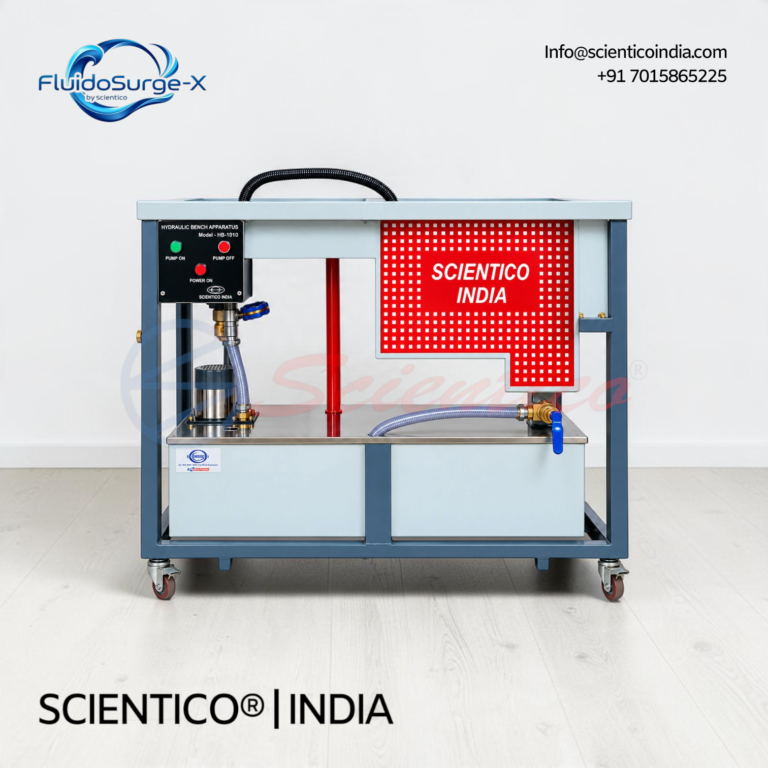
Hydraulic Bench Apparatus | FluidoSurgeX 101
The SCIENTICO FluidoSurgeX 101 Hydraulic Bench Apparatus is a basic supply and measurement unit used in fluid mechanics laboratories. It enables the circulation, measurement, and collection of water for a wide range of experimental modules.The system operates on a closed-loop water circuit consisting of a storage tank, centrifugal pump, and an elevated measuring tank. Volumetric flow rates are determined using stepped measuring tanks and a calibrated measuring beaker, supported by manual stopwatch timing.An integrated work surface with a built-in flume allows experiments involving weirs while ensuring safe placement of accessories and controlled collection of return water.
View product detailsApparatus Required
- Flow Measurement Apparatus (Venturi meter + orifice meter + rotameter mounted in series with hydraulic bench)
- Hydraulic Bench (for reference flow measurement)
- Differential manometer (U-tube or inclined)
- Stopwatch and measuring tank
Theory
Venturi meter: Uses a gradual convergent-divergent section. Flow: Q_actual = Cd × A₁A₂√(2gh) / √(A₁²–A₂²), where h = differential head (m of fluid), A₁ = inlet area, A₂ = throat area, Cd = coefficient of discharge (typically 0.95–0.99 for Venturi, low head loss).
Orifice meter: Sharp-edged orifice plate creates a vena contracta. Same formula as Venturi but Cd = 0.60–0.65 (higher head loss due to abrupt contraction). Simpler and cheaper than Venturi but less accurate.
Rotameter: Variable area flowmeter, float rises in a tapered glass tube as flow increases. Direct reading, no differential pressure measurement needed. Cd is incorporated into the calibration.
Procedure
- Start the hydraulic bench pump. Set flow to maximum. Check manometer connections for air bubbles.
- Record the differential head (h) across the Venturi meter (manometer reading). Measure actual flow rate (Q_actual) using the bench measuring tank and stopwatch.
- Calculate Cd = Q_actual / Q_theoretical.
- Repeat for 5 different flow rates by adjusting the bench flow control valve.
- Repeat steps 2–4 for the orifice meter at the same flow rates.
- Record the rotameter float reading (in L/min) at each flow rate. Compare with bench measurement.
- Plot Q_actual vs √h for Venturi and orifice meters. The slope gives Cd × (A₁A₂/√(A₁²–A₂²)) × √2g.
Frequently Asked Questions
Why is the coefficient of discharge of a Venturi meter higher than an orifice meter?
The Venturi meter has a smooth, gradual convergent-divergent passage that minimises flow separation and energy losses, Cd ≈ 0.95–0.99. The orifice meter creates an abrupt area change, causing significant flow separation and a small vena contracta downstream, Cd ≈ 0.60–0.65. The lower Cd means the orifice meter underestimates the theoretical flow more than the Venturi, but it is cheaper and easier to install.
What is the advantage of a rotameter over Venturi and orifice meters?
A rotameter (variable area meter) gives a direct flow reading without requiring differential pressure measurement or calculations, the float position in the tapered tube directly indicates flow rate. It has low pressure drop, works well for low flow rates, and is transparent (visible float). Disadvantages: must be installed vertically, limited to clean fluids, and less accurate than Venturi at high flow rates.
What is vena contracta in an orifice meter?
Vena contracta is the point of minimum cross-sectional area of the fluid jet downstream of the orifice, where the streamlines converge to their smallest diameter after passing through the sharp-edged orifice. The actual area of flow at vena contracta is less than the orifice area, quantified by the coefficient of contraction Cc. The coefficient of discharge Cd = Cc × Cv, where Cv is the velocity coefficient.
Get Fluid Mechanics Lab Equipment
Scientico India manufactures ISO 9001:2015 and model-specific fluid mechanics lab apparatus. Contact us for specifications and CIF pricing.
Scientico India manufactures this and the full range of Fluid Mechanics Lab equipment, model-specific and supplied to engineering colleges worldwide.
Explore Fluid Mechanics Lab Equipment → or request a quoteOne honest ask
We don't gate anything on this site. You just read the whole thing free. If it was useful, leave your email and two things happen: we send you this page as a plain-text block you can paste into a tender file or an internal email, and we notify you the next time we publish a buyer tool like this one. Nothing else. No drip sequence, no sales calls booked without asking.