
Equipment mentioned in this guide
Review the product information, specifications and model before requesting a quotation.
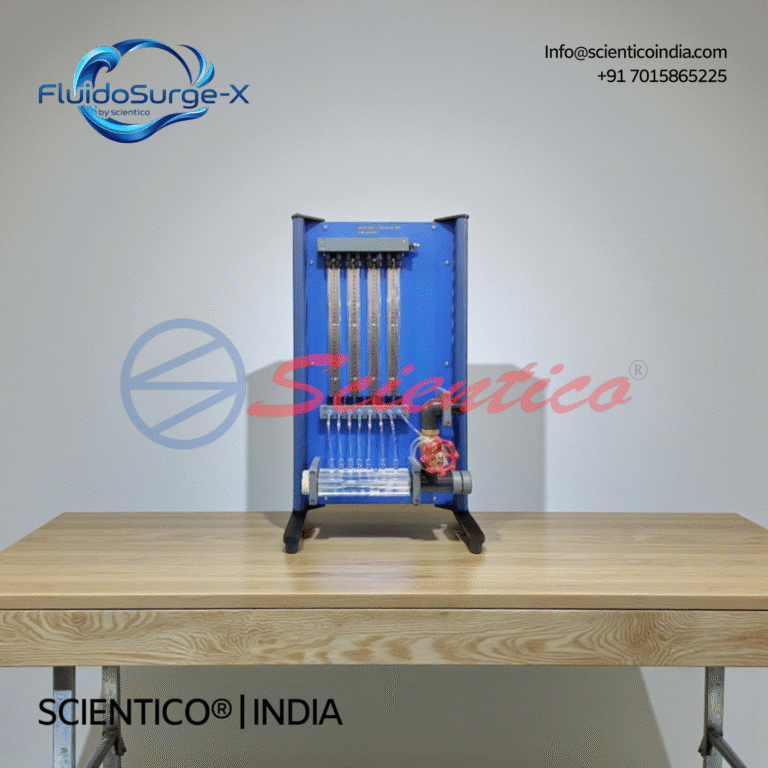
Bernoulli’s Theorem Apparatus | FluidoSurge-X 120
The Bernoulli's Theorem Apparatus FluidoSurge-X 120 is designed for experimental verification of Bernoulli’s principle in fluid mechanics laboratories. It enables detailed study of pressure, velocity, and energy variations along a converging and diverging duct. The apparatus uses a transparent Venturi test section with multiple pressure tapping points. It is intended for structured academic experiments and analytical comparison with theoretical flow behavior.
View product details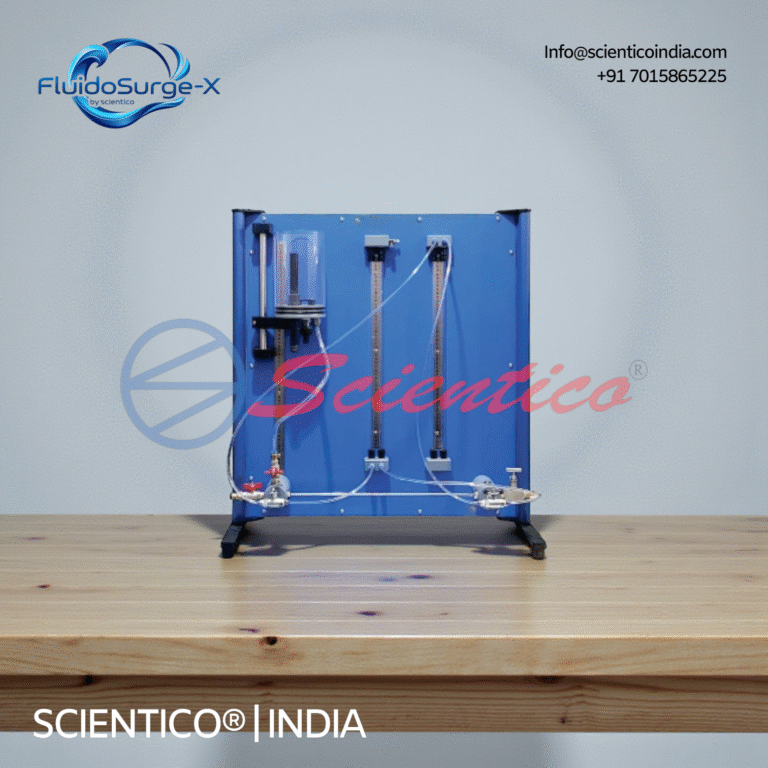
Pipe Friction Apparatus | FluidoSurge-X 168
The Pipe Friction Apparatus FluidoSurge-X 168 is designed for experimental determination of friction losses in pipe flow. It enables study of both laminar and turbulent flow regimes under controlled conditions. The apparatus allows measurement of head loss and determination of critical Reynolds number. It is suitable for fluid mechanics laboratory instruction and experimental analysis.
View product detailsWhat is Laminar Flow?
Laminar flow occurs when fluid moves in smooth, parallel layers with minimal mixing between layers. Each layer slides past adjacent layers without disruption. The fluid velocity is highest at the centre of the pipe and zero at the walls (no-slip condition).
Characteristics of laminar flow:
- Reynolds number Re < 2000
- Smooth, orderly, parallel streamlines
- Low velocity, high viscosity, or small pipe diameter
- Pressure drop proportional to velocity (linear)
- Velocity profile is parabolic
What is Turbulent Flow?
Turbulent flow is characterised by chaotic, irregular fluid motion with significant mixing between layers. Eddies, vortices, and swirls are constantly forming and dissipating.
Characteristics of turbulent flow:
- Reynolds number Re > 4000
- Irregular, chaotic, three-dimensional motion
- High velocity, low viscosity, or large pipe diameter
- Pressure drop proportional to velocity squared (non-linear)
- Flatter velocity profile compared to laminar
Laminar vs Turbulent Flow, Comparison Table
| Parameter | Laminar Flow | Turbulent Flow |
|---|---|---|
| Reynolds Number | Re < 2000 | Re > 4000 |
| Flow Pattern | Smooth, parallel layers | Chaotic, irregular |
| Velocity Profile | Parabolic | Flatter / plug |
| Friction Factor | f = 64/Re | Moody chart / Colebrook equation |
| Mixing | Minimal (molecular diffusion) | Intense (turbulent diffusion) |
| Energy Loss | Lower | Higher |
| Examples | Oil pipelines, blood flow in capillaries | Water supply mains, river flow |
Reynolds Number, The Deciding Factor
The Reynolds number (Re) is a dimensionless number that predicts the flow regime:
Re = ρVD / μ = VD / ν
Where:
- ρ = fluid density (kg/m³)
- V = mean velocity (m/s)
- D = pipe diameter (m)
- μ = dynamic viscosity (Pa·s)
- ν = kinematic viscosity (m²/s)
Transition Flow (2000 < Re < 4000)
Between Re = 2000 and 4000, the flow is in a transitional state, it can switch between laminar and turbulent depending on pipe roughness, entrance conditions, and disturbances. This region is unpredictable and engineers generally avoid designing for it.
Reynolds Number Experiment in the Lab
The Reynolds Number Apparatus demonstrates laminar and turbulent flow visually using a dye injection technique. Students observe:
- At low flow rates (low Re): the dye travels in a straight, unbroken filament, laminar flow
- At high flow rates (high Re): the dye disperses rapidly and mixes, turbulent flow
- The transition regime where the dye filament begins to break up
Practical Examples in Engineering
Laminar flow applications:
- Blood flow in arteries and capillaries (medical engineering)
- Viscous oil flow in pipelines
- Lubrication films in journal bearings
- Microfluidic devices and lab-on-chip systems
Turbulent flow applications:
- Water distribution mains and sewers
- Heat exchangers (turbulence enhances heat transfer)
- Aircraft boundary layer (aerodynamics)
- Mixing tanks in chemical engineering
Friction Factor in Laminar vs Turbulent Flow
For laminar flow: the Darcy-Weisbach friction factor is f = 64/Re (Hagen-Poiseuille equation)
For turbulent flow: f is determined using the Moody chart or the Colebrook-White equation, which accounts for relative pipe roughness.
Lab Equipment Used
Engineering colleges use the following apparatus for studying laminar and turbulent flow:
- Reynolds Number Apparatus, visualises laminar-turbulent transition
- Pipe Friction Apparatus, measures head loss and calculates friction factor
- Bernoulli’s Theorem Apparatus, demonstrates energy conservation in flowing fluids
All Scientico India fluid mechanics apparatus are model-specific and ISO 9001:2015 compliant. Request a quote for your engineering college.
Scientico India manufactures this and the full range of Fluid Mechanics Lab equipment, model-specific and supplied to engineering colleges worldwide.
One honest ask
We don't gate anything on this site. You just read the whole thing free. If it was useful, leave your email and two things happen: we send you this page as a plain-text block you can paste into a tender file or an internal email, and we notify you the next time we publish a buyer tool like this one. Nothing else. No drip sequence, no sales calls booked without asking.