
Equipment mentioned in this guide
Review the product information, specifications and model before requesting a quotation.
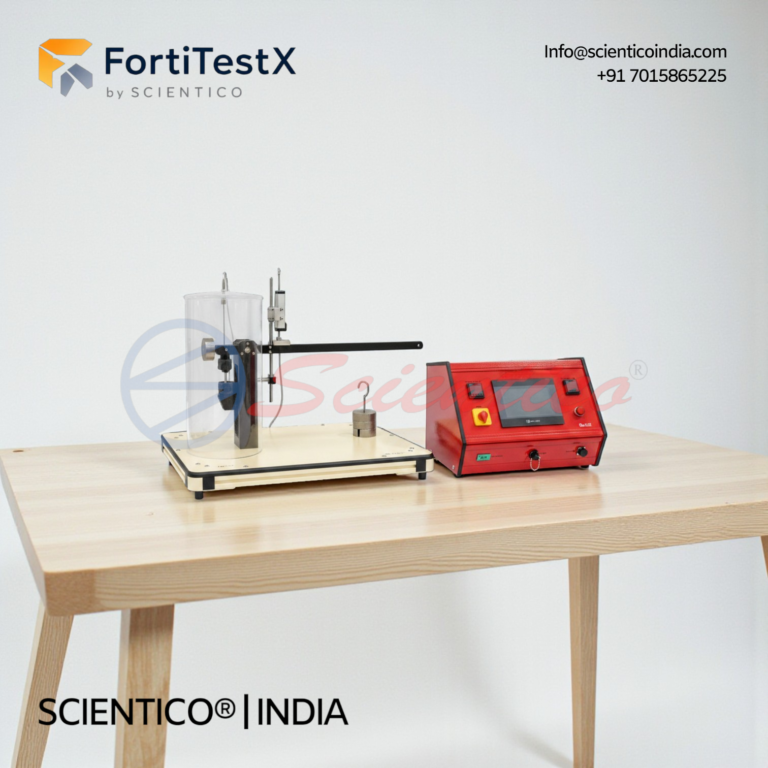
Creep Testing Machine | FortiTestX – 14
Creep Testing Machine FortiTestX 14 is a benchtop strength of materials lab equipment unit designed to demonstrate and investigate the creep behaviour of lead and polypropylene specimens under sustained tensile stress at and below room temperature. This Creep Testing Machine applies load through a transmission lever and dead weight system, measuring specimen displacement via a dial gauge with 0.01 mm resolution across a 0 to 10 mm range. The FortiTestX 14 supports creep rupture testing across a tensile stress range of 2.5 to 35 N/mm², making it a complete creep testing machine strength of materials lab equipment unit for undergraduate engineering and materials science programmes.
View product details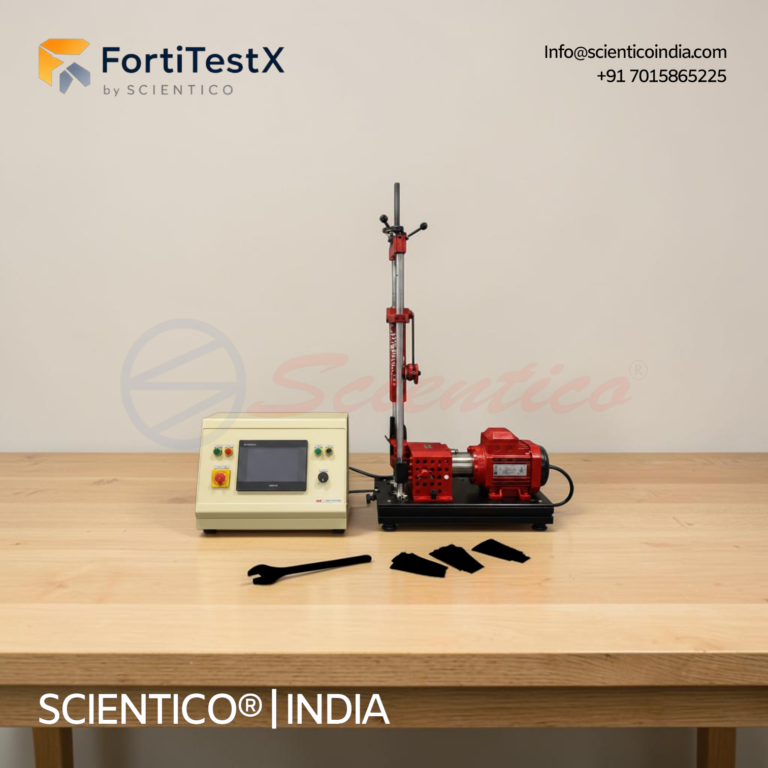
Fatigue Testing Machine | FortiTestX – 22
Fatigue Testing Machine FortiTestX 22 is a benchtop strength of materials lab equipment unit designed for fatigue strength testing of cylindrical metal specimens under cyclic bending load using a rotating cantilever configuration. This Fatigue Testing Machine clamps a revolving metal test bar at one end, applies a controlled point force via a spring balance and moveable plain bearing, and subjects the specimen to a sinusoidal bending stress cycle until fracture, with automatic shutdown triggered by a stop switch integrated into the bearing. The FortiTestX 22 includes an 8-digit electronic load cycle and revolutions counter with contactless inductive speed sensor, making it a complete fatigue testing machine strength of materials lab equipment unit for undergraduate materials testing and failure analysis programmes.
View product detailsWhat is Creep?
Creep is the time-dependent permanent deformation of a material under a constant load at elevated temperature. Unlike elastic deformation, creep continues to increase with time even when the applied stress remains constant. Understanding creep is critical for designing components that operate at high temperatures, such as turbine blades, boiler tubes, and nuclear reactor components.
Aim of the Experiment
- To study the creep behaviour of a material under constant load at elevated temperature
- To plot the creep curve (strain vs time) and identify its three stages
- To determine the steady-state creep rate
- To understand the concept of rupture life
Theory, The Creep Curve
When a constant stress below the yield strength is applied to a material at elevated temperature (typically above 0.3–0.4 Tm, where Tm is the melting point in Kelvin), the material undergoes three distinct stages of creep:
Stage I, Primary Creep
The creep rate starts high and decreases with time due to work hardening. The material strengthens as dislocations accumulate.
Stage II, Secondary (Steady-State) Creep
The creep rate becomes approximately constant. This is the most important stage for engineering design. Work hardening and thermal softening (recovery) reach equilibrium. The steady-state creep rate (ε̇s) follows the empirical power law:
ε̇s = A σⁿ exp(−Q/RT)
Where σ = stress, Q = activation energy, R = gas constant, T = absolute temperature, n and A are material constants.
Stage III, Tertiary Creep
The creep rate accelerates rapidly due to necking, grain boundary cracking, or void formation, leading ultimately to creep rupture (fracture).
Apparatus Required
- Creep testing machine (FortitestX-14) with furnace and PID temperature controller
- Test specimens, lead (Pb) or tin (Sn) wire/rod (suitable for room-temperature creep demonstration), or standard metallic specimens for elevated-temperature tests
- Extensometer or LVDT for strain measurement
- Dead-weight loading system
- Thermocouple and digital temperature indicator
- Stopwatch or automated data logger
Experimental Procedure
- Measure the initial gauge length (L₀) and diameter of the specimen using a Vernier calliper. Record cross-sectional area A₀.
- Mount the specimen in the creep testing machine grips. Set the furnace to the required test temperature.
- Allow the furnace to stabilise at the test temperature for at least 30 minutes before loading.
- Apply the constant load corresponding to the target stress (σ = W/A₀). Note the time as t = 0.
- Record strain (extension/L₀) at fixed time intervals: every 1 minute for the first 10 minutes, then every 5 minutes until the test ends.
- Continue until the specimen fractures (creep rupture) or until steady-state is clearly established.
- After the test, remove the specimen and measure the final gauge length and diameter to calculate ductility.
Note: Lead specimens at room temperature exhibit creep because room temperature is approximately 0.52 Tm for lead, making it ideal for laboratory demonstration without a furnace.
Observation Table
| Time (min) | Dial Gauge / LVDT Reading (mm) | Extension ΔL (mm) | Creep Strain ε = ΔL/L₀ | Creep Rate (per min) |
|---|---|---|---|---|
| 0 | 0 | 0 | 0 | – |
| 1 | ||||
| 5 | ||||
| 10 | ||||
| 20 | ||||
| 30 | ||||
| Rupture | – |
Graph, Creep Curve
Plot Creep Strain (ε) on the Y-axis against Time (t) on the X-axis. The resulting S-shaped curve should show:
- Initial elastic strain at t = 0 (instantaneous on load application)
- Primary region: decreasing slope (t = 0 to end of Stage I)
- Secondary region: constant slope (linear portion, this is ε̇s)
- Tertiary region: increasing slope leading to fracture point
The steady-state creep rate ε̇s is the slope of the linear (secondary) portion of the creep curve.
Results
- Steady-state creep rate ε̇s = ___ per minute
- Rupture time tr = ___ minutes
- Fracture strain = ___
- Reduction in area = ____%
Precautions
- Allow temperature to fully stabilise before applying load.
- Apply the load smoothly without impact to avoid initial plastic strain.
- Ensure thermocouple is in contact with the specimen gauge length.
- Handle lead specimens with care and wash hands after the experiment.
Scientico India manufactures this and the full range of Strength of Materials equipment, model-specific and supplied to engineering colleges worldwide.
Explore Strength of Materials Equipment → or request a quote