
Equipment mentioned in this guide
Review the product information, specifications and model before requesting a quotation.

Four Bar Chain Apparatus | ProDynami 1240
The Four Bar Chain Apparatus ProDynami 1240 is a benchtop unit that converts rotary motion into oscillatory motion using a four bar chain model. This four bar chain apparatus is designed to investigate the kinematic behaviour of four bar chain mechanisms and to check the Grashof set.
View product details
Whitworth Quick Return Apparatus | ProDynami 1244
The Whitworth Quick Return Apparatus ProDynami 1244 is a benchtop model used to produce and analyze irregular reciprocating motion with slow feed and quick return. This Whitworth Quick Return Apparatus clearly demonstrates the transmission pattern of such an assembly, with the input angle set by turning the crank and the output stroke read on a ruler on the slider.
View product details
Geneva Mechanism Apparatus | ProDynami – 1292
The Geneva Mechanism Apparatus ProDynami - 1292 demonstrates the Geneva drive, or Maltese cross, a gear mechanism that translates continuous rotation into intermittent rotary motion. This Geneva Mechanism apparatus uses a rotating drive wheel with a pin that reaches into a slot of the driven wheel, advancing it by one step. A raised circular blocking disc locks the driven wheel in position between steps.
View product details
Ratchet Mechanism | ProDynami 1374
The Ratchet Mechanism ProDynami 1374 demonstrates how ratchets limit rotary or linear motion to only one direction. This Ratchet Mechanism transmits intermittent rotary motion or permits a shaft to rotate in one direction but not in the opposite one.
View product details
Slotted Link Apparatus | ProDynami 1236
The Slotted Link Apparatus ProDynami 1236 is designed to demonstrate the concept and working principle of pure simple harmonic motion. As the crank rotates, it drives the bar in an oscillating manner. This Slotted Link Apparatus demonstrates the same mechanism observed in piston and crankshaft motion in an engine.
View product details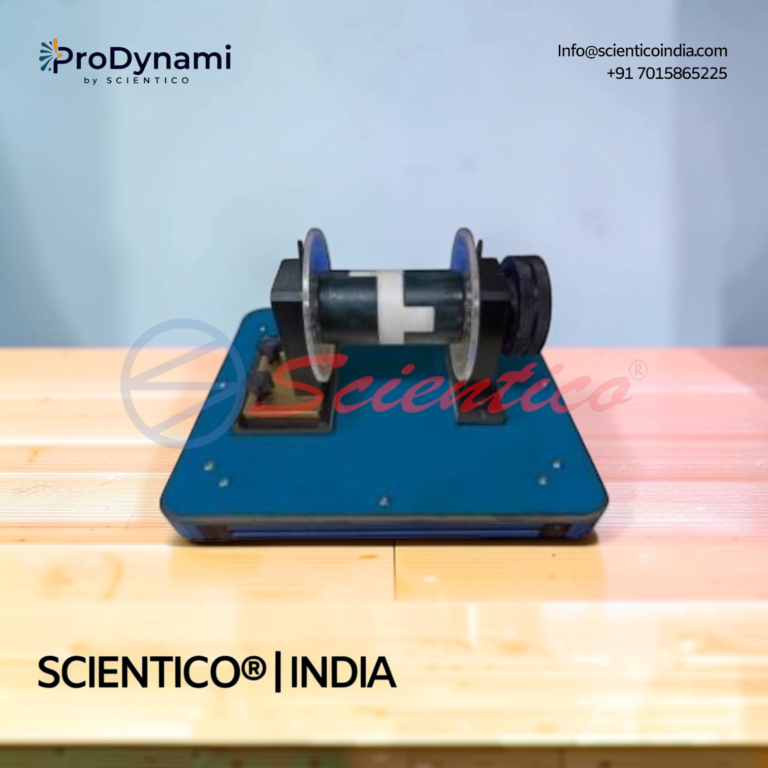
Oldham Coupling | ProDynami – 1342
The Oldham Coupling ProDynami - 1342 is a device used to connect two shafts together at their ends for the purpose of transmitting power. This Oldham Coupling has three discs: one coupled to the input, one coupled to the output, and a middle disc joined to the first two by tongue and groove. It permits some degree of misalignment or end movement while maintaining constant velocity transmission.
View product detailsMechanical engineering lab equipment made in Ambala, not resold
If you are looking for a mechanical engineering lab equipment manufacturer in India, the useful question is what you can actually buy from one works under one purchase order. For the mechanical lab that means the theory of machines bench, the friction and statics bench and the vibration bench. Scientico makes all three ranges ourselves.
Scientico has built laboratory and engineering teaching equipment at its own works in Ambala, Haryana since 1993. We are ISO 9001:2015 certified, we export to more than 60 countries, and the current catalogue carries over 370 products. Each apparatus is supplied with a calibration certificate and an operation manual.
This page is written for a lab in-charge or purchase officer who has a syllabus practical list and needs to match it to real apparatus, and for a dealer who needs a manufacturer behind a bid. Every item below links to its product page with the specification, the experiments it supports and a datasheet you can download.
Mechanisms and linkages
These are the models students move by hand to see how a mechanism converts one motion into another. They are the core of a kinematics practical and they are cheap to stock in numbers, which matters when a batch of 30 students shares a lab.
- Four Bar Chain Apparatus
- Whitworth Quick Return Apparatus
- Geneva Mechanism Apparatus
- Ratchet Mechanism
- Slotted Link Apparatus
- Oldham Coupling
- Hooke’s Coupling Apparatus
- Cam and Follower Apparatus
- Ackerman Steering Apparatus
- Velocity Joint Apparatus
Gears and drives
Gear and drive apparatus covers simple trains, epicyclic sets, worm drives and belt drives. The epicyclic and differential units are the ones most often missing from an older lab and most often asked about in a syllabus review.
- Gear Train Model
- Gear Trainer Demonstrator Apparatus
- Gearbox Apparatus
- Geared System Apparatus
- Double Epicyclic Gear Apparatus
- Three Stage Epicyclic Gear
- Worm And Wheel Apparatus
- Rack and Pinion
- Differential-Crownwheel & Pinion
- Belt Drive Mechanism
- Lathe Gear
- Assembly Unit Combined Drives
Governors, flywheels, balancing and gyroscopic effects
This group is the dynamics of rotating machinery. Governor and flywheel apparatus show speed regulation. The balancing rig and the whirling of shaft rig show what happens when rotating parts are not balanced. The gyroscope and the centrifugal and Coriolis units cover the forces students otherwise only meet in equations.
- Governor Apparatus
- Flywheel Apparatus
- Static and Dynamic Balancing
- Gyroscope Apparatus
- Centrifugal Force Apparatus
- Coriolis Force Apparatus
- Conservation of Angular Momentum Apparatus
- Whirling of Shaft
- Inertia In Rotational Motion Apparatus
Friction and brakes
Friction apparatus is the busiest bench in most first and second year labs. The range runs from dry and inclined plane friction through belt, drum, pivot and journal bearing units, to clutch plate and disc brake models.
- Dry Friction Apparatus
- Friction on Inclined Plane Apparatus
- Belt and Cord Friction Apparatus
- Drum Friction Apparatus
- Pivot Friction Apparatus
- Bearing Friction Apparatus
- Journal Bearing Friction Apparatus
- Clutch Plate Friction Apparatus
- Disc Brake Apparatus
Vibration
Vibration is where a lab shows its age. Free and damped vibration, torsional systems and bifilar and trifilar suspension are standard practicals, and for programmes that teach condition monitoring there is a computerised vibration analyser and a machinery diagnostic base unit.
- Universal Vibration Apparatus
- Free and Damped Torsional Vibration Apparatus
- Bifilar & Trifilar Apparatus
- Compound Pendulum Apparatus
- Spring Mass Vibration System
- Vibration Test Rig
- Computerized Vibration Analyzer
- Base Unit for Machinery Diagnostic System
Statics and structures
- Forces in a Jib Crane Apparatus
- Forces in Truss Apparatus
- Roof Truss Apparatus
- Pin-Jointed Frameworks Apparatus
- Equilibrium of Parallel Forces Apparatus
- Centre of Gravity Apparatus
- Two Arm Lever Apparatus
- Screw Jack Apparatus
- Winch Apparatus
How to build the list for your lab
Start from the practicals your university lists, not from a catalogue. Our B.Tech mechanical lab equipment list and the guide to choosing theory of machines equipment map practicals to apparatus. The theory of machines setup guide shows a full bench layout. For the strength side of the same lab, see our material testing machines, and for fluids the fluid mechanics lab equipment.
One point of honesty. This is teaching and training grade equipment for instruction and demonstration. We are not a NABL accredited calibration or testing laboratory, and we do not present ourselves as one. If you need third party certification of materials or measurements, tell us early so nobody wastes a quotation cycle.
What to send us to get a quotation
A quotation is fastest when we can see the real requirement. Send us the apparatus names or the syllabus practical list, the quantity of each, the destination country or state, whether you need a full lab or a few items, and any tender clause numbers you have to comply with. If you are answering a tender, add the closing date so we can prioritise the paperwork.
We do not publish prices for mechanical lab equipment. Cost depends on the model, quantity, options and destination, so every quotation is prepared against your list. You can start on the contact page, message us on WhatsApp on +91 7015865225, or call the same number.
Tender and export paperwork
Institutions buying through a tender usually need more than a price. We can supply a tender compliance matrix against your specification, and a manufacturer authorisation letter for bidders who need one, explained in our guide to the Manufacturer Authorisation Form. For overseas orders, our guide on importing lab equipment from India covers the steps, and the supplier evaluation checklist shows what a careful buyer should ask any supplier, including us.
Dealers and trading houses who want to represent our range in their territory can start on the distributor page.
Frequently asked questions
Do you supply a complete mechanical engineering lab, or only single items?
Both. We can quote a single apparatus, a bench such as theory of machines, or a full lab built from your practical list. Sending the list is the quickest way to get a complete quotation.
Are you a manufacturer or a trader?
We build the apparatus at our own works in Ambala, Haryana. That is why we can adjust to a specification and issue our own calibration certificate and manual with each unit.
Can you export mechanical lab equipment to my country?
We have supplied to more than 60 countries. Tell us the destination and we will confirm the shipping terms and export documents in the quotation.
Do you publish prices?
No. Pricing depends on the model, quantity, options and destination, so we quote against your list.
See the full range by discipline on our engineering training equipment manufacturers page.
For other disciplines, see our engineering laboratory equipment manufacturer and supplier page.
One honest ask
This article and public product information are available to browse without an account. To open a product datasheet, complete the contact form shown with its download link. If this article was useful, leave your email and two things happen: we send you this page as a plain-text block you can paste into a tender file or an internal email, and we notify you the next time we publish a buyer tool like this one. Nothing else. No drip sequence, no sales calls booked without asking.