
Choose refrigeration and air-conditioning training equipment from the practical outcome students must complete. A unit for observing a basic compression cycle, an instrumented system for capacity calculations, a psychrometric air-conditioning bench and an electrical fault simulator solve different teaching problems. This guide maps those outcomes to current Scientico product records so a department can shortlist models before requesting a technical offer.
Equipment mentioned in this guide
Review the product information, specifications and model before requesting a quotation.
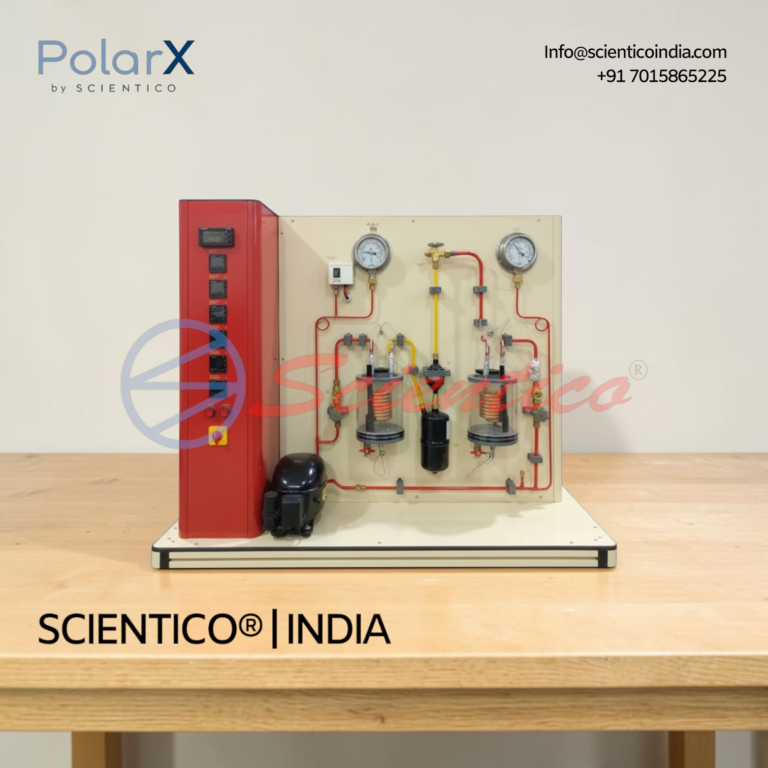
Simple Compression Refrigeration | PolarX – 501
The Simple Compression Refrigeration PolarX - 501 is a bench-top laboratory unit designed to demonstrate the fundamentals of a compression refrigeration cycle using a piston compressor, thermostatic expansion valve, pipe coil evaporator, and pipe coil condenser. This simple compression refrigeration unit uses CFC-free refrigerant R134a, includes two water-filled tanks with temperature sensors to simulate the environment, and is fully instrumented with pressure gauges, six K-type temperature sensors, a sight glass, and a digital multifunctional power meter for comprehensive refrigeration cycle analysis.
View product details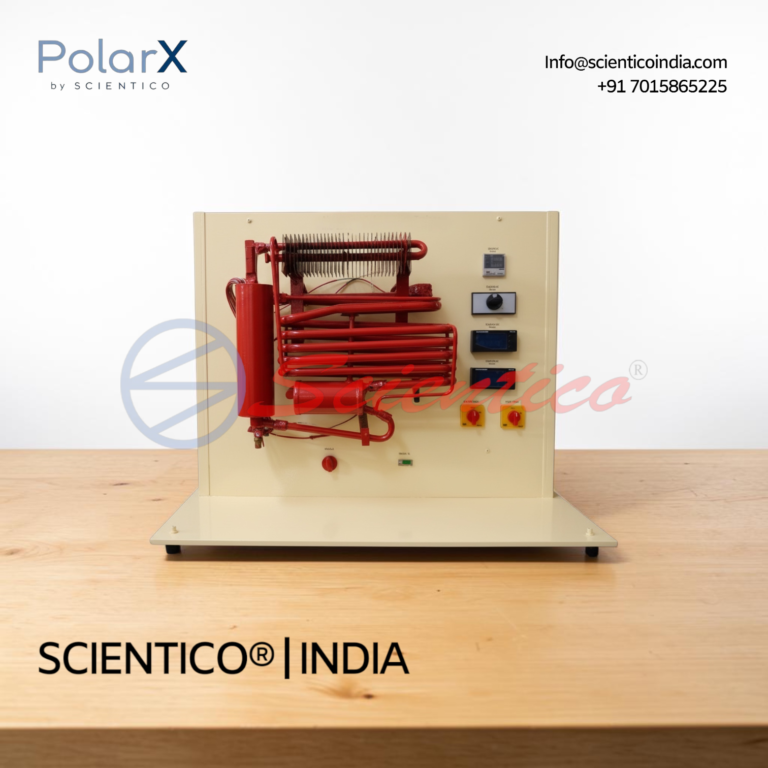
Absorption Refrigeration Trainer | PolarX – 504
The Absorption Refrigeration Trainer PolarX - 504 is a laboratory unit designed to demonstrate the fundamental operation of an absorption refrigeration system using an ammonia-water solution as the working medium and hydrogen as an auxiliary gas. This absorption refrigeration trainer includes an evaporator, absorber, boiler with bubble pump, and condenser as its primary components, with an adjustable electric heater at the evaporator as the cooling load and digital displays for temperature and power measurement across the refrigeration circuit.
View product details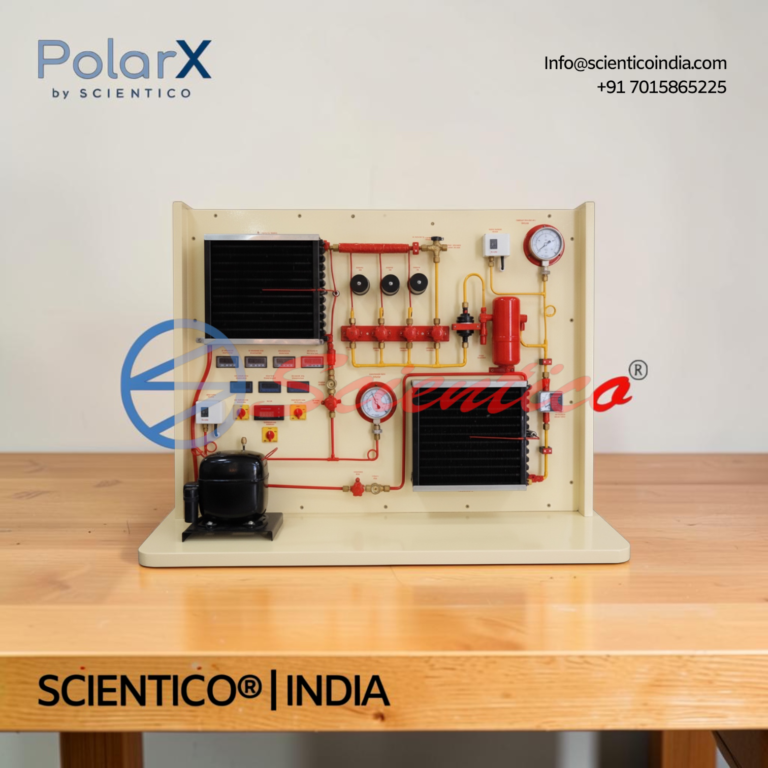
Refrigeration Cycle Demonstration Unit | PolarX – 516
The Refrigeration Cycle Demonstration Unit PolarX - 516 consists of a hermetic compressor, condenser, evaporator, and expansion element built for investigating refrigeration circuit behavior. This refrigeration cycle demonstration unit uses finned tube heat exchangers for both the evaporator and condenser. Three capillary tubes of different lengths and a thermostatic expansion valve allow direct comparison of expansion elements.
View product details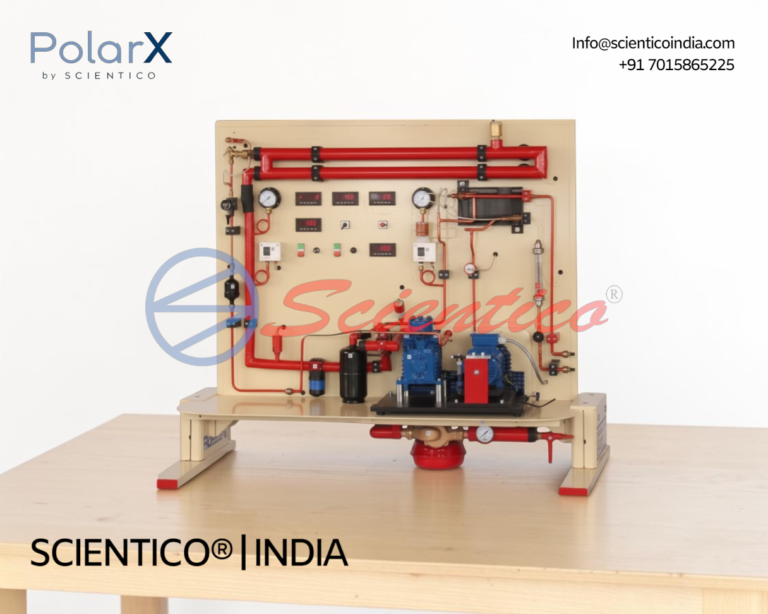
Refrigeration System with Open Compressor | PolarX – 520
The Refrigeration System with Open Compressor PolarX - 520 is a trainer designed to make the thermodynamic processes in a refrigeration system as transparent as possible. The capacities of the compressor, evaporator, and condenser can all be measured directly. Pressure and temperature measuring points are located at all relevant locations, allowing detailed investigation of pressure and heat losses in the system.
View product details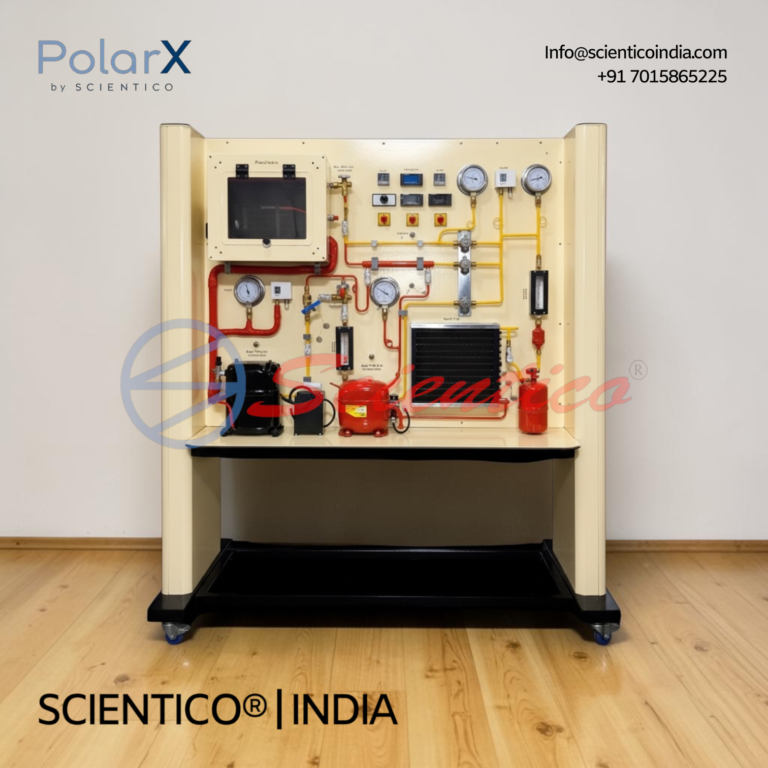
Refrigeration System with Two-Stage Compression | PolarX – 532
The Refrigeration System with Two-Stage Compression PolarX - 532 is designed for the generation of particularly low temperatures. This Refrigeration System with Two-Stage Compression links two compressors in series, each operating at a low pressure ratio, to overcome the drop in volumetric efficiency that occurs at high pressure ratios.
View product details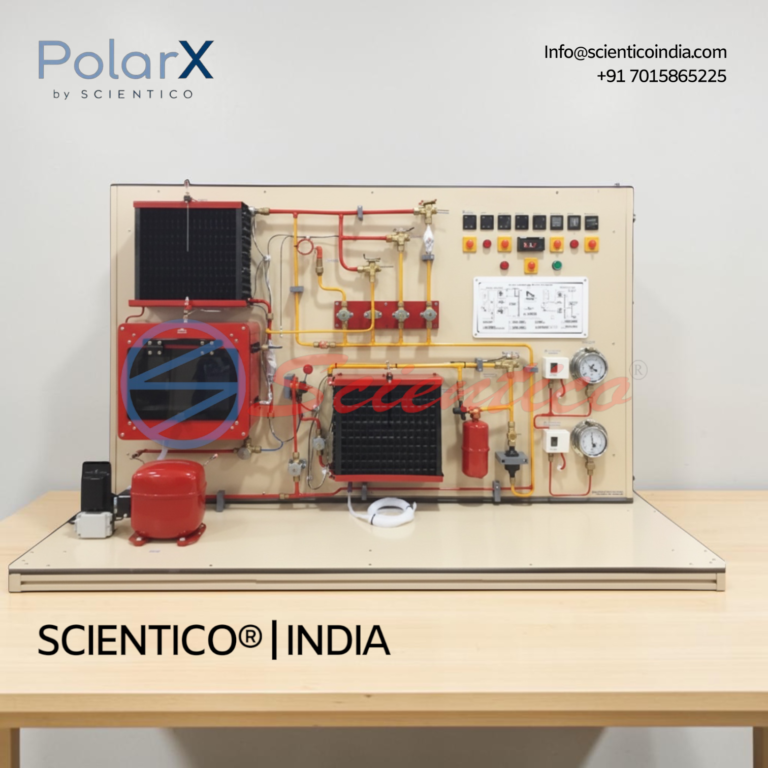
Reverse Cycle Refrigeration & AC Training Unit | PolarX – 536
The Reverse Cycle Refrigeration & AC Training Unit PolarX - 536 operates two evaporators on a single compressor using an evaporator pressure regulator. This Reverse Cycle Refrigeration & AC Training Unit demonstrates both refrigeration and air conditioning concepts in a single apparatus.
View product detailsFive questions that narrow the shortlist
- Which process must students observe? Separate simple compression, absorption, two-stage compression, reverse-cycle operation and air-conditioning processes before comparing models.
- Which measurements must they record? Mark pressure, temperature, flow, electrical power, torque, humidity and air-flow requirements against each practical. Only request a variable when the experiment uses it.
- Is the purpose demonstration, analysis or service diagnosis? A visible cycle bench, an instrumented performance unit and a fault-simulation panel should not be evaluated as interchangeable equipment.
- Is a fixed or modular arrangement required? A self-contained model simplifies a single practical. A base unit with interchangeable models supports a different teaching workflow and must be quoted with the required model modules.
- Which digital functions are required? Some current records list optional data acquisition or optional fault functions. Mark optional items explicitly so they are not assumed to be part of the standard supplied scope.
Scientico refrigeration and AC trainer selection matrix
Every model-specific statement below comes from the linked live Scientico product record reviewed for this guide. The matrix is for shortlisting, not a substitute for a current quotation or datasheet.
| Teaching requirement | Model to review | Evidence on the current product record |
|---|---|---|
| Fundamentals of a simple compression cycle | Simple Compression Refrigeration PolarX-501 | Bench-top piston-compressor circuit with a thermostatic expansion valve, pipe-coil evaporator and condenser, R134a, pressure gauges, six K-type temperature sensors, sight glass and power meter. The evaporator and condenser coils sit in separate water-filled tanks. |
| Absorption refrigeration principle | Absorption Refrigeration Trainer PolarX-504 | Ammonia-water working medium with hydrogen as auxiliary gas; evaporator, absorber, boiler with bubble pump and condenser. The record lists adjustable boiler and evaporator heaters, four K-type temperature sensors and power measurement. |
| Compare expansion elements and refrigerant charge effects | Refrigeration Cycle Demonstration Unit PolarX-516 | Three capillary tubes of different lengths plus a thermostatic expansion valve. A receiver allows refrigerant to be added or removed to study overfilling and underfilling; the unit measures refrigerant flow, temperature, pressure and compressor electrical usage. |
| Measure component capacities and compressor drive behaviour | Refrigeration System with Open Compressor PolarX-520 | Variable-speed open compressor, water-cooled condenser, thermostatic expansion valve and hot-water-heated evaporator. The record lists drive-torque measurement, calculation of mechanical drive power and capacity measurement for compressor, evaporator and condenser. |
| Investigate two-stage compression and intercooling | Two-Stage Compression PolarX-532 | Two compressors in series with injection intercooling. Valves can switch refrigerant supercooling and injection intercooling off; sensors record relevant values and two flow meters show intercooling and total volumetric flow. |
| Combine refrigeration, air conditioning and reverse-cycle operation | Reverse Cycle Refrigeration & AC Unit PolarX-536 | Two evaporators on one compressor, an evaporator pressure regulator, air- and water-cooled condensers, four listed flow-control choices and a solenoid reversing valve. The front control box includes overload and earth-leakage protection. |
| Teach automotive air-conditioning operation | Automotive Air Conditioning Trainer PolarX-544 | Recirculating-air arrangement with automotive-style vents, a three-stage evaporator fan and 12 VDC automotive supply. Compressor speed is variable through an electric-motor drive and frequency converter; eight connectable faults are listed as optional. |
| Study individual air-conditioning processes and psychrometrics | Air Conditioning Lab Unit PolarX-556 | Open duct with air cooler, steam humidifier, fan, air preheater and reheater that can be switched individually. Sensors before and after each stage record air temperature and humidity, with refrigerant pressure and temperature also measured. |
| Study recirculated air, mixed flows and climatic loads | Recirculating Air Conditioner Trainer PolarX-560 | Transparent air duct and climate chamber with air cooler, condensing unit, fan, steam humidifier and air heater. Three motorised ventilation flaps manage distribution; wet and dry loads, temperature, relative humidity, refrigeration pressure, temperature and flow are listed. |
| Diagnose compressor electrical faults | Refrigeration Compressor Fault Simulator PolarX-572 | Real compressor with visible, wired start and protection components. The record lists simulated motor-coil fracture, operational-capacitor short circuit and welded start-relay contacts; a multimeter is required but not provided. |
| Build a modular hardware-software course | Refrigeration & AC Training System Base Unit PolarX-584 | Base compressor, condenser and receiver accept model modules through self-sealing refrigerant couplings and electrical cables. USB or LAN connection, system-operation/data-acquisition software and model-specific educational modules are listed. |
| Study commercial refrigeration components and service connections | Commercial Refrigeration Training Unit PolarX-604 | Air-cooled condensing unit with hermetic compressor, suction and discharge service valves and gauge-manifold connections. The listed forced-air evaporator has a removable panel, thermal load, thermostatic expansion valve and high/low pressure controls and gauges. |
Three practical decision routes
For cycle fundamentals
Begin with PolarX-501 when the requirement is a simplified compression circuit. Review PolarX-516 when the practical must compare expansion devices or refrigerant charge conditions. Review PolarX-504 when the named outcome is absorption refrigeration.
For deeper thermodynamic analysis
Review PolarX-520 when direct component-capacity and mechanical-drive measurements are needed. Review PolarX-532 for two-stage compression and intercooling. Review PolarX-536 where two evaporators, multiple flow controls and reverse-cycle operation are central to the practical.
For HVAC, service or vocational work
Review PolarX-556 or PolarX-560 for air treatment and humidity work, PolarX-544 for automotive context, PolarX-572 for compressor electrical diagnosis, PolarX-584 for a modular course, and PolarX-604 for commercial components and service connections.
Plan an experiment-to-equipment schedule
Create one row per required practical. Add columns for the cycle or process, variables students must change, measurements they must record, calculations or charts they must complete, required model, options, utilities and acceptance evidence. This exposes duplicate purchases and missing capabilities before quotations are compared.
For procedure and calculation intent, use the refrigeration and air-conditioning lab experiment guide. For the difference between the two core refrigeration principles, read the vapour-compression versus absorption trainer comparison. Those articles answer learning questions; this page owns equipment-selection intent.
Copy this refrigeration and AC trainer RFQ checklist
- Programme, course, student level and the applicable syllabus or BOQ
- Required practicals and the result, calculation or chart expected from each
- Cycle or application: compression, absorption, two-stage, reverse-cycle, automotive, psychrometric, diagnostic or commercial
- Required adjustable variables and measurement points
- Required fixed model, self-contained unit or modular base-and-model arrangement
- Mandatory data acquisition, software, interface and computer requirements
- Fault simulation requirement and whether it must be standard or may be optional
- Electrical supply, water, drainage, ventilation and other available services
- Number of units, students per group and available laboratory space
- Required manuals, experiment material, installation, commissioning and training
- Destination, delivery term and tender deadline
- Line-by-line compliance response, options, exclusions and deviations
Use the broader laboratory equipment RFQ checklist to add commercial, documentation and acceptance requirements.
Configuration note: This guide reflects information published on the linked Scientico product records when reviewed. Confirm refrigerant, utilities, measurement ranges, software, optional functions, supplied accessories, documentation and commercial terms in the current written quotation.
Browse the complete refrigeration and air-conditioning equipment category for additional models.