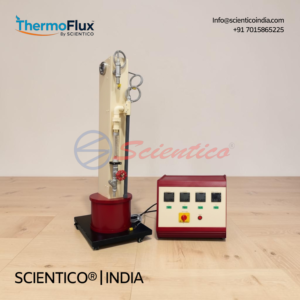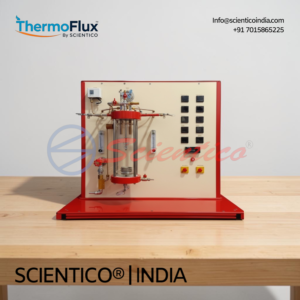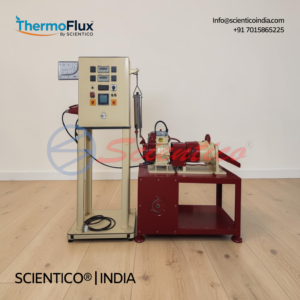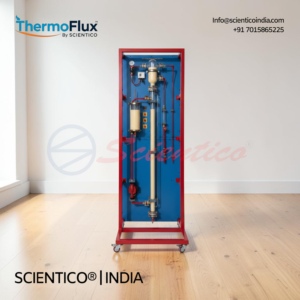

Extended Surface Heat Transfer Module | ThermoFlux – 7049/4
The Extended Surface Heat Transfer Module ThermoFlux – 7049/4 is a laboratory module for studying temperature distribution and heat loss along a cylindrical brass pin fin. This extended surface heat transfer module provides a 10 mm diameter, 350 mm long brass rod with 9 thermocouple positions and a 100 W base heater. Students measure the full axial temperature profile, determine the thermal conductivity of the rod material, and calculate combined free convection and radiation heat transfer, comparing all results against analytical fin theory. Operation requires the Heat Transfer Service Unit ThermoFlux – 7049.
The Extended Surface Heat Transfer Module ThermoFlux – 7049/4 is a laboratory module for investigating temperature distribution and heat transfer along a cylindrical pin fin under combined free convection and radiation conditions. This extended surface heat transfer module uses a 350 mm brass pin fin with 9 thermocouple positions and a 100 W heater to enable direct measurement and comparison with theoretical fin analysis. Students determine thermal conductivity of the rod material and calculate combined convective and radiative heat transfer from the fin surface.
Product Overview
The ThermoFlux – 7049/4 centres on a cylindrical brass pin fin element, 10 mm in diameter and 350 mm in length, instrumented with 9 thermocouple positions along its length. The fin is heated at its base by a 100 W heater. Temperature readings at each of the 9 positions along the rod allow students to plot the full axial temperature distribution and compare measured profiles directly against theoretical predictions from analytical fin equations.
Extended surfaces, commonly referred to as fins, transfer heat from a body by combining conduction within the solid with convection and radiation from its outer surface to the surrounding environment. Pin fins, characterised by a high length-to-diameter aspect ratio, are widely used in cooling systems for electrical appliances such as computer power supplies and substation transformers, as well as in engine cooling applications. The ThermoFlux – 7049/4 replicates this configuration at laboratory scale for structured experimental analysis.
Three core experiments are supported: measurement of axial temperature distribution with theoretical comparison, determination of thermal conductivity of the brass rod material, and calculation of combined free convection and radiation heat transfer from the extended surface with comparison to theoretical predictions.
The module requires the Heat Transfer Service Unit ThermoFlux – 7049 for operation.
Extended Surface Heat Transfer Module ThermoFlux – 7049/4, Technical Specifications
| Parameter | Value |
|---|---|
| Model | ThermoFlux – 7049/4 |
| Pin Fin Element Shape | Cylindrical pin fin |
| Pin Fin Material | Brass |
| Pin Fin Diameter | 10 mm |
| Pin Fin Length | 350 mm |
| Thermocouple Positions | 9 |
| Heater Power | 100 W |
| Heat Transfer Modes | Free convection and radiation |
| Required for Operation | Heat Transfer Service Unit ThermoFlux – 7049 |
| Scope of Delivery | 1 experimental module, 1 instruction manual |
Technical Data
Cylindrical Pin Fin Element
| Parameter | Value |
|---|---|
| Shape | Cylindrical pin fin |
| Material | Brass |
| Diameter | 10 mm |
| Length | 350 mm |
| Thermocouple Positions | 9 |
Heater
| Parameter | Value |
|---|---|
| Power Rating | 100 W |
| Location | Base of pin fin element |
Key Features
- Pin Fin Element: Brass, cylindrical, 10 mm diameter, 350 mm length
- Thermocouple Positions: 9 positions along the rod length for full axial temperature profile
- Heater: 100 W base heater for controlled thermal input
- Extended Surface Heat Transfer Analysis: Combined free convection and radiation from fin surface
- Measurable Parameters: Axial temperature distribution, thermal conductivity of rod material, combined convective and radiative heat loss
- Theoretical Comparison: Measured results compared directly against analytical fin theory predictions
- Required for Operation: Heat Transfer Service Unit ThermoFlux – 7049/4
Experiments
- Measure the temperature distribution along an extended surface and compare results with theoretical analysis
- Determine the constant of proportionality (thermal conductivity, k) for the brass rod material
- Calculate the heat transfer from an extended surface due to the combined effects of free convection and radiation heat transfer, and compare results with theoretical predictions
Construction and Design
The Extended Surface Heat Transfer Module ThermoFlux – 7049/4 is built around a single cylindrical brass pin fin, 10 mm in diameter and 350 mm in length, mounted for horizontal or vertical exposure to the surrounding laboratory environment. Nine thermocouple positions are distributed along the rod length, providing a detailed axial temperature profile from the heated base to the fin tip. A 100 W heater is fitted at the base of the pin fin to supply a controlled, steady thermal input.
This extended surface heat transfer module replicates the operating principle of real-world pin fin cooling systems: heat conducts along the brass rod from the base while free convection and radiation simultaneously transfer energy from the outer surface to the surrounding air. The 9-point thermocouple array allows students to construct a complete measured temperature distribution curve. This measured profile is then compared to the distribution predicted by standard analytical fin equations, enabling direct quantitative validation of theory.
The module connects to and is powered through the Heat Transfer Service Unit ThermoFlux – 7049/4, which provides instrumentation, power supply, and data display for the module.
Scope of Delivery
- 1 experimental module
- 1 instruction manual
Required for Operation
- Heat Transfer Service Unit ThermoFlux – 7049
Q1: What is the pin fin element made of and what are its dimensions?
The pin fin element is a cylindrical brass rod, 10 mm in diameter and 350 mm in length. It has 9 thermocouple positions distributed along its length for axial temperature measurement.
Q2: What heat transfer modes does this extended surface heat transfer module investigate?
The module covers combined free convection and radiation from the outer surface of the brass pin fin to the surrounding environment. Conduction along the rod length is also analysed through the measured axial temperature distribution.
Q3: What can students determine from the temperature distribution measurements?
Students can determine the thermal conductivity (k) of the brass rod material and calculate the total heat transfer from the extended surface due to combined free convection and radiation. Both sets of results are compared against theoretical analytical predictions.
Q4: Is additional equipment required to operate the ThermoFlux – 7049/4?
Yes. The Heat Transfer Service Unit ThermoFlux – 7049 is required for operation. It provides the power supply, instrumentation, and display functions necessary to run the module.
Q5: How many temperature measurement points are available along the pin fin?
Nine thermocouple positions are built into the brass rod, providing a detailed axial temperature profile from the heated base to the tip of the 350 mm fin.
Need Assistance? We're Here to Help!
Connect with our team for product specifications, pricing, and customized solutions for your institution or project.