
Aim: To determine the friction factor (f) for turbulent flow in a pipe using the Darcy-Weisbach equation and verify the relationship between friction head loss and velocity of flow.
Equipment mentioned in this guide
Review the product information, specifications and model before requesting a quotation.
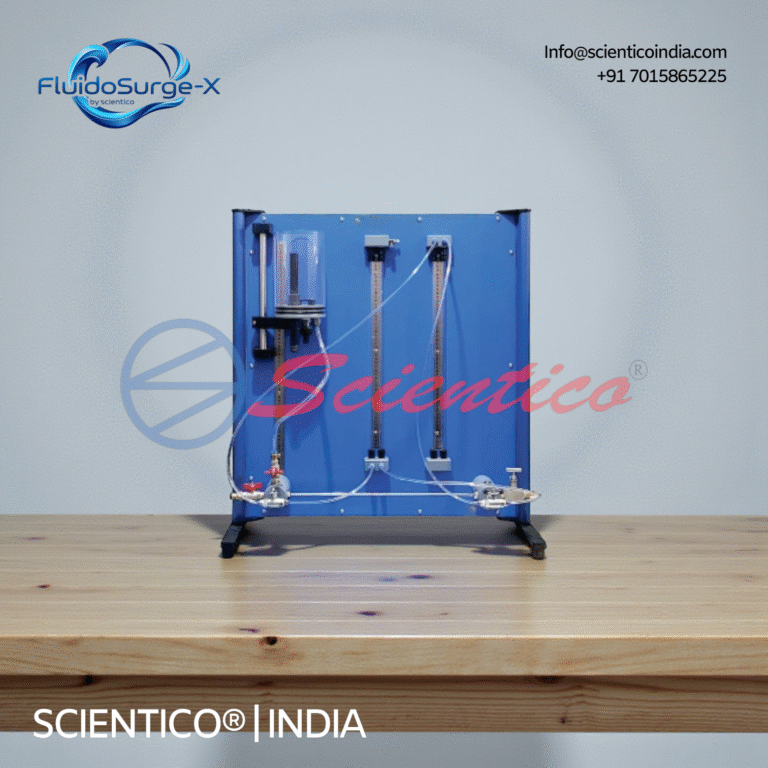
Pipe Friction Apparatus | FluidoSurge-X 168
The Pipe Friction Apparatus FluidoSurge-X 168 is designed for experimental determination of friction losses in pipe flow. It enables study of both laminar and turbulent flow regimes under controlled conditions. The apparatus allows measurement of head loss and determination of critical Reynolds number. It is suitable for fluid mechanics laboratory instruction and experimental analysis.
View product details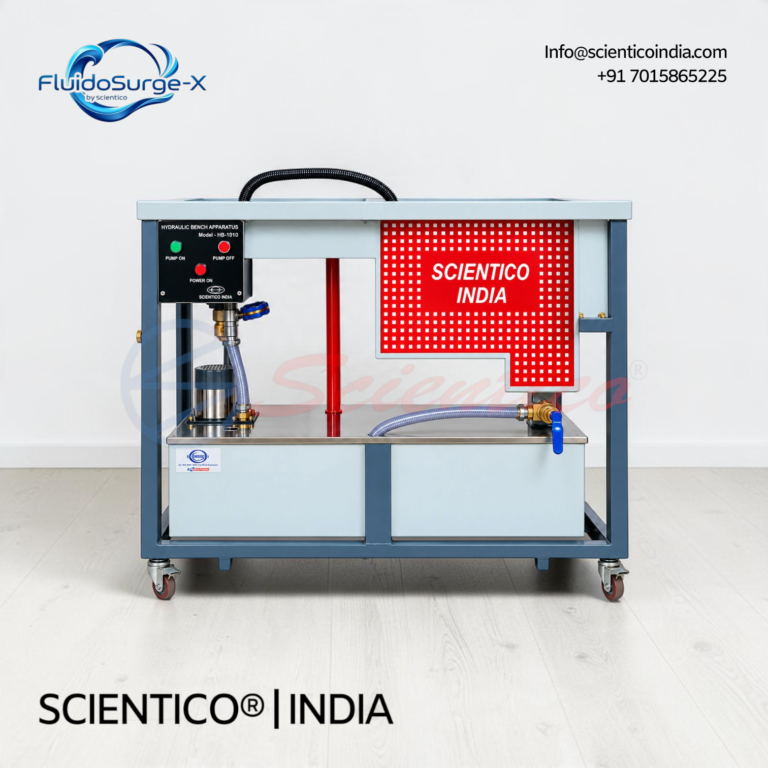
Hydraulic Bench Apparatus | FluidoSurgeX 101
The SCIENTICO FluidoSurgeX 101 Hydraulic Bench Apparatus is a basic supply and measurement unit used in fluid mechanics laboratories. It enables the circulation, measurement, and collection of water for a wide range of experimental modules.The system operates on a closed-loop water circuit consisting of a storage tank, centrifugal pump, and an elevated measuring tank. Volumetric flow rates are determined using stepped measuring tanks and a calibrated measuring beaker, supported by manual stopwatch timing.An integrated work surface with a built-in flume allows experiments involving weirs while ensuring safe placement of accessories and controlled collection of return water.
View product detailsApparatus Required
- Pipe Friction Apparatus (pipes of different diameters with pressure tappings)
- Hydraulic Bench for flow supply
- Differential manometer (or piezometer board)
- Stopwatch and measuring tank
Theory
Head loss due to friction in a pipe (major loss) is given by the Darcy-Weisbach equation: hf = f × (L/D) × (V²/2g), where hf = friction head loss (m), f = Darcy friction factor (dimensionless), L = pipe length between tappings (m), D = pipe diameter (m), V = mean velocity (m/s), g = 9.81 m/s². Reynolds number: Re = VD/ν. For turbulent flow (Re > 4000), f is determined from the Moody chart or Colebrook-White equation.
Procedure
- Select a test pipe (note diameter D and length L between pressure tappings).
- Open the flow control valve and allow water to flow through the pipe at a set rate.
- Wait for steady flow. Read the differential pressure head (hf) from the manometer.
- Measure discharge Q using the volumetric tank and stopwatch.
- Calculate mean velocity V = Q/A (where A = πD²/4).
- Repeat for 5–6 different flow rates (from low to high).
- Repeat the procedure for a different pipe diameter if available.
Observation Table
| Obs. No. | Volume (L) | Time (s) | Q (m³/s) | V (m/s) | hf (m) | Friction Factor f | Re | log V | log hf |
|---|---|---|---|---|---|---|---|---|---|
| 1 | – | – | – | – | – | – | – | – | – |
| 2 | – | – | – | – | – | – | – | – | – |
| 3 | – | – | – | – | – | – | – | – | – |
Calculations
Velocity: V = Q / (πD²/4)
Friction factor: f = hf × 2gD / (L × V²)
Reynolds number: Re = VD/ν (ν = 1×10⁻⁶ m²/s for water at 20°C)
Verification: Plot log(hf) vs log(V), a straight line with slope ≈ 2 confirms hf ∝ V² for turbulent flow (Darcy-Weisbach).
Frequently Asked Questions
What is the Darcy-Weisbach equation used for?
The Darcy-Weisbach equation calculates major head loss (friction loss) in pipes: hf = f(L/D)(V²/2g). It is used in pipe network design, pump selection, and hydraulic system analysis. The friction factor f depends on Reynolds number and pipe roughness, obtained from the Moody chart.
What is the difference between major and minor losses in pipe flow?
Major losses are friction losses along the straight length of a pipe, calculated by the Darcy-Weisbach equation. Minor losses occur at fittings, bends, valves, and entry/exit points, quantified by a loss coefficient K (hm = KV²/2g). For long pipelines, major losses dominate; for short systems with many fittings, minor losses are significant.
How is friction factor related to Reynolds number?
For laminar flow (Re < 2000): f = 64/Re (Hagen-Poiseuille). For turbulent flow in smooth pipes (Re 4000–100,000): the Blasius equation f = 0.316/Re⁰·²⁵ applies. For rough pipes at high Re, the Colebrook-White equation or Moody chart is used. The pipe friction experiment typically produces turbulent flow conditions.
Get Fluid Mechanics Lab Equipment
Scientico India manufactures ISO 9001:2015 and model-specific fluid mechanics lab apparatus. Contact us for specifications and CIF pricing.
Scientico India manufactures this and the full range of Fluid Mechanics Lab equipment, model-specific and supplied to engineering colleges worldwide.
Explore Fluid Mechanics Lab Equipment → or request a quote