
Equipment mentioned in this guide
Review the product information, specifications and model before requesting a quotation.
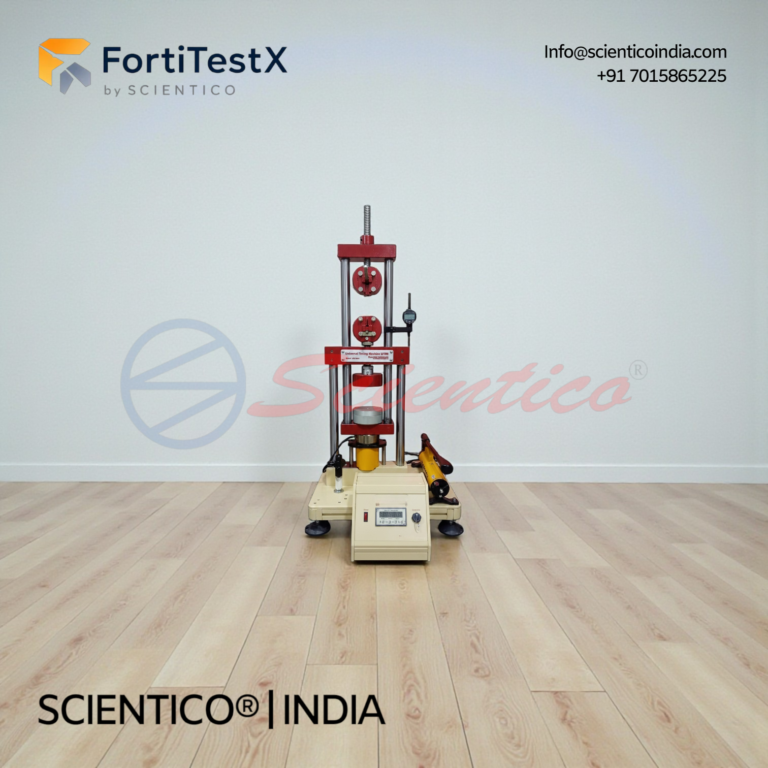
Universal Testing Machine 30kN | FortiTestX – 16
Universal Testing Machine 30kN FortiTestX 16 is a benchtop strength of materials lab equipment unit designed for tensile, compressive, bending, and elongation testing of metallic and non-metallic specimens using a hand-operated hydraulic system requiring no external power supply. This Universal Testing Machine 30kN generates test forces up to 30 kN through a hydraulic system, displaying load on a large dynamometer gauge with trailing pointer and measuring elongation via a dial gauge with 0.01 mm graduation. The FortiTestX 16 accepts a comprehensive range of standard and optional accessories for shear, cupping, spring, and Brinell hardness testing, making it a complete universal testing machine 30kN strength of materials lab equipment unit for undergraduate engineering and materials science programmes.
View product details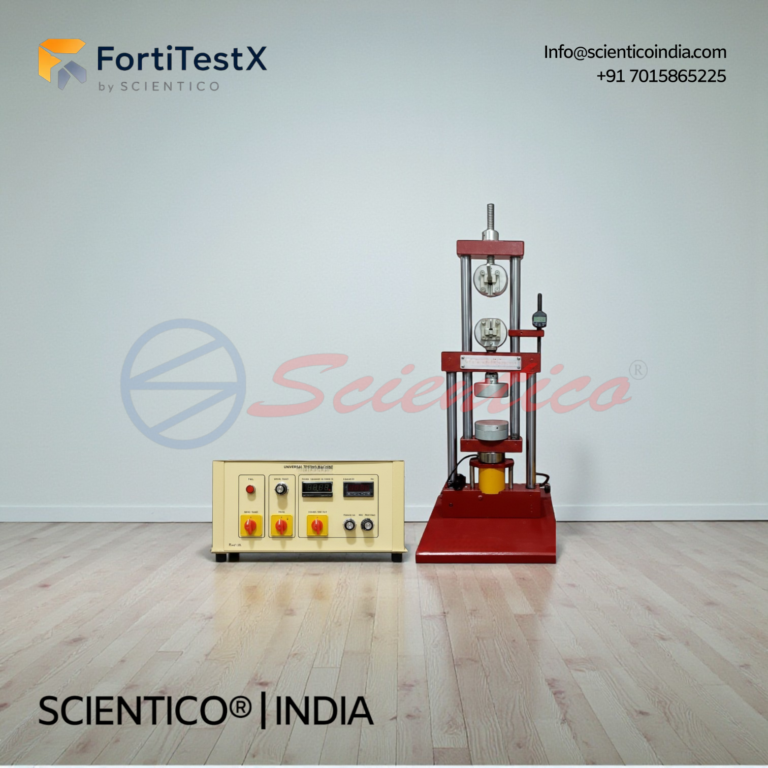
Universal Testing Machine 50kN | FortiTestX – 40
Universal Testing Machine 50kN FortiTestX 40 is a vertical benchtop strength of materials lab equipment unit designed for compressive and tensile testing of materials, parts, and structures using a hydraulically operated or servo ball screw-based loading system. This Universal Testing Machine 50kN generates test forces up to 50 kN across a maximum stroke of 150 mm, measuring force via full bridge strain gauges and displacement via a linear potentiometer, with both values displayed on dedicated digital displays. The FortiTestX 40 accepts a comprehensive range of standard and optional accessories for bending, shear, deep draw, spring, Brinell hardness, and additional tensile configurations, making it a complete universal testing machine 50kN strength of materials lab equipment unit for undergraduate and industrially focused engineering programmes.
View product details
Universal Hardness Tester
The Universal Hardness Tester manufactured by Scientico India combines Brinell, Vickers, and Rockwell hardness testing methods in a single machine. The machine uses interchangeable indenters and a built-in optical measuring system for Brinell/Vickers measurements, with direct-reading digital display for Rockwell hardness.
View product details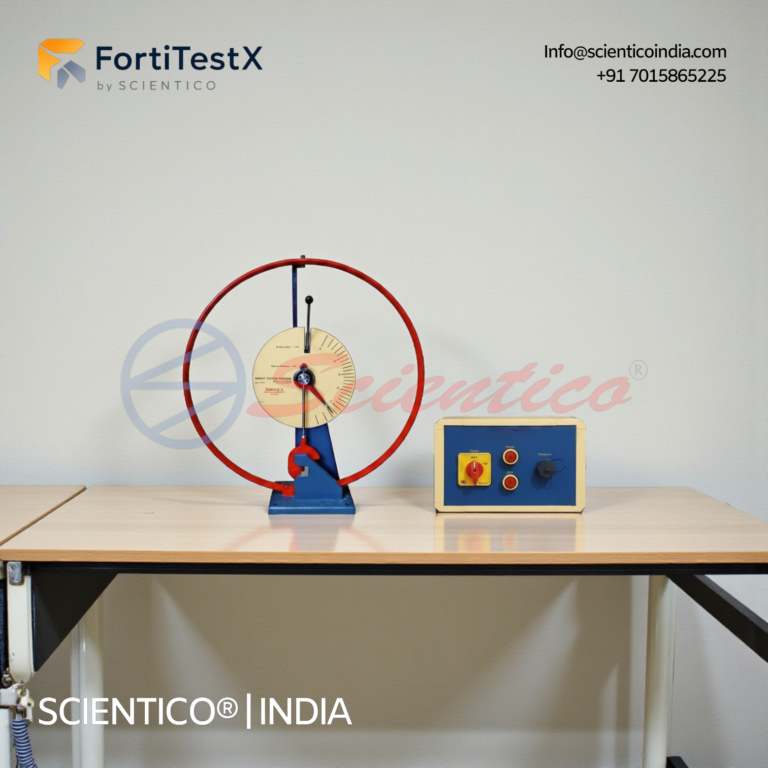
Impact Testing Machine | FortiTestX – 15
Impact Testing Machine FortiTestX 15 is a benchtop strength of materials lab equipment unit designed for notched bar impact bending tests on metallic and non-metallic specimens. This Impact Testing Machine operates on the pendulum principle, delivering a hammer impact speed of 3.8 m/s and a maximum work capacity of 25 Nm, with impact energy read directly from the gauge on a large scale. The FortiTestX 15 supports U, V, and keyhole notch configurations across four specimen materials, making it a complete impact testing machine strength of materials lab equipment unit for undergraduate material testing programmes.
View product details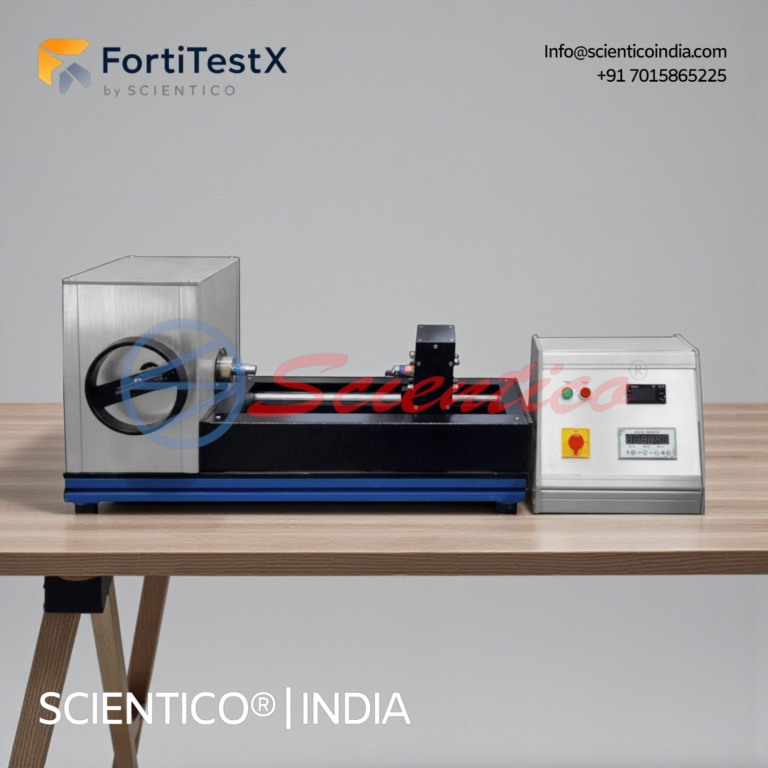
Torsion Testing Machine 300Nm (Manual) | FortiTestX – 10A
Torsion Testing Machine 300Nm Manual FortiTestX 10A is a manual, benchtop strength of materials lab equipment unit engineered for torsional testing of mild steel, aluminium, and brass specimens up to fracture under a maximum test torque of 300 Nm. This Torsion Testing Machine 300Nm apparatus applies twisting moment manually via a handwheel and worm gear reduction mechanism, measuring test torque through a strain gauge shaft and angle of twist through an incremental encoder, with both values shown simultaneously on digital displays. The FortiTestX 10A accommodates specimen lengths up to 300 mm via a sliding measurement jig and is supplied complete with 15 calibrated test specimens across three materials, making it a comprehensive torsion testing machine 300Nm unit for undergraduate engineering laboratories.
View product details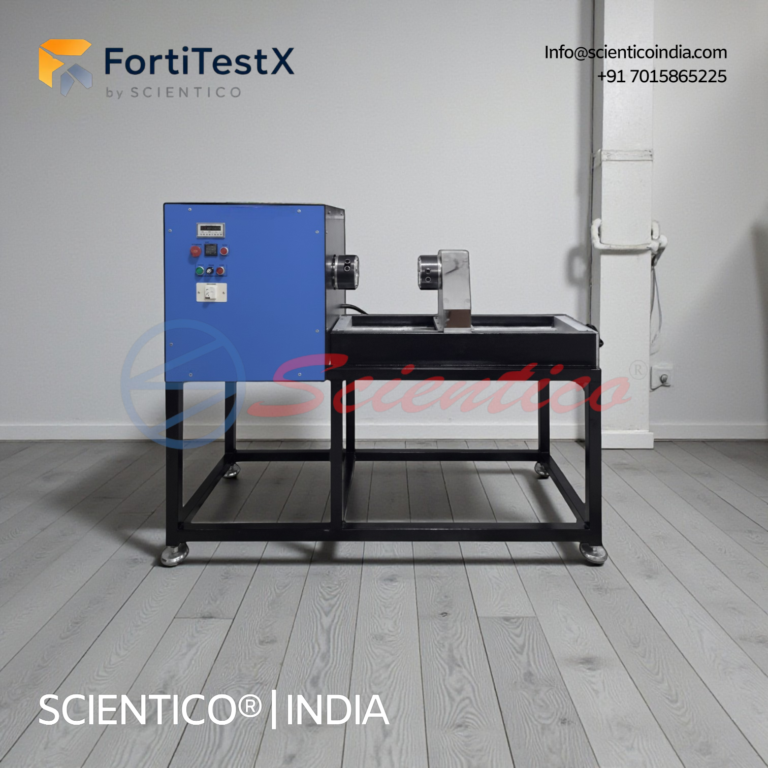
Torsion Testing Machine 1000Nm (Motorized) | FortiTestX – 12
Torsion Testing Machine FortiTestX 12 is a motorised, benchtop strength of materials lab equipment unit engineered for torsional testing of various material specimens to fracture under a maximum test torque of 1000 Nm. This Torsion Testing Machine 1000Nm Motorized apparatus applies torque via a motor-driven worm gear reduction mechanism, measuring test torque through a strain gauge shaft and angle of twist through an incremental encoder, with both values displayed simultaneously on digital readouts within a microprocessor-based enclosure. The FortiTestX 12 accommodates specimen lengths up to 650 mm via a sliding measurement jig and accepts specimens of different diameters through a jaw-type holder, making it the highest-capacity torsion testing machine 1000Nm motorized unit in the FortiTestX range for undergraduate and research-level engineering laboratories.
View product detailsStrength of Materials Lab Equipment: Complete List, Experiments, and Setup Guide
The strength of materials laboratory (also called mechanics of solids or materials testing lab) is a core requirement for B.Tech and B.E. mechanical, civil, and manufacturing engineering programmes. This guide covers the complete strength of materials lab equipment list, experiment descriptions, AICTE/NBA/ABET compliance requirements, and procurement guidance for engineering colleges worldwide.
Complete Strength of Materials Lab Equipment List
1. Universal Testing Machine (UTM)
The UTM is the centrepiece of every materials testing laboratory. It applies tensile, compressive, and bending loads to test specimens and measures the resulting deformation.
- Capacity: 40 kN (for student labs), 100 kN, 200 kN (for research)
- Key experiments: Tensile test (stress-strain curve, Young’s modulus, UTS, elongation), compression test, bending test, shear test
- Scientico model: Universal Testing Machine Manufacturer India
2. Impact Testing Machine
Measures the energy absorbed by a material when struck by a sudden impact, assessing toughness and notch sensitivity. Supports Charpy (horizontal beam) and Izod (vertical cantilever) configurations.
- Capacity: 300 J (Charpy), 170 J (Izod)
- Key experiments: Charpy impact test; Izod impact test; comparison of brittle vs. ductile fracture energy
- Scientico model: Impact Testing Machine Manufacturer India
3. Torsion Testing Machine
Applies a twisting moment (torque) to a specimen and measures the angle of twist. Used to determine shear modulus (modulus of rigidity) and shear strength of materials.
- Capacity: 100 N·m to 1000 N·m
- Key experiments: Torsion test on mild steel and cast iron; determination of modulus of rigidity G; polar moment of inertia
- Scientico model: Torsion Testing Machine Manufacturer India
4. Hardness Testing Machine
Measures material resistance to surface indentation. The Universal Hardness Tester supports Brinell, Vickers, and Rockwell scales in a single machine.
- Brinell (HB): Ball indenter, 500–3000 kgf load, for soft metals and castings
- Vickers (HV): Diamond pyramid, 1–120 kgf, for thin materials and surface hardness
- Rockwell (HR): Diamond cone or ball, pre-load method, for rapid production testing
5. Spring Testing Machine
Applies compressive and tensile loads to helical springs to determine spring stiffness (spring rate), energy stored, and deflection characteristics.
- Key experiments: Load vs. deflection of close-coiled and open-coiled helical springs; determination of spring stiffness k
- Scientico model: Spring Testing Machine (available with hydraulic bench)
6. Deflection of Beam Apparatus
Applies central or off-centre point loads to simply supported and cantilever beams of different cross-sections (rectangular, I-section) to verify Euler-Bernoulli beam deflection theory.
- Key experiments: Load vs. deflection of simply supported beam; cantilever beam deflection; comparison of steel, aluminium, brass beams
7. Fatigue Testing Machine
Subjects a rotating-beam specimen to cyclic bending stress to determine the fatigue life and S-N (Wöhler) curve of materials, critical for machine design applications.
- Key experiments: S-N curve plotting; endurance limit determination; effect of stress concentration on fatigue life
8. Verification of Columns and Struts Apparatus
Demonstrates Euler’s buckling theory for slender columns under compressive loads with various end conditions (pin-pin, pin-fixed, fixed-fixed).
- Key experiments: Critical buckling load vs. effective length; verification of Euler’s formula Pcr = π²EI/(Le)²
Standard Lab Setup Requirements
| Accreditation Body | Minimum Equipment Required |
|---|---|
| AICTE India | UTM, impact tester, torsion machine, hardness tester, spring tester, beam deflection |
| NBA India | Above + fatigue machine, Vickers hardness, creep apparatus |
| ABET (Worldwide) | UTM, impact, torsion, hardness, model-specific |
| CAA (UAE) | model-specific UTM, impact, torsion, hardness minimum set |
| BQA (Bahrain) | ABET-equivalent model-specific strength of materials set |
Key Experiments Covered in Strength of Materials Lab
- Tensile test, Young’s modulus, UTS, % elongation, % reduction in area
- Compression test, compressive strength, brittleness vs. ductility comparison
- Bending test, flexural strength, modulus of rupture
- Charpy and Izod impact tests, toughness, energy absorbed
- Torsion test, shear modulus G, shear strength
- Brinell, Vickers, Rockwell hardness tests
- Spring stiffness and energy storage
- Beam deflection, simply supported and cantilever
- Column buckling, Euler critical load
Procurement and Export
Scientico India supplies complete strength of materials lab setups to engineering colleges across UAE, Saudi Arabia, Kuwait, Bahrain, Qatar, Oman, Kenya, Tanzania, Uganda, Ghana, Bangladesh, Sri Lanka, Philippines, Vietnam, Nepal, Ethiopia, Senegal, Mozambique, and 50+ more countries. All equipment is ISO 9001:2015 certified and documentation reviewed per model, with full ABET, NBA, NAAC, and AICTE documentation packages.
Email [email protected] with your institution name, country, and equipment list for a model-specific CIF proforma invoice after technical review.
See Also
- Strength of Materials Lab Setup Guide, B.Tech Mechanical Equipment List
- Universal Testing Machine Buyer’s Guide, Specifications & Capacity
- Engineering Lab Equipment Maintenance Schedule & Checklist
- Bending Moment vs Shear Force: Difference, Diagrams & Relationship
- What Is Factor of Safety in Engineering? Definition & Calculation
Get Specifications & Pricing
Scientico India manufactures laboratory apparatus under an ISO 9001:2015 quality system. Conformity documentation is confirmed for each quoted model. Contact us for full specifications, pricing, and documentation.
WhatsApp: +91 701-586-5225 | [email protected] | FAQ, Shipping, Payment & Warranty
Scientico India manufactures model-specific, ISO 9001:2015 laboratory equipment, exported to 30+ countries since 1993. Request a model-specific CIF proforma invoice after technical review.
View Engineering Lab Equipment →Request a QuoteChoose the machine from the required outcome
Use this map after listing the experiments in the syllabus or test plan. It narrows the equipment family; the linked product record and datasheet remain the source for the offered configuration, measurable range, accessories, utilities and documentation. For cross-category purchasing criteria, use the materials-testing equipment selection guide.
Measure tensile, compression, bending or shear behaviour
Start with a universal testing machine, then confirm the specimen, force range, fixtures, travel and measurements required by the method.
Machine records: 30 kN Universal Testing Machine · 50 kN Universal Testing Machine
Compare Brinell, Rockwell and Vickers hardness
Select the method and scale before the machine. A combined tester is useful only when the required indenters, loads and reading method match the practical.
Machine records: Universal Hardness Tester
Compare impact energy and fracture behaviour
Define Charpy, Izod or both, including specimen and notch preparation, before comparing pendulum machines.
Machine records: Impact Testing Machine
Measure torque, angle of twist or torsional rigidity
Choose manual or motorised operation after fixing the specimen, torque range, angle measurement and intended calculation.
Machine records: 300 Nm Manual Torsion Testing Machine · 1000 Nm Motorised Torsion Testing Machine · Torsion of Bar Apparatus
Plot an S-N curve or demonstrate endurance behaviour
Use a fatigue testing machine and confirm the loading mode, specimen form, cycle measurement and stopping condition required by the exercise.
Machine records: Fatigue Testing Machine
Observe time-dependent creep deformation
Use a creep testing machine when the learning outcome depends on deformation over time under a sustained condition.
Machine records: Creep Testing Machine
Measure beam deflection, shear force or bending moment
Match the apparatus to the diagram, support condition or deflection relationship students must verify; these are related but not interchangeable practicals.
Machine records: Deflection of Beam Apparatus · Shearing Force and Bending Moment Apparatus · Shear Force in a Beam Apparatus
Verify Hooke’s law or compare spring behaviour
Use the experiment named in the syllabus: proportional load-extension, compression, or extension-and-compression behaviour.
Machine records: Hooke’s Law Apparatus · Compression of Spring Apparatus · Extension and Compression of Spring Apparatus
Study elastic instability and column buckling
Match end conditions, member form and the intended Euler-theory comparison before choosing a buckling apparatus.
Machine records: Column Buckling Apparatus · Buckling of Bars Apparatus
Measure strain or visualise stress distribution
Use a strain-gauge trainer for electrical strain measurement; use a polariscope when the outcome is photoelastic stress-pattern observation.
Machine records: Strain Gauge Trainer · Polariscope
One honest ask
We don't gate anything on this site. You just read the whole thing free. If it was useful, leave your email and two things happen: we send you this page as a plain-text block you can paste into a tender file or an internal email, and we notify you the next time we publish a buyer tool like this one. Nothing else. No drip sequence, no sales calls booked without asking.