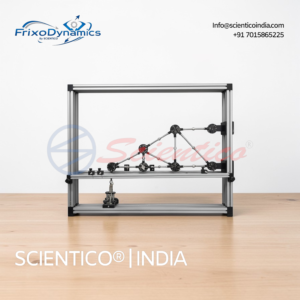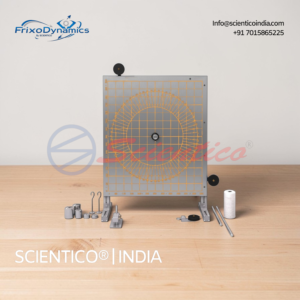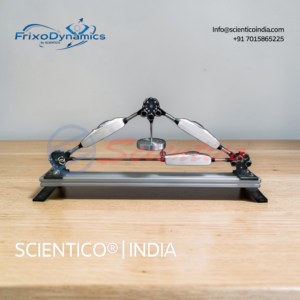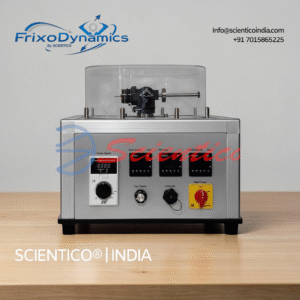
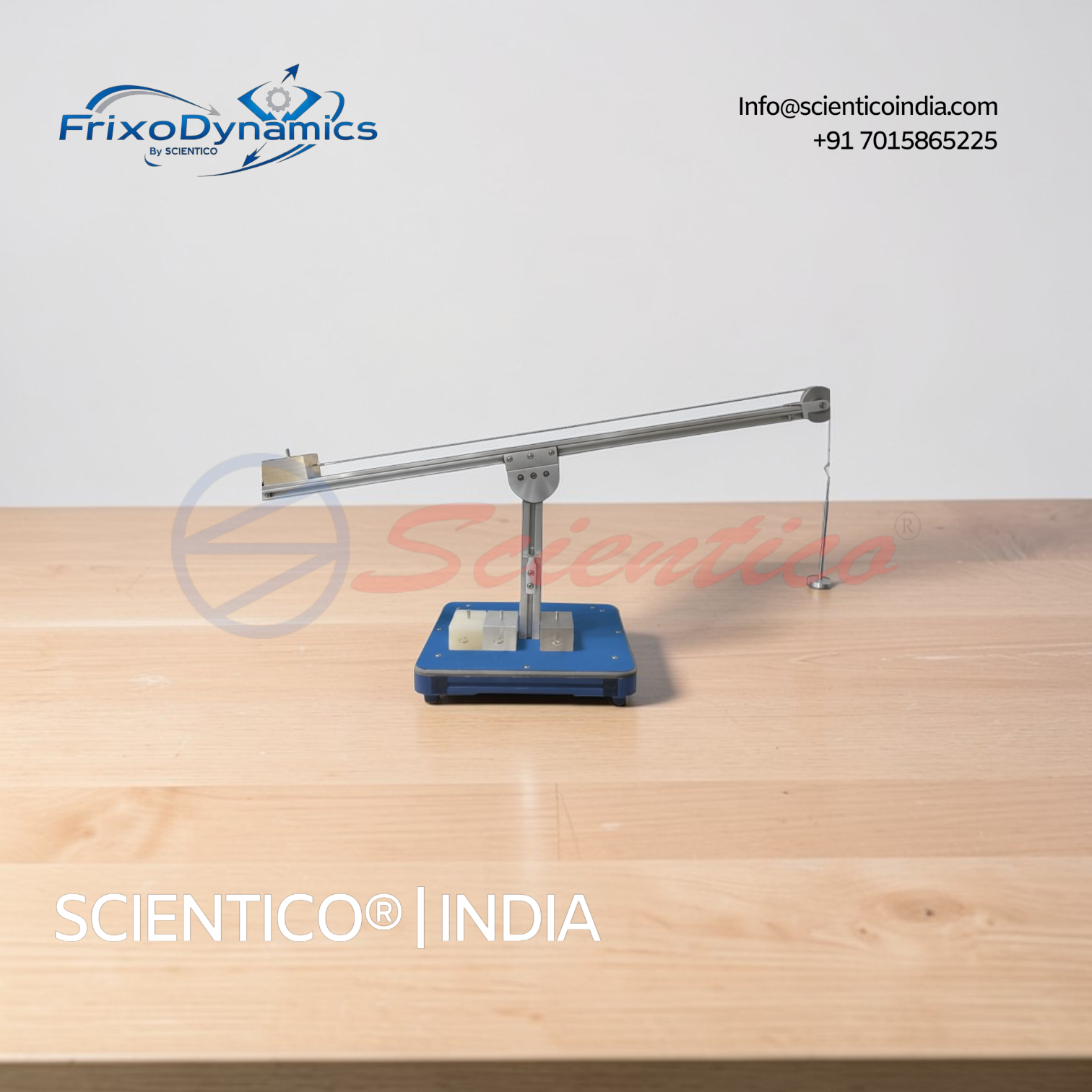
Friction on Inclined Plane Apparatus | FrixoDynamics FX-509
The Friction on Inclined Plane Apparatus (FrixoDynamics FX-509) supports static and sliding-friction experiments with an adjustable plane, four material sample blocks and a pulley-based tensile-force method. Students can compare materials using angle-based and force-loading approaches. Confirm the supplied samples, measurement method, dimensions and accessories in the quotation.
The SCIENTICO FrixoDynamics FX-509 Friction on Inclined Plane Apparatus is a bench-mounted experimental unit for the quantitative determination of static and dynamic friction coefficients across different material pairings. Using an adjustable inclined plane, a ball bearing-mounted deflection pulley, and four material sample blocks, students investigate the transition from static to sliding friction under two distinct experimental methods, angle-based tilting and tensile force loading. The apparatus covers a broad range of fundamental friction experiments and provides direct, measurable results for material comparisons. Manufactured by SCIENTICO, the FX-509 is suitable for supply to engineering institutions and distributors worldwide.
Product Overview
Friction on an inclined plane is one of the most fundamental topics in applied mechanics. The FX-509 approaches this subject through two complementary experimental methods, each isolating a different aspect of frictional behaviour.
In the first method, the inclined plane is tilted gradually from horizontal until the sample block begins to slide under its own weight. The angle at which sliding commences is the angle of friction, from which the coefficient of static friction can be directly calculated using standard trigonometric relations. This method requires no applied weights, the transition from rest to sliding occurs purely under gravity.
In the second method, the plane is fixed at a set angle of inclination and a cord is attached to the sample block, passed over the ball bearing-mounted deflection roller at the upper end of the plane, and connected to a weight hanger. Weights are added incrementally to the hanger until the block begins to move up the plane at a uniform velocity. The total hanging weight at the point of uniform motion corresponds to the sum of the gravitational component along the plane and the dynamic friction force, allowing the coefficient of dynamic friction to be calculated directly.
Four sample blocks are provided, one steel/polypropylene pairing and one aluminium/brass pairing, enabling students to compare friction coefficients across materially distinct combinations and understand how surface material affects frictional behaviour. The graduated weight set provides fine resolution for incremental loading during the tensile force experiments.
Request Specifications & Pricing
model-specific, ISO 9001:2015 compliant. Supplied to universities and institutions in 30+ countries.
WhatsApp: +91 701-586-5225 | Email: [email protected]
View Quality Certifications | FAQ, Shipping, Warranty, Lead Time
| Parameter | Specification |
|---|---|
| Model | FrixoDynamics FX-509 |
| Inclined Plane Length | 800 mm |
| Angle of Inclination | Adjustable, 0° to +45° |
| Angle Measurement | Pointer and protractor scale on drag link |
| Deflection Roller | Ball bearing-mounted |
| Base | Mild steel (MS) |
| Friction Body Dimensions | 80 x 60 x 22 mm each |
| Sample Material Pairings | 1 x steel/polypropylene, 1 x aluminium/brass |
| Weight Set | 1 x 0.5 N hanger, 3 x 5 N, 2 x 2 N, 2 x 1 N, 2 x 0.5 N, 5 x 0.1 N |
| Scope of Delivery | 1 experimental unit, 4 samples, 1 set of weights, 1 thread, 1 instructional manual |
Key Features
- Inclined plane adjustable from 0° to 45° with pointer and protractor scale for direct angle reading
- Ball bearing-mounted deflection roller minimises pulley friction, ensuring accurate tensile force transmission to the sample
- Four sample blocks across two material pairings (steel/polypropylene and aluminium/brass) for comparative friction coefficient experiments
- Graduated weight set with fine increments (down to 0.1 N) for precise incremental loading during tensile force experiments
- Two independent experimental methods: angle-of-sliding method and tensile force method
- Mild steel base provides stability and resistance to movement during experiments
- All sample blocks are identical in geometry (80 x 60 x 22 mm), isolating material as the sole variable in comparative tests
- Suitable for both static friction and dynamic (kinetic) friction determination
Applications
- Determination of the coefficient of static friction for different material pairings
- Determination of the coefficient of dynamic (kinetic) friction under tensile loading
- Investigation of the transition from static to dynamic friction
- Study of static equilibrium of forces on an inclined plane
- Experimental determination and verification of the angle of inclination at which sliding begins
- Comparative analysis of friction behaviour across steel, aluminium, brass, and polypropylene surfaces
- Undergraduate laboratory practicals in applied mechanics, tribology, and mechanical engineering fundamentals
Construction and System Design
The FX-509 is built on a mild steel base that provides a stable, level foundation for the inclined plane assembly. The plane surface is 800 mm in length and is connected to the base via a drag link fitted with an angle scale and pointer, allowing the inclination to be set and read directly without additional measuring instruments. The angle is adjustable up to 45° and can be fixed securely at any position within this range.
At the upper end of the inclined plane, a deflection roller is mounted on precision ball bearings. This ensures that the cord running from the sample block over the roller to the weight hanger transmits the applied force with minimal frictional loss at the pulley, keeping experimental error low. The cord is supplied with the unit and is of sufficient length to accommodate the full range of inclination angles.
The four sample blocks are uniform in size (80 x 60 x 22 mm) and each presents a defined material contact face to the plane surface, steel, polypropylene, aluminium, or brass. This uniformity ensures that block geometry does not introduce a variable into comparative material friction experiments. Weights are added to the hanger in fine increments, and the point of uniform sliding motion is identified visually, providing a clear and repeatable criterion for recording the critical load.
Export and Supply Capability
The SCIENTICO FrixoDynamics FX-509 is available for supply to engineering colleges, technical universities, mechanical engineering departments, research institutions, and industrial training centres. SCIENTICO manufactures and exports laboratory equipment to institutions and distributors across multiple regions. Standard packaging is suitable for international shipment. Bulk orders, customised configurations, and institutional procurement enquiries are welcomed. Please contact SCIENTICO directly for pricing, lead times, and shipping terms.
Q1: What is the friction on inclined plane apparatus used for?
The FX-509 is used to determine the coefficients of static and dynamic friction for different material pairings on an inclined surface. Students use two methods, the angle-of-sliding method and the tensile force method, to measure the friction force at the point of impending or uniform motion, and calculate friction coefficients from the recorded data. The unit also supports experiments on static equilibrium and the critical angle of inclination for sliding.
Q2: What are the two experimental methods supported by the FX-509?
In the first method, the inclined plane is tilted gradually until the sample block begins to slide under gravity alone. The angle at which sliding begins is used to calculate the coefficient of static friction. In the second method, the plane is held at a fixed angle and a hanging weight applies a tensile force to the block via a cord and pulley. Weights are added until the block slides upward at uniform velocity, giving the coefficient of dynamic friction.
Q3: What material pairings are provided with the FX-509?
The FX-509 includes four sample blocks representing two material pairings: one steel block and one polypropylene block, and one aluminium block and one brass block. Each block measures 80 x 60 x 22 mm and is placed with its defined material face in contact with the plane surface. This allows students to compare friction coefficients across four distinct material combinations against the plane surface.
Q4: Why is a ball bearing-mounted deflection roller used instead of a simple pulley?
A ball bearing-mounted roller significantly reduces friction at the deflection point, ensuring that the force applied by the hanging weights is transmitted to the sample block with minimal loss. This keeps the experimental error low and ensures that the measured hanging weight at the point of sliding accurately reflects the friction force acting on the block, rather than including pulley friction as an uncontrolled variable.
Q5: What is included in the scope of delivery for the FX-509? The FX-509 is supplied as a complete experimental kit including: one inclined plane experimental unit with MS base, drag link, angle scale, and ball bearing deflection roller; four material sample blocks (steel, polypropylene, aluminium, brass); one graduated weight set (1 x 0.5 N hanger, 3 x 5 N, 2 x 2 N, 2 x 1 N, 2 x 0.5 N, 5 x 0.1 N); one thread; and one instructional manual covering both experimental methods, data recording procedures, and sample calculations.
Need Assistance? We're Here to Help!
Connect with our team for product specifications, pricing, and customized solutions for your institution or project.