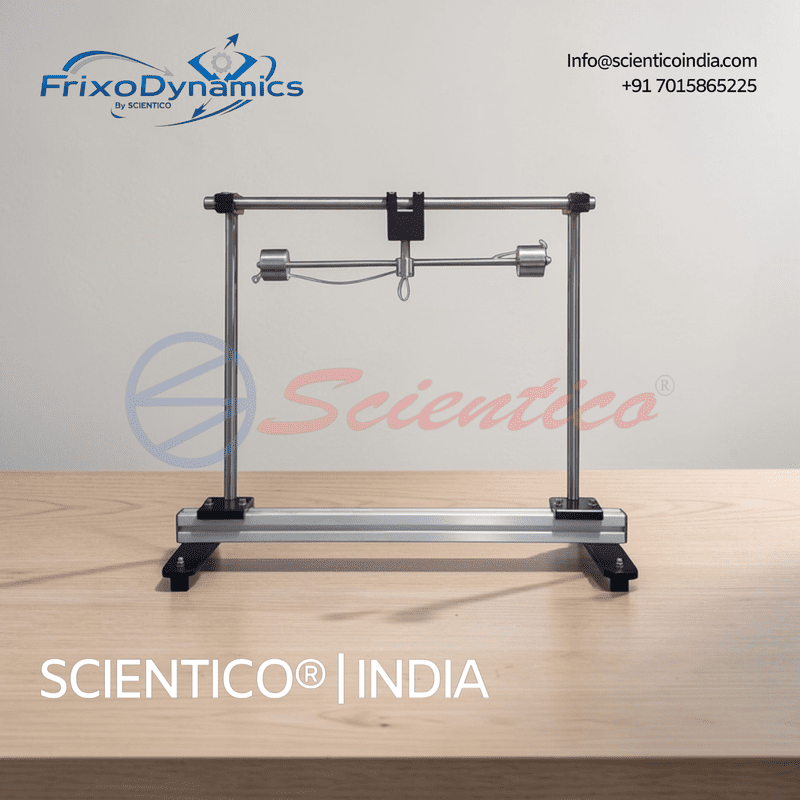
Conservation of Angular Momentum Apparatus | FrizoDynamics FX-508

The SCIENTICO FrizoDynamics FX-508 Conservation of Angular Momentum Apparatus is a bench-mounted demonstration unit that provides a clear, visually immediate illustration of angular momentum conservation in rotating systems. Two sliding dead weights are mounted symmetrically on a bearing-supported rotating arm and can be drawn radially inward or outward via a pull cord. When the arm is spun manually and the weights are pulled toward the centre, the reduction in moment of inertia produces a sharp, visible increase in rotational speed — directly demonstrating the conservation principle without any measurement instrumentation. The unit is intended for qualitative demonstration only and requires no power supply, making it quick to deploy in lecture theatres, laboratory induction sessions, and introductory mechanics practicals. Supplied complete with thread and instructional manual. Manufactured by SCIENTICO, available for institutional supply and international distribution.

The SCIENTICO FrizoDynamics FX-508 Conservation of Angular Momentum Apparatus is a bench-mounted demonstration unit designed to provide a clear, visually striking illustration of the principle of conservation of angular momentum. The apparatus uses a manually spun rotating arm fitted with two radially adjustable sliding weights, allowing students and instructors to directly observe the relationship between the radial distribution of mass and rotational speed. While the unit is intended for qualitative demonstration rather than quantitative measurement, it delivers an immediate and memorable visual representation of a fundamental concept in dynamics and mechanics. Manufactured by SCIENTICO, the FX-508 is suitable for supply to engineering institutions and distributors worldwide.

Product Overview

Conservation of angular momentum states that when no external torque acts on a rotating system, its total angular momentum remains constant. As a consequence, any reduction in the system’s moment of inertia — achieved by drawing mass closer to the axis of rotation — must be accompanied by a corresponding increase in rotational speed, and vice versa. The FX-508 demonstrates this relationship directly and visibly.

The apparatus consists of a vertical bench-mounted stand fitted with a horizontal rotating arm supported on bearings. Two dead weights are positioned symmetrically on the arm and can be moved radially inward or outward along the arm by a pull cord operated by the student or demonstrator. With the weights positioned at their maximum radius from the centre, the moment of inertia of the system is at its highest, and the arm rotates slowly after being spun by hand. When the cord is pulled and the weights move toward the centre, the moment of inertia decreases and the rotational speed increases sharply — a direct, observable consequence of angular momentum conservation.

The effect is immediate and visually dramatic, making it well suited to lecture demonstrations, laboratory induction sessions, and introductory practical classes. No measurements are taken and no data recording is required, keeping the focus entirely on the physical concept being demonstrated.

Parameter Specification
Model FrizoDynamics FX-508
Apparatus Type Qualitative demonstration unit
Mounting Bench-mounted vertical stand
Rotating Arm Horizontal, bearing-mounted
Weights Two sliding dead weights, radially adjustable
Weight Actuation Pull cord operated manually
Arm Drive Manual spin by hand
Measurements None intended — demonstration only
Scope of Delivery 1 experimental unit, 1 thread, 1 instructional manual

Key Features

  • Immediate, visually dramatic demonstration of conservation of angular momentum with no instrumentation required
  • Two sliding weights adjustable along the full radial length of the rotating arm via a pull cord
  • Bearing-mounted rotating arm ensures smooth, low-friction rotation for clear and repeatable demonstration
  • Bench-mounted vertical stand provides a stable base on any standard laboratory bench
  • Manually operated — no power supply, electronics, or setup time required
  • Suitable for lecture theatre demonstrations, laboratory induction sessions, and introductory practical classes
  • Supplied with thread and comprehensive technical manual

Applications

  • Qualitative demonstration of the conservation of angular momentum
  • Illustration of the inverse relationship between moment of inertia and rotational speed
  • Visual demonstration of the effect of radial mass distribution on angular velocity
  • Introductory practical sessions and lecture demonstrations in dynamics and rotational mechanics
  • Supplementary demonstration for courses covering structural engineering, machine dynamics, and applied mechanics
  • Suitable for undergraduate engineering, physics, and applied science programmes

Construction and System Design

The FX-508 is built on a rigid vertical board that mounts securely on a standard laboratory bench. The horizontal rotating arm is attached to the vertical base through a precision bearing assembly, minimising frictional resistance and allowing the arm to spin freely after a manual impulse. Two dead weights are threaded onto the arm and can slide radially along its length. A pull cord connects both weights through the arm’s central axis — when the cord is pulled, both weights are drawn symmetrically toward the centre of rotation simultaneously.

The arm is set in motion by hand, and once spinning freely, the demonstrator or student pulls the cord to bring the weights inward. The resulting acceleration in rotational speed is immediate and clearly visible, providing an unambiguous illustration of the angular momentum principle. Releasing the cord allows the weights to return outward under centrifugal reaction, slowing the rotation again. This inward-outward cycle can be repeated multiple times in a single demonstration session. The design requires no power supply, no calibration, and no measurement instruments, making it one of the most straightforward units to deploy in a teaching environment.

Export and Supply Capability

The SCIENTICO FrizoDynamics FX-508 is available for supply to engineering colleges, technical universities, mechanical engineering and physics departments, research institutions, and industrial training centres. SCIENTICO manufactures and exports laboratory equipment to institutions and distributors across multiple regions. Standard packaging is suitable for international shipment. Bulk orders, customised configurations, and institutional procurement enquiries are welcomed. Please contact SCIENTICO directly for pricing, lead times, and shipping terms.

Q1: What does the FX-508 demonstrate?

The FX-508 demonstrates the principle of conservation of angular momentum. When the two sliding weights are pulled inward along the rotating arm, the moment of inertia of the system decreases and the rotational speed increases proportionally. When the weights are allowed to move outward again, the rotation slows. This cycle provides a direct, visible illustration of the conservation law without requiring any measurement or data recording.

Q2: Can the FX-508 be used for quantitative experiments?

No. The FX-508 is designed exclusively as a qualitative demonstration unit. Its purpose is to provide a clear visual and physical illustration of angular momentum conservation for students and instructors. No force, speed, or angular measurement capability is incorporated into the unit. For quantitative rotational dynamics experiments, other apparatus in the FrizoDynamics series may be more appropriate.

Q3: How is the apparatus operated?

The rotating arm is spun manually by hand. While the arm is spinning, the pull cord is operated by the student or demonstrator to draw the two sliding weights radially inward along the arm. The resulting increase in rotational speed is immediately visible. Releasing the cord allows the weights to move back outward, reducing the speed. No power supply or electronic controls are required.

Q4: What is the principle behind the change in rotational speed when the weights are moved?

The rotational speed changes because angular momentum — the product of moment of inertia and angular velocity — is conserved in the absence of external torque. When the weights move inward, the moment of inertia decreases because mass is concentrated closer to the axis. To maintain constant angular momentum, the angular velocity must increase. This is the same principle observed in a figure skater pulling their arms inward to spin faster.

Q5: What is included in the scope of delivery for the FX-508?

The FX-508 is supplied as a complete demonstration kit including: one bench-mounted experimental unit with bearing-supported rotating arm and two sliding weights; one thread for pull cord operation; and one comprehensive instructional manual covering the operating procedure, underlying theory, and suggested demonstration approaches.

You may also like

Lorem ipsum dolor sit amet, consectetur adipiscing elit, sed do eiusmod tempor incididunt ut labore et dolore magna aliqua. Ut enim ad minim veniam, quis nostrud exercitation ullamco laboris nisi ut aliquip ex ea commodo consequat.

Testimonials

Lorem ipsum dolor sit amet, consectetur adipiscing elit, sed do eiusmod tempor incididunt ut labore et dolore magna aliqua. Ut enim ad minim veniam, quis nostrud exercitation ullamco laboris nisi ut aliquip ex ea commodo consequat.

Subscribe to our newsletter

Lorem ipsum dolor sit amet, consectetur adipiscing elit, sed do eiusmod tempor incididunt ut labore et dolore magna aliqua.

    My Quote List

    Cart Quote is empty.
    Scroll to Top