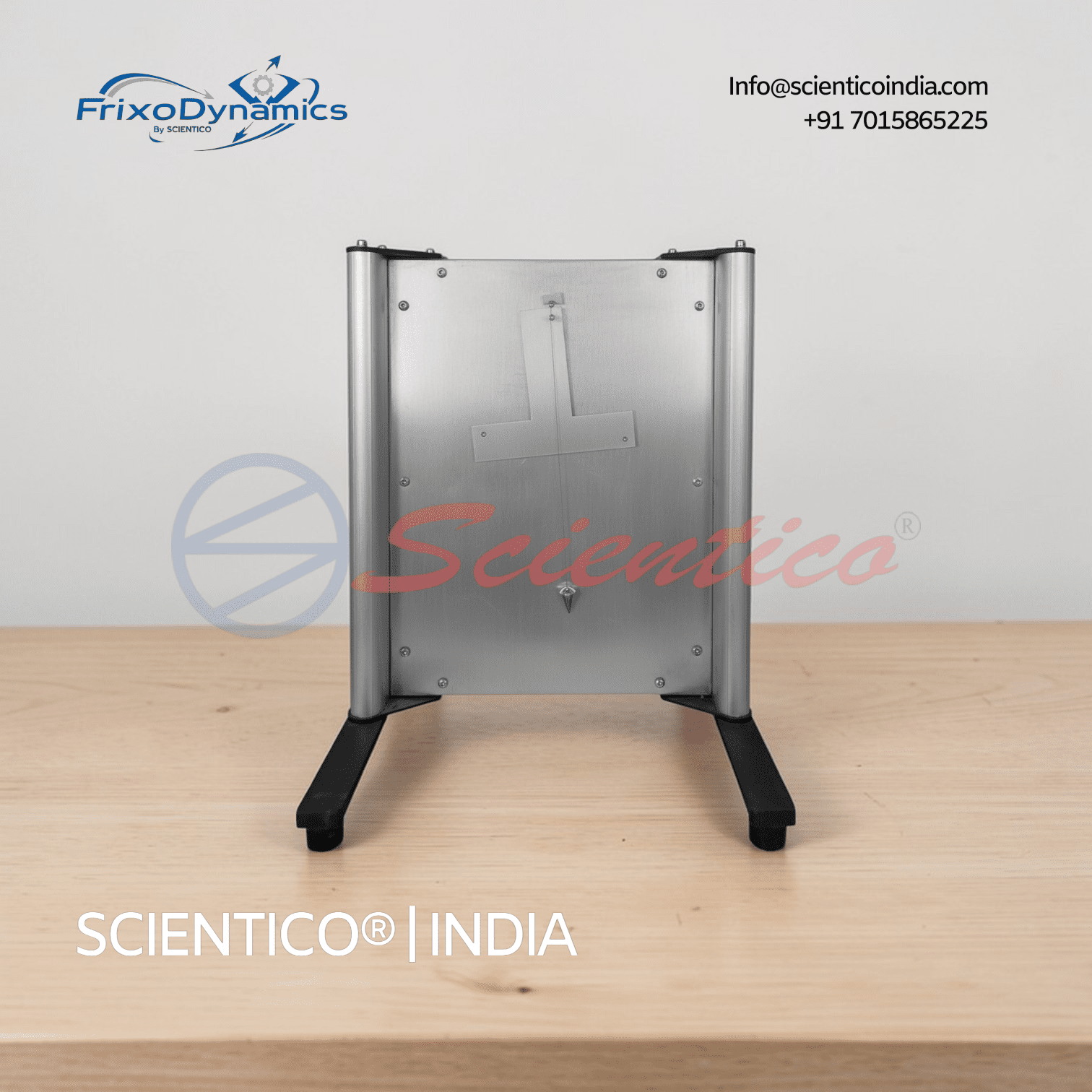
Centre of Gravity Apparatus | FrizoDynamics FX-504

The SCIENTICO FrizoDynamics FX-504 Centre of Gravity Apparatus enables students to experimentally determine the centre of gravity of six flat lamina shapes — circle, isosceles triangle, trapezium, L-shape, T-shape, and semi-circle — using the plumb bob method. Each lamina is suspended from a pin on a free-standing backboard, a plumb bob defines the vertical line of action of its weight, and the process is repeated from a second hole. The intersection of the resulting lines locates the CG, which is then compared against values from calculation or standard reference books. The experiment clearly demonstrates that for compound shapes such as the L and T sections, the CG may fall outside the physical boundary of the object — a result that is difficult to visualise analytically but immediately apparent through experiment. Designed for statics and solid mechanics laboratories, the FX-504 is supplied complete with six lamina samples, plumb bob, thread, and instructional manual. Manufactured by SCIENTICO, available for institutional supply and international distribution.

The SCIENTICO FrizoDynamics FX-504 Centre of Gravity Apparatus is a bench-mounted, free-standing experimental unit designed to help students determine the centre of gravity (CG) of flat shapes by experiment and compare results with theoretical calculations. Six laminas of different geometry — circle, isosceles triangle, trapezium, L-shape, T-shape, and semi-circle — are supplied for testing. Using a plumb bob suspended from the same pin as the lamina, students identify the vertical line of action of the object’s weight and locate the CG as the intersection of two or more such lines. Manufactured by SCIENTICO, the FX-504 is suitable for supply to engineering institutions and distributors worldwide.

Product Overview

The FX-504 consists of a free-standing backboard mounted on a bench, fitted with a pin from which laminas can be suspended freely. When a lamina hangs from the pin, it comes to rest with its centre of gravity directly below the pivot point. A plumb bob, suspended from the same pin via a thread, defines the exact vertical line passing through the CG. This line is transferred onto the lamina surface. The lamina is then rehung from a second hole, a new vertical line is marked, and the intersection of the two lines identifies the CG of the shape.

The six supplied laminas cover a range of geometries: three regular shapes — circle, isosceles triangle, and semi-circle — whose CG positions can be verified against standard reference formulas, and three compound or irregular shapes — trapezium, L-shape, and T-shape — whose CG positions are less immediately obvious and benefit most from the experimental approach. This selection allows students to practise both experimental determination and analytical calculation, then directly compare the two sets of results.

The experiment reinforces a concept that is fundamental across mechanical design, structural analysis, vehicle dynamics, and civil engineering: the location of the centre of gravity governs how a body responds to gravitational loading and determines its stability under static and dynamic conditions.

Parameter Specification
Model FrizoDynamics FX-504
Mounting Bench-mounted free-standing backboard
Suspension Method Pin-mounted lamina with plumb bob and thread
Lamina Shapes Supplied Circle, isosceles triangle, trapezium, L-shape, T-shape, semi-circle (6 total)
CG Determination Method Plumb bob method — intersection of vertical lines from multiple suspension points
Plumb Bob 1 x plumb bob with thread
Scope of Delivery 1 experimental unit, 6 lamina samples, 1 plumb bob, 1 thread, 1 instructional manual

Key Features

  • Six lamina shapes supplied — circle, isosceles triangle, trapezium, L-shape, T-shape, and semi-circle — covering both regular and compound geometries
  • Plumb bob and thread suspended from the same pin as the lamina for accurate vertical line definition
  • Multiple suspension holes on each lamina allow two or more plumb lines to be generated and intersected
  • Supports direct comparison between experimentally determined CG and values from calculation or reference tables
  • Free-standing backboard requires no wall fixing — bench-mounted and portable
  • Straightforward setup with no electrical components or instrumentation required
  • Instructional manual includes assembly guidance, experimental procedure, application notes, and example test results

Applications

  • Experimental determination of the centre of gravity of regular shapes — circle, isosceles triangle, and semi-circle — with comparison against theoretical values
  • Experimental determination of the centre of gravity of compound and irregular shapes — trapezium, L-shape, and T-shape — using the plumb bob method
  • Direct comparison of experimental CG results with values derived from calculation or standard reference books
  • Demonstration of the relationship between suspension point, vertical line of action of weight, and CG location
  • Introduction to the significance of centre of gravity in mechanical design, structural stability, and equilibrium analysis
  • Undergraduate laboratory practicals in statics, mechanics of solids, mechanical engineering, and civil engineering

Construction and System Design

The FX-504 is built around a rigid free-standing backboard that provides a stable vertical surface for lamina suspension. A pin mounted on the board serves as the single pivot point from which both the lamina and the plumb bob are hung. Each lamina is supplied with multiple suspension holes positioned at different locations around its perimeter or body, allowing the plumb bob line to be generated from at least two distinct points.

When the lamina is hung from a hole and allowed to settle, the plumb bob hangs vertically alongside it, defining the line of action of gravity through that suspension point. The student marks or traces this line onto the lamina, then moves the lamina to a second hole and repeats the process. The intersection of the two lines is the centre of gravity. For compound shapes such as the L and T laminas — where the CG may lie outside the physical boundary of the shape — the intersection point clearly illustrates this counterintuitive result. All six laminas are of uniform thickness and uniform material density, satisfying the conditions under which the plumb bob method yields accurate results.

Export and Supply Capability

The SCIENTICO FrizoDynamics FX-504 is available for supply to engineering colleges, technical universities, mechanical engineering departments, research institutions, and industrial training centres. SCIENTICO manufactures and exports laboratory equipment to institutions and distributors across multiple regions. Standard packaging is suitable for international shipment. Bulk orders, customised configurations, and institutional procurement enquiries are welcomed. Please contact SCIENTICO directly for pricing, lead times, and shipping terms.

Q1: What is the centre of gravity apparatus used for?

The FX-504 centre of gravity apparatus is used to experimentally locate the centre of gravity of flat laminas of various shapes. Students suspend each lamina from a pin, use a plumb bob to mark the vertical line of action of the object’s weight, repeat the process from a second hole, and identify the CG as the intersection of the two lines. Results are then compared with values from standard formulas or reference tables to validate the experimental method.

Q2: What shapes are included with the FX-504?

The FX-504 is supplied with six lamina shapes: a circle, an isosceles triangle, a trapezium, an L-shape, a T-shape, and a semi-circle. The set includes both regular shapes — whose CG positions can be calculated using standard geometric formulas — and compound shapes, where the CG location is less obvious and the experimental method is particularly informative.

Q3: What is the plumb bob method for finding centre of gravity?

The plumb bob method involves suspending a flat object freely from a pin and allowing it to come to rest. A plumb bob hung from the same pin defines the vertical line passing through the centre of gravity of the object. This line is marked on the object’s surface. The object is then rehung from a different point, generating a second line. The centre of gravity lies at the intersection of these lines. The method is reliable for objects of uniform thickness and uniform density.

Q4: Can the centre of gravity lie outside the physical boundary of a shape?

Yes. For compound shapes such as L-sections and T-sections, the calculated and experimentally determined centre of gravity often lies in the void area between the limbs of the shape — outside the actual material boundary. The FX-504 demonstrates this directly, as the intersection of the plumb lines falls in an empty region of the lamina. This is an important concept in structural section design and reinforces why the experimental method is a valuable complement to analytical calculation.

Q5: What is included in the scope of delivery for the FX-504?

The FX-504 is supplied as a complete experimental kit including: one experimental unit (free-standing backboard with suspension pin), six lamina samples (circle, isosceles triangle, trapezium, L-shape, T-shape, semi-circle), one plumb bob, one thread, and one instructional manual containing assembly details, experimental procedure, application notes, and example test results.

You may also like

Lorem ipsum dolor sit amet, consectetur adipiscing elit, sed do eiusmod tempor incididunt ut labore et dolore magna aliqua. Ut enim ad minim veniam, quis nostrud exercitation ullamco laboris nisi ut aliquip ex ea commodo consequat.

Testimonials

Lorem ipsum dolor sit amet, consectetur adipiscing elit, sed do eiusmod tempor incididunt ut labore et dolore magna aliqua. Ut enim ad minim veniam, quis nostrud exercitation ullamco laboris nisi ut aliquip ex ea commodo consequat.

Subscribe to our newsletter

Lorem ipsum dolor sit amet, consectetur adipiscing elit, sed do eiusmod tempor incididunt ut labore et dolore magna aliqua.

    My Quote List

    Cart Quote is empty.
    Scroll to Top