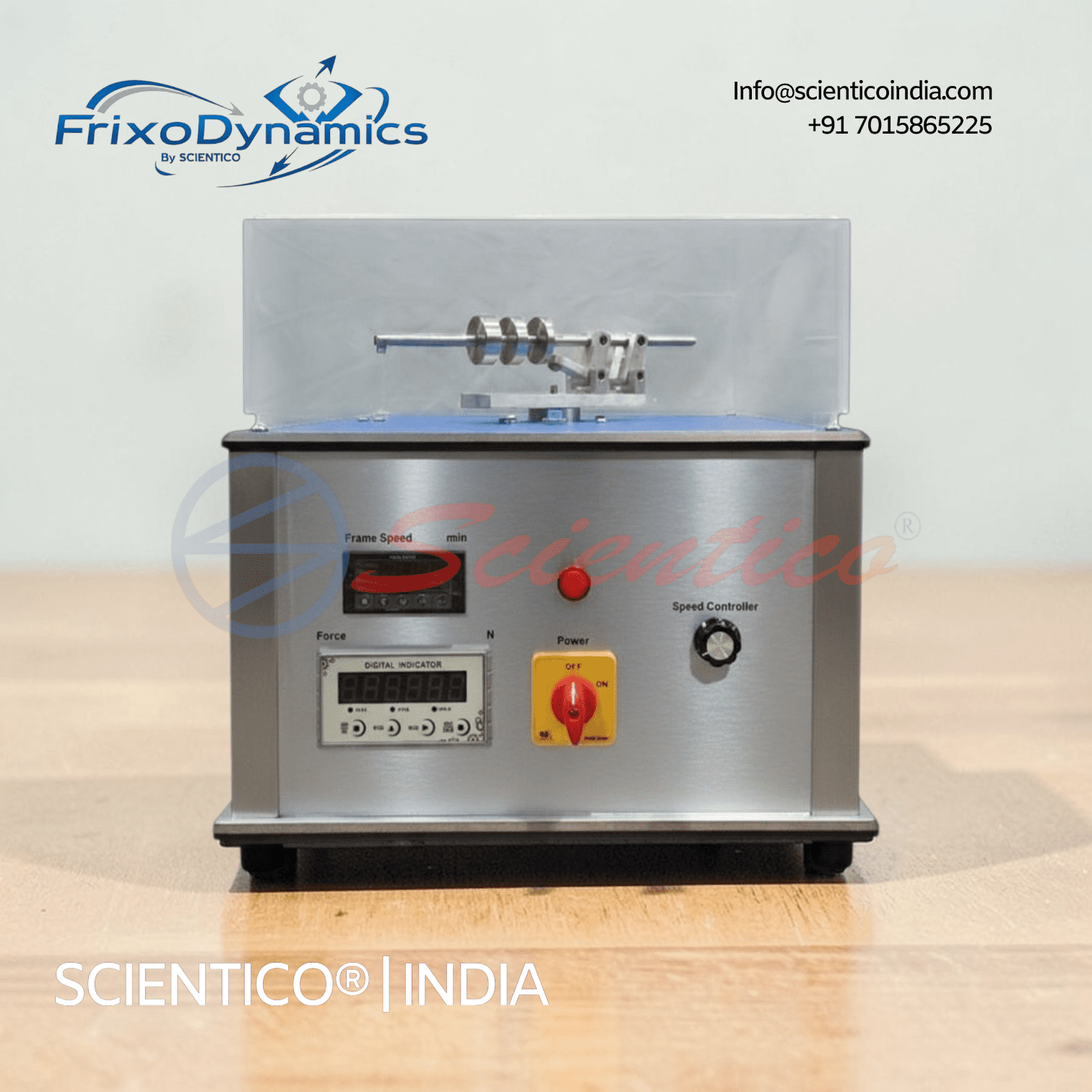
Q1: What is centrifugal force, and how does the FX-507 measure it?
Centrifugal force is the reaction force experienced by a body rotating about an axis, acting outward from the centre of rotation. In the FX-507, this force is transmitted from the rotating mass through the metallic rod to a bending bar. The bar deflects elastically in proportion to the applied force, and an electronic sensor converts this deflection into a force reading displayed digitally on the control panel with a resolution of 0.01 N.
Q2: What variables can be investigated using the FX-507?
The FX-507 is designed to investigate three independent variables: the effect of rotational speed on centrifugal force, the effect of the mass of the rotating body, and the effect of the radius of the circular path. By changing one variable at a time — using the three provided masses, five path radii, and continuously adjustable speed — students can isolate and quantify each dependency individually.
Q3: How is the rotational speed controlled on the FX-507?
Rotational speed is controlled via a 10-turn potentiometer on the control panel, which drives the electric motor at a continuously variable speed between 0 and 400 rpm. The 10-turn design allows finer, more stable speed adjustment compared to a standard single-turn control, and the current speed is confirmed on the digital display throughout the experiment.
Q4: Is the FX-507 safe to operate in an open laboratory environment?
Yes. The rotating assembly is fully enclosed by a transparent protective cover throughout operation, separating students from all moving parts while maintaining a clear view of the mechanism. The unit is also free-standing and portable — it does not require clamping or fixed installation — making it straightforward to position and use on any standard laboratory bench.
Q5: What is included in the scope of delivery for the FX-507?
The FX-507 is supplied as a complete experimental kit including: one centrifugal force experimental unit with motorised rotating platform, bending bar sensor, and digital control panel; three rotating masses (50 g, 75 g, and 100 g); one transparent protective cover; one power cord; and one instructional manual covering experimental procedures, variable configurations, and data recording guidance.