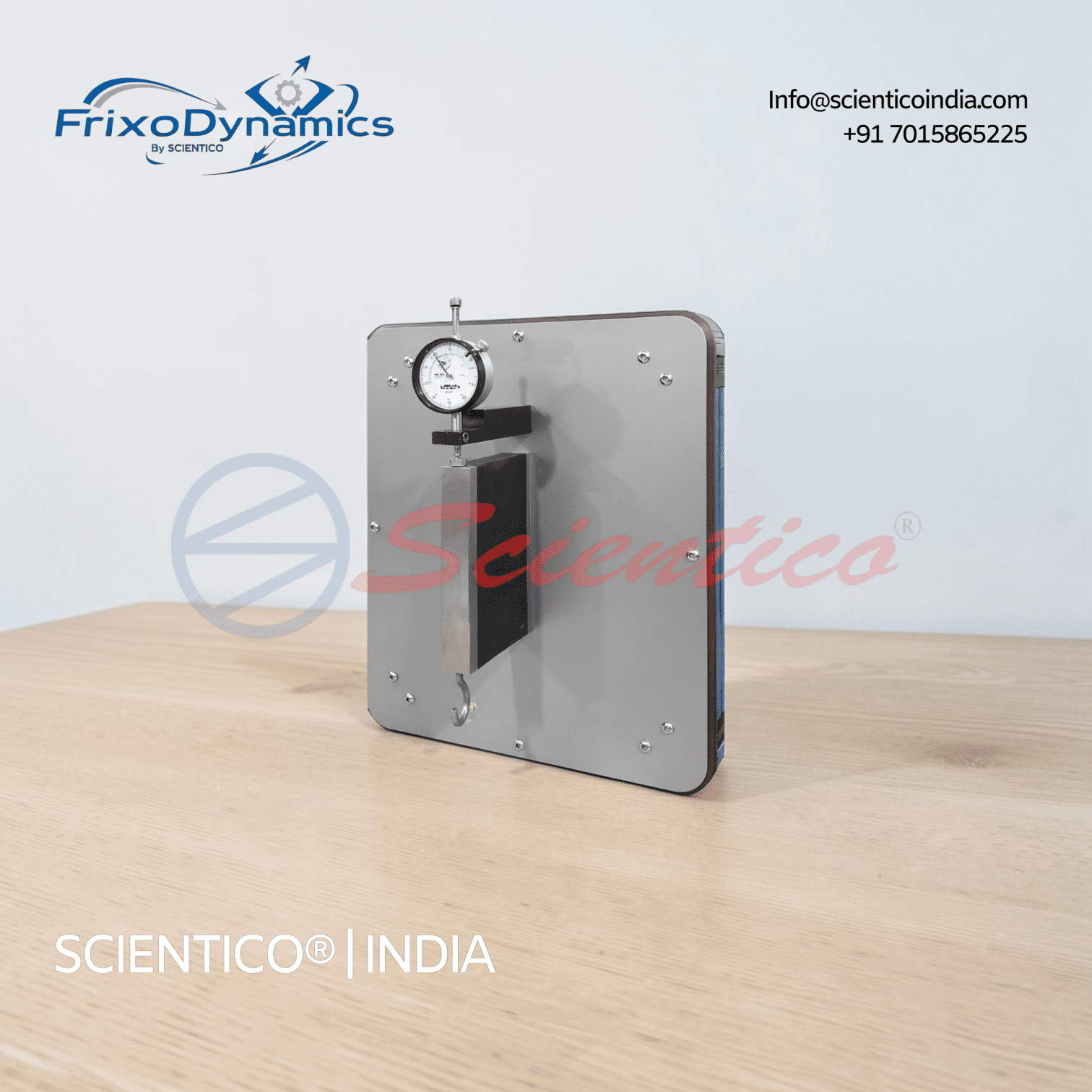
Q1: What is a rubber shear apparatus used for?
A rubber shear apparatus is used to study the shear deformation of rubber under applied loads. It allows students to measure deflection at each load increment and use those values to calculate the modulus of rigidity and investigate the shear stress versus shear strain relationship.
Q2: What is the modulus of rigidity, and how is it determined using the FX-500?
The modulus of rigidity, also called the shear modulus, is the ratio of shear stress to shear strain in a material. Using the FX-500, students apply known weights to the free plate, measure the resulting deformation with the dial gauge, and calculate stress and strain from the block dimensions. The slope of the resulting load-deformation graph gives the modulus of rigidity.
Q3: Why is rubber used as the shear body in this apparatus?
Rubber produces significant, measurable deformation under relatively small loads, making it practical for laboratory-scale testing. It also displays hysteresis — a difference between the loading and unloading deformation paths — which is a key property in engineering applications such as vibration isolation, engine mounting, and flexible couplings.
Q4: What is hysteresis, and can the FX-500 demonstrate it?
Hysteresis in materials refers to the energy dissipated during a loading and unloading cycle, seen as a difference between the two deformation paths. The FX-500 demonstrates this by recording deflection readings while incrementally loading and then unloading the rubber block. The resulting loop on a load-deformation graph represents the energy absorbed by the rubber.
Q5: What is included in the scope of delivery for the FX-500?
The FX-500 is supplied as a complete kit including: one experimental unit (rubber block bonded between aluminium alloy plates, dial gauge, and mounting bracket), one set of calibrated weights (1 x 1 N hanger, 4 x 2 kg, 1 x 1 kg), and one instructional manual covering experimental procedures and data recording.