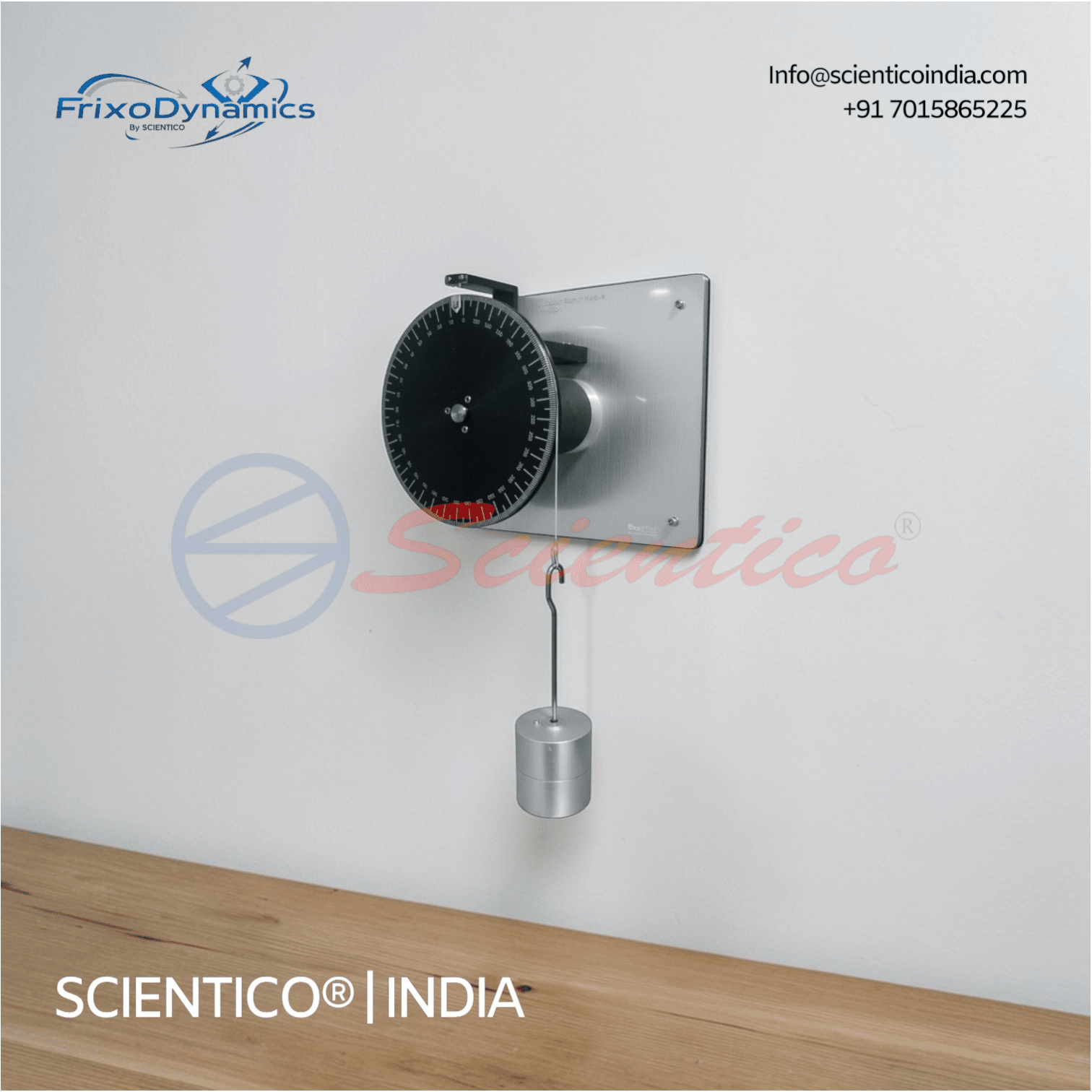
Rubber Shear (Radial) Apparatus | FrizoDynamics FX-501

The SCIENTICO FrizoDynamics FX-501 Rubber Shear (Radial) Apparatus enables students to study the torsional shear behaviour of a rubber cylinder under incrementally applied torque. A graduated round plate (0°–360°) with pointer provides direct angular deformation readings, allowing users to determine the modulus of rigidity, investigate the shear stress–shear strain relationship, and observe hysteresis under cyclic torsional loading. The radial loading mode distinguishes the FX-501 from linear shear units, making it particularly relevant to the study of torsional vibration dampers, flexible couplings, and rotary engine mounting systems. Designed for undergraduate and postgraduate mechanical engineering laboratories, the unit is supplied complete with thread, calibrated weight set, and instructional manual. Manufactured by SCIENTICO, available for institutional supply and international distribution.

The SCIENTICO FrizoDynamics FX-501 Rubber Shear (Radial) Apparatus is a bench-mounted experimental unit designed for mechanical engineering laboratories studying torsional shear behaviour in elastomeric materials. Unlike the linear shear model, this apparatus applies torque to a rubber cylinder and measures the resulting angle of rotation, enabling students to investigate the relationship between shear stress, shear strain, and the modulus of rigidity under radial loading conditions. The unit is compact, self-contained, and supplied with a complete weight set and instructional manual. Manufactured by SCIENTICO, the FX-501 is suitable for supply to engineering institutions and distributors worldwide.  
Product Overview

The FX-501 operates on the principle of torsional shear loading applied to a rubber cylinder bonded between two aluminium alloy plates. The lower plate is fixed rigidly to a wall or support structure using a high-density fixture (HDF), providing a stable base. The upper plate carries a round graduated disc marked from 0° to 360°, fitted with a pointer for direct angular measurement. A loaded weight applies torque to the upper plate via a thread, causing the rubber cylinder to deform in radial shear. The angle of rotation of the upper plate relative to the fixed lower plate is read directly from the graduated disc.

Rubber is chosen as the test body for its capacity to undergo large, measurable deformations under moderate loads — a practical advantage in a laboratory setting. As with linear shear, rubber under torsional loading exhibits hysteresis: the angle of rotation during unloading does not follow the same path as during loading, indicating energy dissipation within the material. This directly reflects the behaviour of rubber components used in torsional vibration dampers, flexible shaft couplings, and engine mounting systems. The FX-501 makes this behaviour directly observable and quantifiable.

Parameter Specification
Model FrizoDynamics FX-501
Rubber Cylinder Dimensions Diameter 75 mm, Length 100 mm
Graduated Disc Range 0° to 360° with pointer
Maximum Load Capacity 9 kg
Plate Material Aluminium Alloy
Wall Fixing HDF (High-Density Fixture)
Weight Set Included 1 x 1 N hanger, 4 x 2 kg, 1 x 1 kg
Scope of Delivery 1 experimental unit, 1 thread, 1 set of weights, 1 instructional manual

Key Features

  • Torsional shear loading applied via dead weights and thread for a controlled, repeatable torque input
  • Graduated round plate (0°–360°) with pointer enables direct angular deformation measurement without additional instrumentation
  • Rubber cylinder (75 mm dia, 100 mm length) bonded between aluminium alloy plates for consistent, repeatable test conditions
  • Lower plate rigidly wall-mounted using HDF, eliminating unwanted movement during loading
  • Demonstrates hysteresis in rubber under torsional loading, linking laboratory results to industrial applications
  • Complete with thread, calibrated weight set, and instructional manual
  • No electrical connections or sensors required — fully mechanical operation

Applications

  • Determination of the variation of angular rotation with applied torsional load
  • Investigation of the relationship between shear stress and shear strain under radial loading
  • Calculation of the modulus of rigidity of a cylindrical rubber block
  • Demonstration of hysteresis in elastomeric materials under cyclic torsional loading
  • Study of torsional vibration damping and flexible coupling behaviour
  • Undergraduate and postgraduate laboratory practicals in mechanical engineering, materials science, and structural mechanics

Construction and System Design

The FX-501 is built around a rubber cylinder of 75 mm diameter and 100 mm length, bonded between two aluminium alloy plates. The bonded interfaces ensure that applied torque is fully transferred into the rubber body as shear stress, without slippage at the plate-rubber joint. The lower plate is bolted to a rigid wall surface using an HDF mounting, establishing a fixed boundary condition throughout the experiment.

The upper plate incorporates a round disc graduated from 0° to 360°, with a fixed pointer for reading the angle of rotation directly. Torque is applied by attaching a thread to the upper plate and hanging calibrated dead weights from it. As each weight increment is added, the rubber cylinder twists, and the angular deformation is read from the disc. The entirely mechanical design eliminates setup complexity and ensures the apparatus is ready for use with minimal preparation.

Export and Supply Capability

The SCIENTICO FrizoDynamics FX-501 is available for supply to engineering colleges, technical universities, mechanical engineering departments, research institutions, and industrial training centres. SCIENTICO manufactures and exports laboratory equipment to institutions and distributors across multiple regions. Standard packaging is suitable for international shipment. Bulk orders, customised configurations, and institutional procurement enquiries are welcomed. Please contact SCIENTICO directly for pricing, lead times, and shipping terms.

Q1: What is a rubber shear radial apparatus used for?

A rubber shear radial apparatus is used to study the torsional shear behaviour of a rubber cylinder under applied torque. Students apply incremental loads, measure the resulting angle of rotation from the graduated disc, and use those values to determine the shear stress, shear strain, and modulus of rigidity of the rubber specimen.

Q2: How is the angle of rotation measured in the FX-501?

The FX-501 uses a round graduated plate marked from 0° to 360°, mounted on the free (upper) aluminium plate and fitted with a fixed pointer. As torque is applied via the weighted thread, the upper plate rotates and the pointer indicates the angle of rotation directly on the scale — no external measuring instruments are required.

Q3: What is the difference between the FX-500 and FX-501 rubber shear apparatus?

The FX-500 applies a linear (direct) shear load to a rectangular rubber block and measures linear deflection using a dial gauge. The FX-501 applies a torsional (radial) shear load to a cylindrical rubber block and measures angular rotation using a graduated disc. Both units investigate the modulus of rigidity and hysteresis, but under different loading modes.

Q4: Why does the FX-501 use a cylindrical rubber block instead of a rectangular one?

A cylindrical geometry is appropriate for torsional loading because the circular cross-section distributes shear stress uniformly around the axis of rotation. This makes the calculation of shear stress and the modulus of rigidity more straightforward and consistent with standard torsion theory applied to solid circular sections.

Q5: What is included in the scope of delivery for the FX-501?

The FX-501 is supplied as a complete experimental kit including: one experimental unit (rubber cylinder bonded between aluminium alloy plates, graduated round disc with pointer, and HDF wall mounting), one thread for torque application, one set of calibrated weights (1 x 1 N hanger, 4 x 2 kg, 1 x 1 kg), and one instructional manual covering experimental procedures and data recording.

You may also like

Lorem ipsum dolor sit amet, consectetur adipiscing elit, sed do eiusmod tempor incididunt ut labore et dolore magna aliqua. Ut enim ad minim veniam, quis nostrud exercitation ullamco laboris nisi ut aliquip ex ea commodo consequat.

Testimonials

Lorem ipsum dolor sit amet, consectetur adipiscing elit, sed do eiusmod tempor incididunt ut labore et dolore magna aliqua. Ut enim ad minim veniam, quis nostrud exercitation ullamco laboris nisi ut aliquip ex ea commodo consequat.

Subscribe to our newsletter

Lorem ipsum dolor sit amet, consectetur adipiscing elit, sed do eiusmod tempor incididunt ut labore et dolore magna aliqua.

    My Quote List

    Cart Quote is empty.
    Scroll to Top