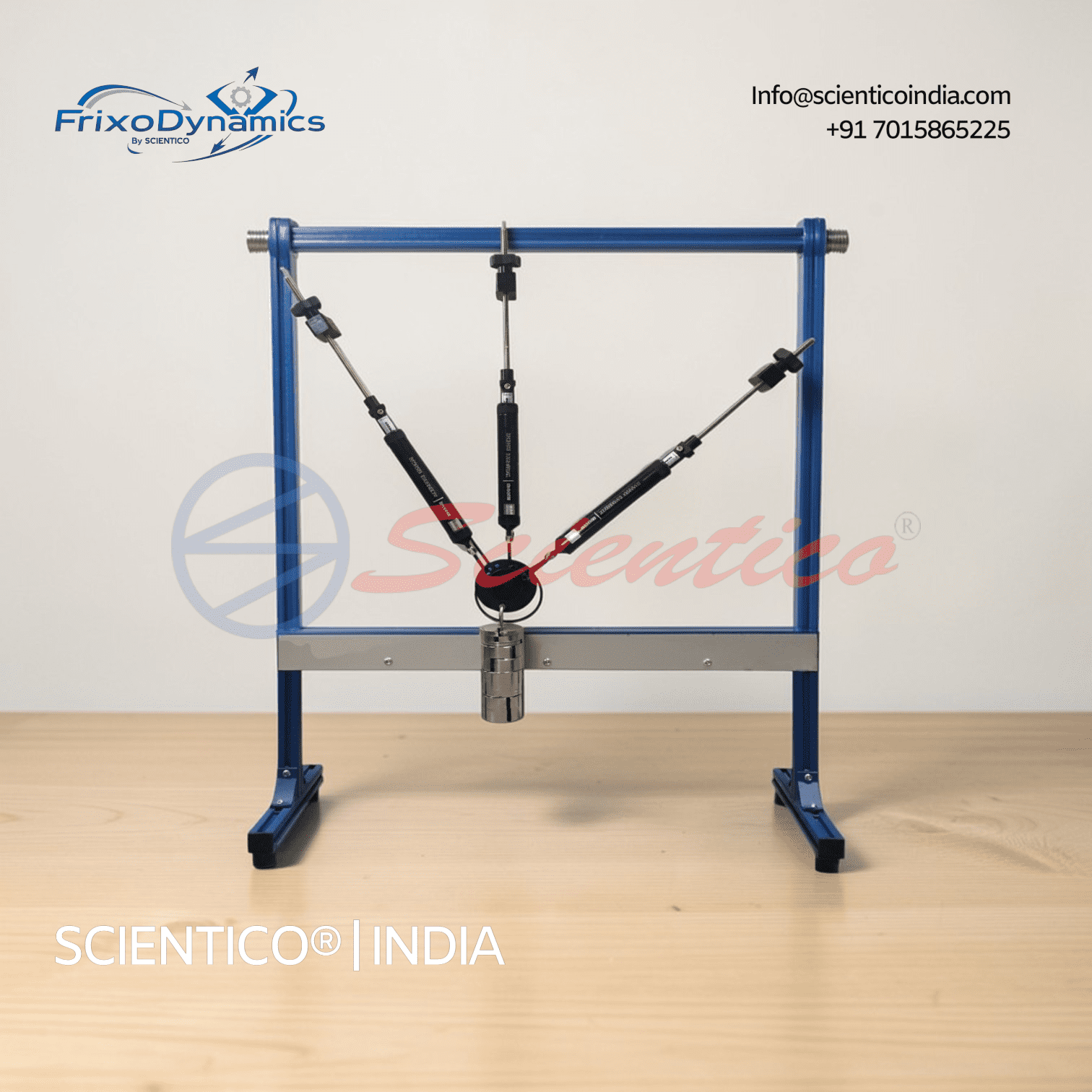
Three Wire Suspension Apparatus | FrizoDynamics FX-503

The SCIENTICO FrizoDynamics FX-503 Three Wire Suspension Apparatus enables students to study force equilibrium in two-wire and three-wire suspension systems. Known loads are applied to a common node ring from which three wires radiate at angles of approximately 45°, 60°, and 90° to the horizontal. The tension in each wire is read directly from integrated linear spring balances, and students verify that the resolved horizontal and vertical force components sum to zero under each applied load. The apparatus also supports investigation of the redundant vertical tie — introducing students to statical indeterminacy in a clear, measurable context. Wire lengths are individually adjustable via threaded rods, allowing accurate geometry setting before each experiment. Designed for statics and structural mechanics laboratories, the FX-503 is supplied complete with three spring balances, node disk, calibrated weight set, and instructional manual. Manufactured by SCIENTICO, available for institutional supply and international distribution.

The SCIENTICO FrizoDynamics FX-503 Three Wire Suspension Apparatus is a bench-mounted, free-standing experimental unit designed for the study of force equilibrium in two and three wire suspension systems. By suspending known loads from a common node ring and reading the tension in each wire directly from integrated spring balances, students verify the conditions of static equilibrium — where the sum of horizontal forces and the sum of vertical forces are both zero. The apparatus also enables investigation of the redundant vertical tie condition in a three wire system. Manufactured by SCIENTICO, the FX-503 is suitable for supply to engineering institutions and distributors worldwide.

Product Overview

The FX-503 consists of a free-standing backboard mounted on a worktable, from which three wires are anchored at fixed angular positions of approximately 45°, 60°, and 90° to the horizontal. All three wires converge at a common node ring — the weight ring — from which a load hanger is suspended. Known weights are applied to the hanger, loading the system and inducing tension in each wire.

Each wire incorporates a direct-reading linear spring balance, allowing the tension in every wire to be measured independently and simultaneously. The length of each wire can be adjusted using a threaded rod connected to its spring balance, enabling the geometry of the system to be set accurately before each experiment. A universal ring connects the load hanger to the node assembly.

The primary experimental objective is equilibrium verification: students resolve the measured wire tensions into horizontal and vertical components and confirm that these components sum to zero under the applied load. The apparatus further allows investigation of the redundant vertical tie — a condition that arises in a three wire system where one wire is vertical and carries a force that cannot be determined by equilibrium equations alone. This introduces students to the concept of statical indeterminacy in a straightforward, observable context.

Parameter Specification
Model FrizoDynamics FX-503
Wire Angles Approximately 45°, 60°, and 90° to the horizontal
Spring Balances 3 x direct-reading linear spring balances, 0–10 kg, Graduation: 50 g
Node Disk 1 x node disk (common ring for wire convergence)
Weight Set 1 x 0.5 N hanger, 2 x 5 N, 2 x 2 N, 2 x 1 N, 2 x 0.5 N
Wire Length Adjustment Threaded rod on each wire for individual length setting
Mounting Bench-mounted free-standing backboard
Scope of Delivery 1 experimental unit, 3 spring balances, 1 node disk, 1 set of weights, 1 instructional manual

Key Features

  • Three wires anchored at approximately 45°, 60°, and 90° to the horizontal, all meeting at a common node ring
  • Each wire fitted with a direct-reading linear spring balance (0–10 kg, 50 g graduation) for independent tension measurement
  • Threaded rod adjustment on each wire allows precise setting of wire length and system geometry
  • Node disk and universal ring provide a stable, well-defined load application point
  • Supports both two-wire and three-wire suspension configurations within a single apparatus
  • Enables direct investigation of the redundant vertical tie and introduction to statical indeterminacy
  • Free-standing backboard design requires no wall fixing — bench-mounted and portable
  • Complete with calibrated weight set and instructional manual for students and lecturers

Applications

  • Study of vertical equilibrium in two-wire and three-wire suspension systems
  • Verification of equilibrium conditions where the sum of horizontal and vertical forces equals zero
  • Examination of the redundant vertical tie force in a three-wire suspension system
  • Introduction to statical indeterminacy through a physically observable experiment
  • Resolution of concurrent coplanar forces at a common node
  • Undergraduate laboratory practicals in statics, structural mechanics, civil engineering, and mechanical engineering

Construction and System Design

The FX-503 is built around a sturdy free-standing backboard that sits on a standard worktable without requiring wall mounting or additional fixings. Three wire anchor points are positioned on the backboard at angles of approximately 45°, 60°, and 90° to the horizontal. Each wire runs from its anchor point down to the common node ring, passing through a direct-reading linear spring balance mounted in-line along the wire’s length. The threaded rod at each anchor allows the wire length to be adjusted independently, enabling the node ring to be positioned correctly and the system geometry to be reproduced accurately between experiments.

The node disk serves as the convergence point for all three wires and carries the load hanger via a universal ring. Dead weights from the supplied set are added to the hanger to apply the experimental load. The in-line spring balances provide simultaneous, direct tension readings for all three wires without the need for additional measuring equipment. The overall design is mechanically straightforward, keeping setup time low while delivering clear, readable results suitable for both measurement and calculation exercises.

Export and Supply Capability

The SCIENTICO FrizoDynamics FX-503 is available for supply to engineering colleges, technical universities, civil and mechanical engineering departments, research institutions, and industrial training centres. SCIENTICO manufactures and exports laboratory equipment to institutions and distributors across multiple regions. Standard packaging is suitable for international shipment. Bulk orders, customised configurations, and institutional procurement enquiries are welcomed. Please contact SCIENTICO directly for pricing, lead times, and shipping terms.

Q1: What is a three wire suspension apparatus used for?

A three wire suspension apparatus is used to study the equilibrium of forces in a concurrent coplanar wire system. Students apply a known load to a common node ring, read the tension in each wire from integrated spring balances, and verify that the resolved horizontal and vertical force components sum to zero — confirming static equilibrium. The apparatus also demonstrates the redundant force condition that arises when one wire is vertical.

Q2: What is a redundant vertical tie, and how does the FX-503 demonstrate it?

In a three-wire suspension system where one wire is vertical, the vertical equilibrium equation alone cannot uniquely determine all three wire tensions — the system is statically indeterminate. The vertical wire is described as redundant because its force cannot be found from equilibrium conditions alone. The FX-503 makes this condition directly observable by allowing students to measure all three wire tensions simultaneously and compare them against values predicted by equilibrium equations.

Q3: How is wire tension measured in the FX-503?

Each of the three wires incorporates a direct-reading linear spring balance with a range of 0–10 kg and a graduation of 50 g. The spring balances are mounted in-line along each wire, so the tension in each wire is read directly from its balance without calculation. This allows all three tensions to be recorded simultaneously at each load increment.

Q4: What is the difference between the FX-503 and the FF-1103?

Both units cover the same experimental objectives — three wire suspension, force equilibrium, and redundant tie investigation — and share the same core specifications. The FX-503 is designated within the FrizoDynamics FX series, while the FF-1103 belongs to the FF series. Buyers should confirm the applicable series with SCIENTICO at the time of enquiry to ensure the correct variant is supplied.

Q5: What is included in the scope of delivery for the FX-503?

The FX-503 is supplied as a complete experimental kit including: one experimental unit (free-standing backboard, three wires with in-line spring balances and threaded rod adjusters, node disk, universal ring, and load hanger), three spring balances (0–10 kg, 50 g graduation), one node disk, one set of calibrated weights (1 x 0.5 N hanger, 2 x 5 N, 2 x 2 N, 2 x 1 N, 2 x 0.5 N), and one instructional manual for students and lecturers.

You may also like

Lorem ipsum dolor sit amet, consectetur adipiscing elit, sed do eiusmod tempor incididunt ut labore et dolore magna aliqua. Ut enim ad minim veniam, quis nostrud exercitation ullamco laboris nisi ut aliquip ex ea commodo consequat.

Testimonials

Lorem ipsum dolor sit amet, consectetur adipiscing elit, sed do eiusmod tempor incididunt ut labore et dolore magna aliqua. Ut enim ad minim veniam, quis nostrud exercitation ullamco laboris nisi ut aliquip ex ea commodo consequat.

Subscribe to our newsletter

Lorem ipsum dolor sit amet, consectetur adipiscing elit, sed do eiusmod tempor incididunt ut labore et dolore magna aliqua.

    My Quote List

    Cart Quote is empty.
    Scroll to Top