
Equipment mentioned in this guide
Review the product information, specifications and model before requesting a quotation.
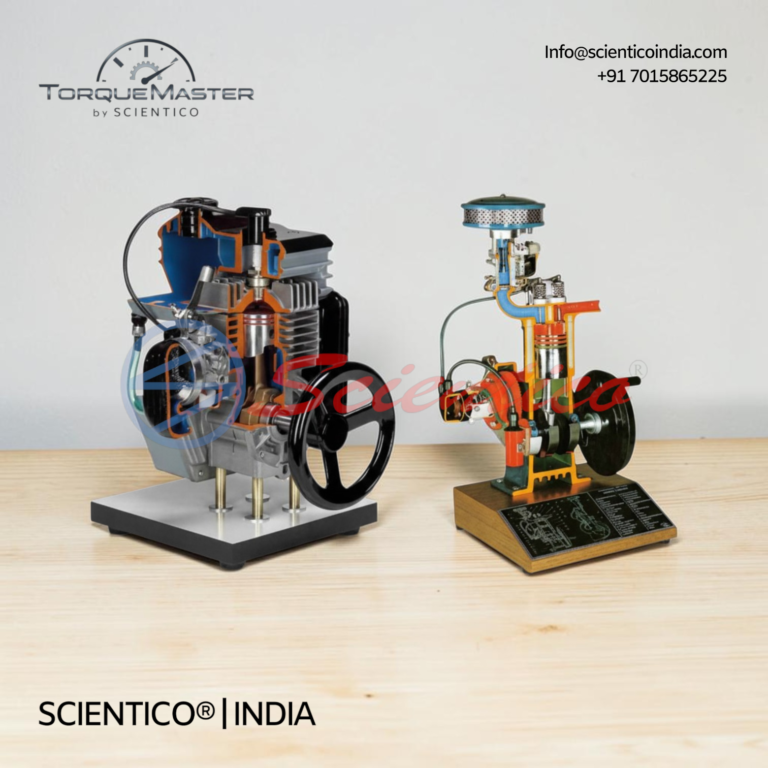
Section Model Two Stroke Four Stroke Petrol Engine | Torquemaster-02
The Section Model Two Stroke Four Stroke Petrol Engine Torquemaster-02 is a cutaway training model built from a real 2-stroke and 4-stroke petrol engine. This Section Model Two Stroke Four Stroke Petrol Engine is sectioned in every detail, including the carburetor and ignition system, to make the engine cycle easy to study.
View product details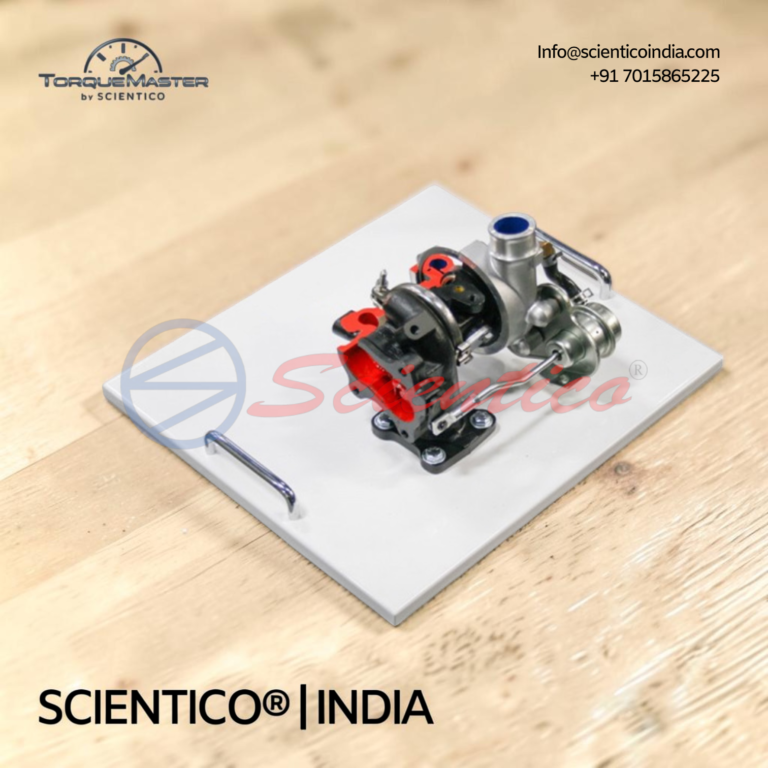
Cut Model Turbo Charger | Torquemaster-04
The Cut Model Turbo Charger Torquemaster-04 enhances the student's learning experience by showing the means by which air intake on naturally aspirated engines can be boosted, thereby increasing power output. As an experienced Cut Model Turbo Charger manufacturer, SCIENTICO Inida carefully sections each unit to reveal all key components and stages.
View product details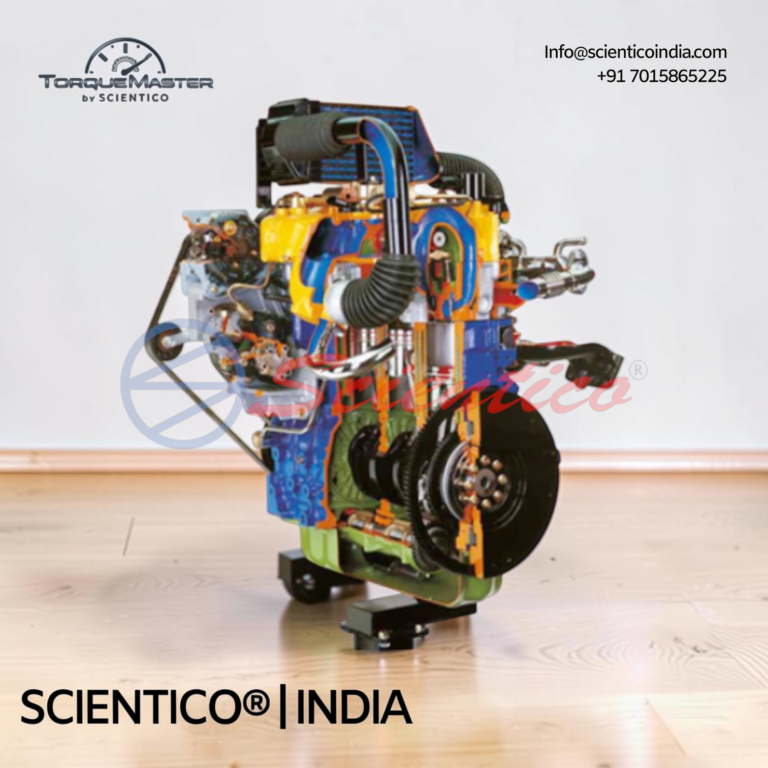
Cut Model of Common Rail Turbo Diesel Engine | Torquemaster-05
The Cut Model of Common Rail Turbo Diesel Engine Torquemaster-05 is carefully sectioned for training purposes, professionally painted with different colours to better differentiate the various parts, cross-sections, lubricating circuits, fuel system, and cooling system. As an experienced Cut Model of Common Rail Turbo Diesel Engine Manufacturer, SCIENTICO India chromium-plates and galvanizes many parts for a longer life.
View product details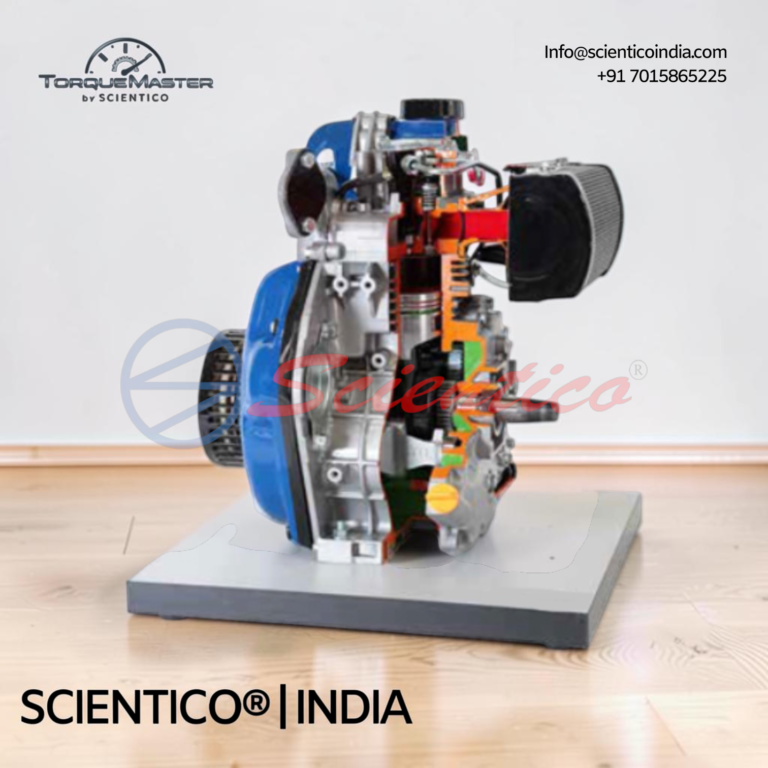
Cut Model of Single Cylinder Four Stroke Diesel Engine | Torquemaster-07
The Cut Model of Single Cylinder Four Stroke Diesel Engine Torquemaster-07 is carefully sectioned for training purposes, professionally painted with different colours to better differentiate the various parts, cross-sections, lubricating circuits, fuel system, and cooling system. As an experienced Cut Model of Single Cylinder Four Stroke Diesel Engine Manufacturer, SCIENTICO chromium-plates and galvanizes many parts for a longer life.
View product details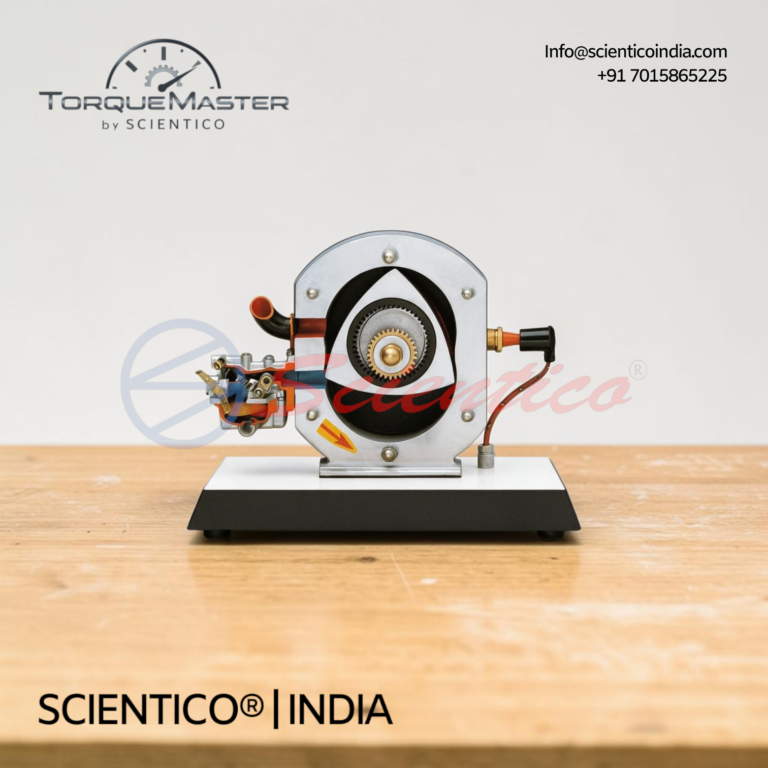
Wankel Engine Model | Torquemaster-09
The Wankel Engine Model Torquemaster-09 is an educational model of a Wankel engine, true to the original and complete with a cutaway carburetor. This Wankel Engine Model clearly demonstrates the rotating motion of the triangular piston inside the stator.
View product details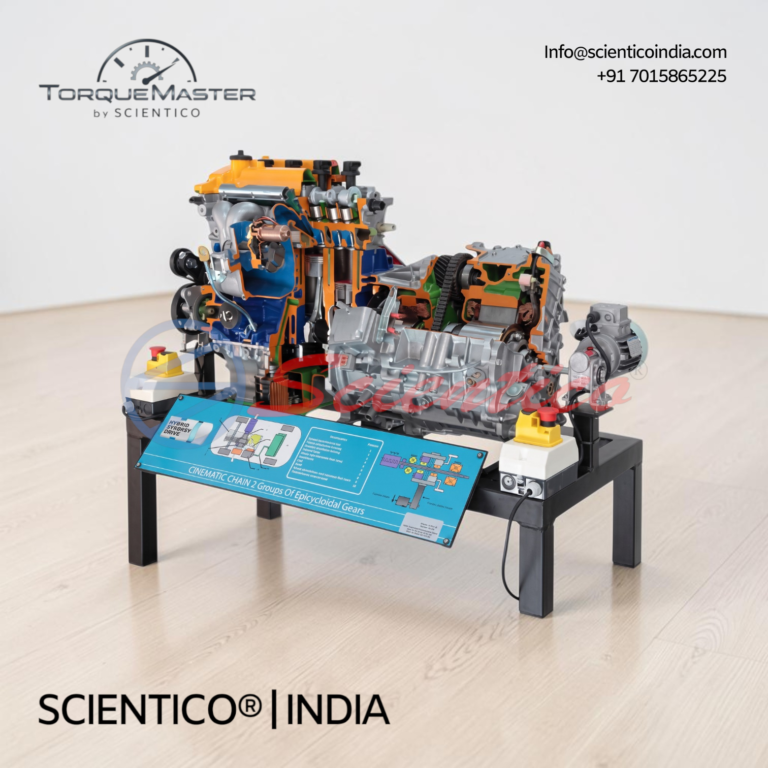
Working Model Of Hybrid Petrol Engine | Torquemaster-15
The Working Model Of Hybrid Petrol Engine Torquemaster-15 is a hybrid petrol engine system working cut section model consisting of a hybrid system (HS) with two sources of power, the petrol engine and the electric motor. This Working Model Of Hybrid Petrol Engine demonstrates how the HS recovers energy otherwise lost to heat in the brakes.
View product detailsWhat an automobile engineering lab actually is, and why it is sized differently
An automobile engineering lab is not a measurement lab. That single sentence changes the whole Bill of Quantities.
In a strength of materials lab or a soil lab, every student eventually has to take a reading off an instrument, so quantity follows batch size. In an automobile lab, most of the teaching value sits in cut-section assemblies, sectioned engines and working trainer boards that a group gathers around while the instructor rotates the crank, opens the throttle, or energises the circuit. One unit serves a rotating group. Buying four gearbox cut-sections for a batch of thirty is money that should have gone into the engine test rig.
I have written and reviewed enough automobile BOQs to see the same two failures repeatedly. The first is quantity inflation on demonstration items. The second is the opposite mistake on the few items that genuinely are per-student or per-group work, mainly the electrical trainers, the diagnostic scan tool exercises and the measurement work that overlaps with the thermal lab.
This page gives you a lab-by-lab list you can lift into a BOQ, with a column for what each item actually demonstrates and a realistic quantity logic for a batch of around thirty students split into groups of five or six. Adjust to your own intake and to the practical list printed in your current university or state board syllabus, which is always the governing document.
Sizing logic before you write a single line item
Fix these four decisions first. Everything else follows.
- Batch size and group size. Most institutions run practicals in batches of about thirty and split into groups of five or six. Write the group count on the front page of your BOQ so every quantity in the file is defensible against one number.
- Demonstration item or working item. A cut-section is a demonstration item, one per lab is normally enough. A trainer board where students make and break connections is a working item, and one per group is the honest requirement.
- Shared across labs or dedicated. Automobile departments almost always share the heat engines and thermal equipment with mechanical engineering. Decide the ownership before purchase, because a shared rig that lives in another block will not be available on your timetable.
- Consumables and running costs. Engine test rigs consume fuel, oil, coolant and brake fluid. Batteries have a service life. Build a recurring line into the file, not just capital items. The wider budgeting logic is covered in the engineering lab equipment cost and budget guide.
Lab 1: Automotive Engines lab
This is the anchor lab of the branch. It carries the dismantling and assembly practicals, the timing exercises and the performance testing. If the budget is phased, this lab goes first.
| Equipment | What it demonstrates or trains | Standard or syllabus link where confident | Qty for a typical batch |
|---|---|---|---|
| Cut-section model of a four stroke petrol engine, motorised | Suction, compression, power and exhaust strokes; piston and connecting rod motion; valve opening sequence relative to crank position | Automotive engines practical: study of petrol engine construction and working | 1 per lab |
| Cut-section model of a four stroke diesel engine, motorised | Compression ignition cycle, injector location, higher compression geometry, differences from the spark ignition unit | Automotive engines practical: study of diesel engine construction | 1 per lab |
| Cut-section of a two stroke engine | Port timing, crankcase scavenging, absence of a conventional valve train | Two stroke cycle study | 1 per lab |
| Actual multi-cylinder petrol engine on stand, dismantling grade | Full strip and rebuild: head removal, piston and ring fitment, bearing inspection, torque sequence discipline | Dismantling and assembly practical | 1 per 2 groups |
| Actual diesel engine on stand, dismantling grade | Strip and rebuild of a compression ignition unit, injector removal, pump timing | Dismantling and assembly practical | 1 per 2 groups |
| Valve timing and port timing diagram apparatus | Marking actual valve open and close angles against crank rotation and plotting the timing diagram | Valve timing diagram experiment | 1 per 2 groups |
| Engine test rig with rope brake, hydraulic or eddy current dynamometer | Brake power, indicated power, mechanical efficiency, specific fuel consumption, heat balance sheet | Performance test on IC engine; loading and fuel measurement per the relevant IS code | 1 to 2 per lab |
| Morse test arrangement on a multi-cylinder engine | Indicated power of each cylinder by successive cut-out, friction power estimation | Morse test practical | 1 per lab |
| Fuel injection pump test bench with nozzle tester | Injection timing, delivery calibration across elements, spray pattern, nozzle opening pressure and chatter | Fuel system practical, diesel | 1 per lab |
| Carburettor and MPFI cut-section set with fuel system trainer | Air fuel mixture formation, float chamber action, comparison of carburetted and electronically injected systems | Fuel system practical, petrol | 1 set per lab |
| Lubrication and cooling system demonstration models | Oil pump and gallery routing, filter position, thermostat action, radiator and water pump circuit | Engine auxiliary systems study | 1 set per lab |
| Engine hand tool kits, torque wrenches, feeler and bore gauges, micrometers, dial indicators | Correct torque application, clearance measurement, cylinder bore wear and ovality, crankshaft run-out | Measurement practical, metrology overlap | 1 kit per group |
The mistake I see most often in this lab is buying a beautiful sectioned engine and no dismantling engine. A cut-section cannot be stripped. If your syllabus has a dismantling and assembly practical, and almost every automobile syllabus does, you need at least one sacrificial engine that students are allowed to open.
Lab 2: Chassis and Transmission lab
This lab is cut-section territory more than any other. Almost everything here is a demonstration or hand-operated working model, which is exactly why the quantity column looks so different from a mechanical measurement lab.
| Equipment | What it demonstrates or trains | Standard or syllabus link where confident | Qty for a typical batch |
|---|---|---|---|
| Sliding mesh, constant mesh and synchromesh gearbox cut-sections | Gear train engagement, dog clutch and synchroniser cone action, gear ratio calculation, reverse idler path | Transmission systems practical | 1 of each per lab |
| Single plate and multi-plate clutch cut-sections, plus a diaphragm clutch unit | Torque transmission, pressure plate and release bearing action, clutch plate wear inspection | Clutch system practical | 1 set per lab |
| Differential and rear axle assembly cut-section | Crown wheel and pinion drive, differential action on cornering, axle types | Final drive practical | 1 per lab |
| Propeller shaft and universal joint model | Angular drive transmission, slip joint accommodation of suspension travel | Drive line study | 1 per lab |
| Steering gearbox cut-sections: rack and pinion, recirculating ball, worm and roller | Steering ratio, mechanical advantage, play adjustment, linkage geometry | Steering system practical | 1 set per lab |
| Power steering demonstration unit | Hydraulic assist circuit, control valve action, pump and reservoir layout | Steering system practical | 1 per lab |
| Front axle and steering geometry model with adjustable camber, caster, KPI and toe | Setting and measuring wheel geometry angles and understanding Ackermann condition | Steering geometry practical | 1 per 2 groups |
| Suspension system trainer: leaf spring, coil, independent strut, air suspension model | Spring rate, damper action, sprung and unsprung mass, independent versus rigid axle behaviour | Suspension practical | 1 set per lab |
| Shock absorber cut-section and test arrangement | Damping in bump and rebound, valve and orifice action, fluid displacement | Suspension practical | 1 per lab |
| Hydraulic brake system trainer with master cylinder, wheel cylinders, drum and disc units | Pascal law in a braking circuit, bleeding procedure, drum shoe and disc caliper comparison, lining wear | Braking system practical | 1 per 2 groups |
| Air brake system trainer | Compressor, reservoir, brake valve and chamber operation on heavy vehicles | Braking system practical, commercial vehicle | 1 per lab |
| Chassis frame model and body types display set | Ladder, monocoque and space frame construction, load paths, mounting points | Vehicle structure study | 1 set per lab |
| Automatic transmission and torque converter cut-section | Planetary gear set operation, fluid coupling and torque multiplication, clutch pack engagement | Advanced transmission topic, degree level | 1 per lab |
One practical note on procurement. Cut-sections vary enormously in quality. A good one is machined so the internals stay functional and hand rotation still turns the train, with the cut faces painted in contrasting colours so a student standing three feet away can read the assembly. A poor one is a scrapped part sliced open. Put the words “functional cut-section, hand operated, cut faces finished and colour coded, mounted on a stand with a nameplate” into your specification and you filter out most of the bad supply. The same discipline that goes into a good tender specification is covered in the tender documents checklist for government colleges.
Lab 3: Automotive Electrical and Electronics lab
This is the lab where the sizing logic flips. Students need to make connections, take meter readings and trace faults, so trainer boards should be per group, not per lab.
| Equipment | What it demonstrates or trains | Standard or syllabus link where confident | Qty for a typical batch |
|---|---|---|---|
| Starting system trainer with starter motor, solenoid and battery | Cranking circuit, solenoid pull-in and hold-in windings, Bendix or pre-engaged drive, current draw measurement | Automotive electrical practical | 1 per group |
| Charging system trainer with alternator and regulator | Alternator output against speed, rectification, voltage regulation, belt drive and load response | Automotive electrical practical | 1 per group |
| Ignition system trainer: conventional coil, electronic and distributorless | Primary and secondary circuit, spark timing, advance mechanisms, coil-on-plug operation | Ignition system practical | 1 per group |
| Lighting and accessories wiring trainer with fault insertion | Head lamp, indicator, horn and wiper circuits, wiring colour codes, relay and fuse logic, systematic fault tracing | Vehicle wiring practical | 1 per group |
| Battery testing set: hydrometer, high rate discharge tester, digital battery analyser, charger | State of charge, specific gravity, load behaviour, charging routine and safety | Battery practical | 1 set per 2 groups |
| Sensors and actuators trainer | Signal behaviour of crank, cam, MAP, oxygen and throttle position sensors, injector and idle actuator response | Automotive electronics, degree level | 1 per 2 groups |
| Engine management system trainer with ECU and simulator | Closed loop control, sensor input to actuator output, fault code generation and clearing | Automotive electronics, degree level | 1 per lab |
| CAN bus and vehicle network demonstration board | Serial communication between control modules, message priority, network fault effects | Advanced elective, degree level | 1 per lab |
| Digital multimeters, clamp meters, oscilloscope, test lamps | Voltage drop testing, current measurement, waveform capture on ignition and sensor signals | Measurement practical | 1 set per group |
If your department also runs shared instrumentation with the electrical department, worth reading alongside the electrical engineering lab equipment list and the ECE lab equipment list, since the meters, power supplies and oscilloscopes overlap heavily and joint procurement usually gets a better line item.
Lab 4: Vehicle Maintenance, Testing and Diagnostics lab
This lab is the closest thing in the syllabus to a working workshop, and it is the one external examiners and inspection panels tend to photograph.
| Equipment | What it demonstrates or trains | Standard or syllabus link where confident | Qty for a typical batch |
|---|---|---|---|
| Wheel alignment equipment, computerised or optical | Measuring and correcting camber, caster, toe and thrust angle on a live vehicle or axle assembly | Vehicle maintenance practical | 1 per lab |
| Wheel balancing machine | Static and dynamic imbalance, weight placement, effect of imbalance on ride and tyre wear | Vehicle maintenance practical | 1 per lab |
| Tyre changer and tyre inspection set | Bead breaking, mounting and demounting, tyre markings, tread depth and wear pattern reading | Wheels and tyres practical | 1 per lab |
| Exhaust gas analyser for petrol engines | Concept of CO, HC, CO2 and O2 measurement, combustion completeness, effect of mixture strength and ignition timing | Emission testing concepts; applicable norms per the current CMVR notification, verify the version in force | 1 per lab |
| Diesel smoke meter | Concept of opacity measurement, effect of injection timing and load on smoke level | Emission testing concepts, diesel | 1 per lab |
| OBD scan tool and diagnostic trainer | Reading and interpreting fault codes, live data streams, freeze frame concept, guided fault tracing | Vehicle diagnostics practical | 1 per 2 groups |
| Compression tester, cylinder leak-down tester, vacuum gauge | Ring, valve and gasket condition assessment without dismantling | Engine condition testing | 1 set per 2 groups |
| Headlamp aiming and alignment device | Beam pattern and aim setting against the marked reference | Vehicle inspection practical | 1 per lab |
| Vehicle lift, hydraulic jacks, axle stands and creepers | Safe raising and supporting of a vehicle, underbody inspection routine | Workshop safety and maintenance | As per bay layout, minimum 1 lift |
| Complete working vehicle, petrol and diesel, for live practicals | System-level integration, servicing routine, road-worthiness checks, live diagnostics | Vehicle maintenance practical | 1 or 2 per department |
| Air compressor with distribution line and air tools | Pneumatic tool operation, cleaning, tyre inflation, impact wrench use | Workshop infrastructure | 1 per workshop |
On the emission side, keep the teaching claim modest and accurate. A college lab teaches the measurement concept, the instrument principle and the interpretation of readings. It is not a certification centre, and no institutional lab should describe its emission readings as compliance test results unless it holds the specific accreditation for that. The distinction between teaching equipment and accredited testing is set out in the NABL and ISO/IEC 17025 accreditation equipment guide.
Lab 5: Heat Engines and Thermal overlap
Every automobile programme carries a thermal block, and in most colleges it is physically the same lab as mechanical engineering’s thermal lab. Sort out ownership early.
| Equipment | What it demonstrates or trains | Standard or syllabus link where confident | Qty for a typical batch |
|---|---|---|---|
| Single cylinder diesel engine test rig with calorimeter | Heat balance sheet, brake thermal efficiency, energy split between work, cooling water and exhaust | Heat engines practical | 1 per lab |
| Variable compression ratio engine rig | Effect of compression ratio on efficiency and knock tendency | Heat engines practical, degree level | 1 per lab |
| Bomb calorimeter and flash and fire point apparatus | Calorific value of fuel, volatility and safe handling temperature of fuels and lubricants | Fuels and lubricants practical, per the relevant IS code | 1 each per lab |
| Redwood and Saybolt viscometer | Viscosity of lubricating oil and its variation with temperature, grade selection logic | Fuels and lubricants practical, per the relevant IS code | 1 each per lab |
| Air compressor test rig | Volumetric efficiency, indicated and shaft power, staged compression | Thermal engineering practical | 1 per lab |
| Automotive air conditioning trainer | Vapour compression cycle on a vehicle HVAC unit, compressor, condenser, expansion device and evaporator | Vehicle HVAC practical | 1 per lab |
If the thermal block is shared, list the items once in the mechanical file and cross-reference them in the automobile file rather than duplicating capital cost. The full sibling list is at the mechanical engineering lab equipment list for B.Tech.
B.Tech level versus diploma level: what actually changes
The core hardware is close to identical. The difference sits in three places.
Depth of instrumentation. Degree programmes carry more analysis, so the engine test rig, the VCR engine, the ECU trainer and the network demonstration board matter more. Diploma programmes weight practice higher, so the dismantling engines, the trainer boards and the workshop bay get more of the budget.
Elective hardware. Hybrid and electric vehicle trainers, battery management demonstration units and advanced driver assistance demonstration kits usually appear at degree level as elective support. Add them once the core five labs are complete, not before.
Documentation weight. A degree programme heading into programme accreditation needs experiment-to-outcome mapping, calibration records and utilisation logs in a form an assessor can audit. Diploma programmes under a state board of technical education face a different inspection format. Both are described in the polytechnic diploma lab equipment list guide, and the accreditation file structure is covered in the NBA accreditation lab documentation guide.
Do not treat any specific numeric threshold you have heard about as settled. Equipment counts, area norms, intake ratios and staffing figures are revised periodically by AICTE, by the National Board of Accreditation and by each state board of technical education. Take the numbers from the current official handbook or approval process document for the year you are applying in, not from a vendor list and not from a page like this one. The category-level view is in the AICTE lab requirements guide for engineering colleges, and institutional assessment context sits in the NAAC lab documentation criteria guide.
The ITI Mechanic Motor Vehicle overlap
If your campus also runs an ITI, or if you are a polytechnic sharing a workshop block with one, the overlap with the Mechanic Motor Vehicle trade is substantial. Dismantling engines, hand tool kits, brake and clutch trainers, battery testing sets, wheel alignment and balancing equipment and the vehicle lift all serve both.
Where they diverge: the ITI trade is heavier on repetition, hand skill and job-card style work, so it needs more tool sets and more bench positions per learner. The degree and diploma labs are heavier on measurement, calculation and reporting, so they need more instrumentation per group. Plan the shared items jointly and the divergent items separately. The trade-wise breakdown is in the ITI lab equipment list by trade.
Writing the specification so you get what you asked for
Automobile equipment is the easiest category in which to receive something technically compliant and pedagogically useless. Six lines that tighten a specification:
- State whether an item must be functional or merely display. “Gearbox cut-section, hand rotatable, all gears engageable through the shift lever” is a very different purchase order line from “gearbox cut-section”.
- Name the mounting. Stand mounted, wall mounted, trolley mounted or bench mounted changes the usable life of the item in a busy lab.
- Ask for the nameplate and the labelled part callouts. A cut-section without labels forces the instructor to repeat the same twenty part names every batch.
- Specify the instruction manual, the experiment sheet and the wiring or hydraulic diagram as deliverables. These become your accreditation evidence later.
- State the electrical supply and any compressed air requirement per item so your civil and electrical layout matches the equipment before delivery, not after.
- Ask for the calibration certificate or test report on measuring instruments, and record the certificate number in your asset register.
For public procurement, the authorisation paperwork usually decides who can bid at all, which is why the manufacturer authorisation form for lab equipment tenders is worth reading before you publish. If you are buying through the government marketplace, the category and specification mechanics are set out in the GeM lab equipment procurement guide.
Phasing a new automobile department
If you are commissioning from zero, this is the order I would fund it in.
Phase one. Automotive Engines lab in full, plus hand tools, plus the workshop bay with a lift and compressor. Without this you cannot run the first practical.
Phase two. Chassis and Transmission cut-sections and the electrical trainer boards. These carry the largest number of listed experiments per rupee spent.
Phase three. Testing and diagnostics: alignment, balancing, gas analyser, smoke meter, scan tools, plus the live vehicles.
Phase four. Electronics depth and electives: ECU trainer, sensors and actuators, network board, hybrid and EV demonstration units.
The general commissioning sequence for a new department, including layout, utilities and first-year shared labs, is in the first procurement guide for new engineering colleges, and the shared first-year science labs are listed in the first-year physics and chemistry lab equipment list.
Safety and layout points that get flagged at inspection
Automobile labs run engines indoors. That single fact drives most of the safety file.
- Exhaust extraction on every running engine position, ducted outside, not just a wall fan.
- Fuel storage in an approved cabinet away from the running bay, with the quantity on record.
- Fire extinguishers of the correct class for fuel and electrical fires, with service tags current.
- Battery charging in a separate ventilated position, with eyewash and neutralising material available.
- Guarding on all rotating shafts, belt drives and dynamometer couplings.
- Clear floor marking around the lift and the vehicle bay, with jack stand use mandatory.
- Displayed standard operating procedure at each rig, and a signed lab safety induction record for every batch.
Keep the safety induction records and the equipment log in the same file as your experiment-to-outcome mapping. Assessors ask for both, and producing them together is far easier than reconstructing them a week before a visit.
About the equipment we build
Scientico has manufactured laboratory and engineering teaching equipment from its own works in Ambala, Haryana since 1993, and supplies institutions in more than 60 countries. The company is ISO 9001:2015 certified, and CE conformity documentation is available on applicable models. Scientico is a teaching equipment manufacturer, not an ISO/IEC 17025 or NABL accredited testing laboratory.
The current catalogue spans multiple engineering equipment families, including engine and thermal rigs in the ThermoFlux family, dynamics and vibration equipment under ProDynami and VibranoX, fluid systems under FluidoSurge and FluidoSurgeX, materials testing under FortiTestX, and friction and wear equipment under FrixoDynamics. Supply is quote-based with no published prices, on CIF or FOB terms from Nhava Sheva or Mundra. Catalogues and specification sheets are available on the downloads page, the broader range sits under engineering training equipment, and institutions outside India can find regional representation through locate a distributor.
Next step
Send us your syllabus practical list and your batch size, and we will return a line-by-line BOQ with quantities matched to your group structure and specifications written in tender-ready language. Write to [email protected] or message WhatsApp +91 7015865225, or use the form on our contact page.
One honest ask
We don't gate anything on this site. You just read the whole thing free. If it was useful, leave your email and two things happen: we send you this page as a plain-text block you can paste into a tender file or an internal email, and we notify you the next time we publish a buyer tool like this one. Nothing else. No drip sequence, no sales calls booked without asking.
Match automotive training equipment to the practical
Build an automobile engineering equipment list from the practicals and competencies students need to complete. Then match each requirement to the format: a cutaway for component construction, a manually operated model for tracing a mechanism, or a working trainer for observing an operating sequence. These formats are not interchangeable. The directory below links every current Torquemaster product record in the live catalogue; open the exact model page and confirm configuration and included scope in its current datasheet and written quotation.
Use the three groups as a navigation aid, not a substitute for the syllabus or technical schedule. Engine and valve-train records cover combustion, construction and related systems; transmission and driveline records help compare gears, clutches, differentials and power transfer; vehicle-system records collect chassis, steering, braking, starting, charging and other vehicle functions. On each product page, check what is visibly described, how the model is operated, the included parts and any stated dimensions or utilities before putting it into a BOQ.
Engine, combustion and valve-train study
- Section Model Two Stroke Four Stroke Petrol Engine — Torquemaster-02
- Cut Model Turbo Charger — Torquemaster-04
- Cut Model of Common Rail Turbo Diesel Engine — Torquemaster-05
- Cut Model of Single Cylinder Four Stroke Diesel Engine — Torquemaster-07
- Wankel Engine Model — Torquemaster-09
- Working Model Of Hybrid Petrol Engine — Torquemaster-15
- Working Model Of MPFI Petrol Engine — Torquemaster-17
- Working Model Of Valve Timing — Torquemaster-22
- Cut Section Model of Four Stroke Petrol Engine — Torquemaster-34
Transmission, gears and driveline
- Cut Section Model of Automatic Transmission — Torquemaster-01
- Cut Model of Planetary Gear System — Torquemaster-03
- Cut Model of Rear Axle with Locking Differential — Torquemaster-06
- Working Model Of Clutch Type Differential — Torquemaster-10
- Working Model Of Drive Shaft — Torquemaster-12
- Working Model Of Gear Box With Clutch — Torquemaster-13
- Working Model Of Gear Box — Torquemaster-14
- Working Model Of Torsion Differential — Torquemaster-21
- Cut Model Of Planetary Gear System — Torquemaster-23
- Model of Automatic Transmission System — Torquemaster-32
Chassis, steering, braking and vehicle electrical systems
- Section Vehicle Chassis Trainer — Torquemaster-08
- Working Model Of Abs Braking System — Torquemaster-11
- Working Model Of Hydraulic Braking System — Torquemaster-16
- Working Model Of Power Steering With Suspension — Torquemaster-18
- Power Window System Trainer — Torquemaster-19
- Fully Functional Cut Section Model Of Chassis — Torquemaster-20
- Cut Model of Agricultural Tractor — Torquemaster-24
- Cut Section Model of Rack and Pinion Steering — Torquemaster-25
- Alternator Trainer Externally Regulated — Torquemaster-29
- ABS Braking System Training Board Simulator — Torquemaster-30
- Car Steering Trainer — Torquemaster-31
- Cut Model of Self Starting System — Torquemaster-33
Check two similarly named planetary-gear listings
The catalogue contains separate Torquemaster-03 and Torquemaster-23 records with closely similar planetary-gear cut-model names and overlapping descriptions. Keep the model codes distinct when comparing bids. The Torquemaster-03 page lists approximate dimensions of 450 × 400 × 300 mm and approximate weight of 10 kg; the Torquemaster-23 page describes the cutaway and its drawing/technical-description material. Confirm the exact model, drawing, configuration and current dimensions for the offered item before using those details in a room plan or tender.
Review Torquemaster-03 side by side with Torquemaster-23; do not infer that the two records are interchangeable from their names.
Prepare a model-specific RFQ or tender comparison
For each BOQ line, provide the exact model name and code, intended practical or competency, required demonstration format, quantity and destination. Ask the manufacturer to confirm the proposed configuration, included assemblies and accessories, dimensions and weight, utility requirements, manuals or drawings, any requested training or commissioning scope, deviations from the technical specification, and applicable delivery and commercial terms. Request a line-by-line technical response so the purchase committee can compare the offered model with its specification. Confirm final technical and commercial scope in writing before issuing the purchase order.
For branch planning, cross-check the automobile engineering lab equipment guide against your syllabus. Browse the engineering training equipment catalogue, then send your syllabus or BOQ, exact model codes and quantities through the enquiry page when requesting a model-specific quotation.