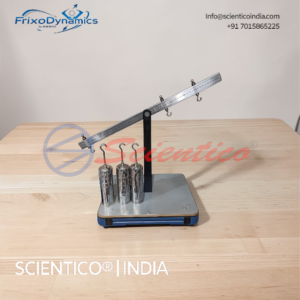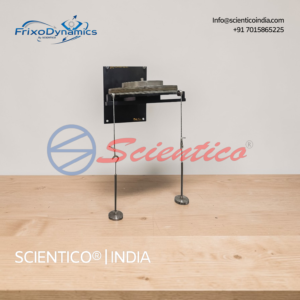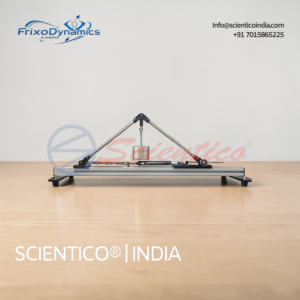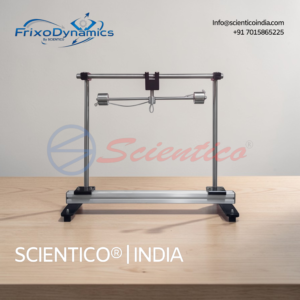

Belt and Cord Friction Apparatus | FrixoDynamics FX-519
The SCIENTICO Belt and Cord Friction Apparatus is a portable, bench-mounted experimental unit for the determination of friction coefficients in belt and cord systems, and for the verification of Eytelwein’s rope friction formula across three belt types, flat belt, V-belt, and round belt. Made by Scientico India, ISO 9001:2015 certified, and supplied with a calibration certificate and operation manual.
The SCIENTICO FrixoDynamics FX-519 Belt and Cord Friction Apparatus is a portable, bench-mounted experimental unit for the determination of friction coefficients in belt and cord systems, and for the verification of Eytelwein’s rope friction formula across three belt types, flat belt, V-belt, and round belt. The apparatus uses a 150 mm diameter cast iron pulley with three distinct belt grooves, and allows the angle of contact to be adjusted between 30° and 210° in 30° increments. Two calibrated weight sets apply the belt tensions required for the experiment, and the influence of contact angle, belt type, and tension ratio on frictional behaviour can be investigated systematically. Manufactured by SCIENTICO, the FX-519 is suitable for supply to engineering institutions and distributors worldwide.
Product Overview
Friction in belt drives governs both the power transmission capability and the wear characteristics of the belt and pulley system. The relationship between the tight-side tension, the slack-side tension, the angle of contact, and the coefficient of friction is described by Eytelwein’s rope friction formula, also known as the belt friction equation. This states that the ratio of the tensions on the two sides of a belt wrapped around a pulley is an exponential function of the product of the friction coefficient and the angle of contact. The FX-519 is designed to allow students to verify this relationship experimentally for three different belt profiles and to compare the frictional behaviour of each.
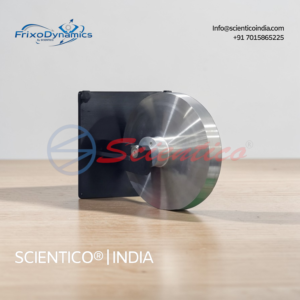
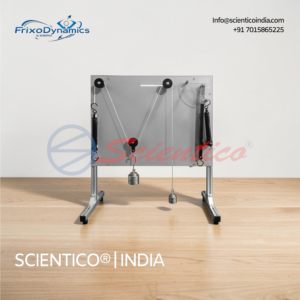
The apparatus consists of a ball bearing-mounted pulley of 150 mm diameter, manufactured from anodised cast iron, fitted with three grooves corresponding to the flat belt, V-belt, and round belt profiles. The pulley is mounted on a rigid metal stand frame. A belt is passed over the pulley at a selected contact angle, which is set and read from a graduated scale on the frame at 30° increments from 30° to 210°. One end of the belt carries a load hanger to which weights are applied, representing the load-side tension. The pulley is then rotated against this load by pulling on a cord attached to a second hanger on the opposite side, with weights added until the belt begins to slip or reaches equilibrium, establishing the tight-side tension.
By recording both tension values at each contact angle and for each belt type, students apply the Eytelwein formula to calculate the implied coefficient of friction, and compare the results across flat belt, V-belt, and round belt configurations. The influence of incorrectly aligned belts on friction and slip behaviour can also be demonstrated, connecting the laboratory experiment directly to practical belt drive maintenance and design considerations.
Request Specifications & Pricing
model-specific, ISO 9001:2015 compliant. Supplied to universities and institutions in 30+ countries.
WhatsApp: +91 701-586-5225 | Email: [email protected]
View Quality Certifications | FAQ, Shipping, Warranty, Lead Time
| Parameter | Specification |
|---|---|
| Model | FrixoDynamics FX-519 |
| Pulley Diameter | 150 mm |
| Pulley Material | Cast iron, anodised |
| Pulley Mounting | Ball bearing-mounted |
| Belt Grooves | 3, flat, V-profile, round |
| Angle of Contact Range | 30° – 210° |
| Angle Graduation | 30° increments |
| Flat Belt | 15 x 2.2 mm, leather/polyamide |
| V-Belt | ISO 4184, Profile V A-Type, 12 x 10 mm, rubber/fabric |
| Round Belts | 8 mm and 10 mm diameter, rubber |
| Weight Set | 1 x 1 N hanger, 1 x 0.5 N hanger, 5 x 5 N, 4 x 2 kg, 1 x 1 kg |
| Frame | Portable metal stand |
| Scope of Delivery | 1 experimental unit, 1 flat belt, 1 V-belt, 2 round belts, 2 sets of weights, 1 thread, 1 instructional manual |
Key Features
- Three belt types, flat belt (leather/polyamide), V-belt (ISO 4184, rubber/fabric), and round belts (rubber, 8 mm and 10 mm), allow direct comparison of friction coefficients across belt profiles
- Contact angle adjustable from 30° to 210° in 30° increments for systematic verification of the Eytelwein formula’s angle dependency
- Ball bearing-mounted 150 mm cast iron pulley with three dedicated grooves ensures correct belt seating for each belt type
- Two calibrated weight sets provide the tight-side and slack-side tension loading for friction coefficient determination
- Consequences of incorrect belt alignment demonstrable directly on the apparatus
- Portable metal stand, self-contained, no wall mounting or power supply required
- Covers flat belt versus V-belt versus round belt friction comparison in a single apparatus
- Results directly comparable against Eytelwein’s rope friction formula theoretical predictions
Applications
- Determination of the coefficient of friction for flat belt, V-belt, and round belt on a cast iron pulley
- Experimental verification of Eytelwein’s rope friction formula
- Investigation of the influence of contact angle on the tension ratio and friction coefficient
- Comparison of friction behaviour across flat belt, V-belt, and round belt profiles
- Study of the consequences of incorrectly aligned belt on friction and slip
- Investigation of the relationship between belt tension, contact angle, and belt drive slip
- Undergraduate laboratory practicals in mechanical engineering, tribology, machine elements, and power transmission
Construction and System Design
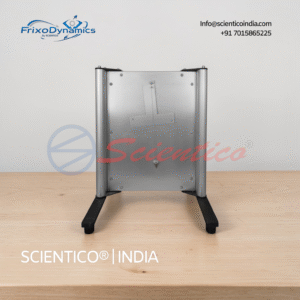
The FX-519 is mounted on a portable metal stand that provides a stable, upright support for the pulley assembly without requiring bench clamping or wall fixing. The 150 mm diameter anodised cast iron pulley is mounted on precision ball bearings, minimising rotational friction at the shaft and ensuring that the resistance measured during the experiment reflects belt-pulley friction rather than bearing losses. Three grooves are machined into the pulley periphery, a flat groove for the flat belt, a V-profile groove matching the ISO 4184 A-type profile, and a round groove for the 8 mm and 10 mm round belts.
The contact angle is set by positioning the belt on the pulley at the required wrap angle and confirming the angle against the graduated scale on the frame. The scale is marked at 30° intervals from 30° to 210°, covering the full practical range of belt wrap angles encountered in drive systems. One end of the belt is attached to a load hanger from which the slack-side weight is suspended. The cord on the opposite side of the pulley carries the tight-side hanger. Weights are added to the tight-side hanger until the pulley rotates against the slack-side load, establishing the critical tension ratio at the point of impending slip.
The flat belt is of leather and polyamide construction at 15 x 2.2 mm cross-section. The V-belt conforms to ISO 4184 standard A-type profile at 12 x 10 mm, manufactured from rubber and fabric. Two round belts of 8 mm and 10 mm diameter, both in rubber, provide additional belt geometry comparisons. The range of belt materials and profiles ensures that the friction coefficient results obtained span a meaningful range, clearly demonstrating how belt design influences frictional performance in practical drive applications.
Export and Supply Capability
The SCIENTICO FrixoDynamics FX-519 is available for supply to engineering colleges, technical universities, mechanical engineering departments, research institutions, and industrial training centres. SCIENTICO manufactures and exports laboratory equipment to institutions and distributors across multiple regions. Standard packaging is suitable for international shipment. Bulk orders, customised configurations, and institutional procurement enquiries are welcomed. Please contact SCIENTICO directly for pricing, lead times, and shipping terms.
Q1: What is Eytelwein’s rope friction formula, and how does the FX-519 verify it?
Eytelwein’s rope friction formula states that the ratio of the tight-side tension to the slack-side tension in a belt wrapped around a pulley is equal to e raised to the power of the product of the friction coefficient and the contact angle in radians. The FX-519 verifies this by measuring both tension values at a series of contact angles for each belt type, calculating the implied friction coefficient from the tension ratio, and confirming that the result remains consistent across angles, as the formula predicts.
Q2: What belt types are included with the FX-519, and why are three types provided?
Three belt types are included: a flat belt (15 x 2.2 mm, leather/polyamide), a V-belt (ISO 4184 A-type, 12 x 10 mm, rubber/fabric), and two round belts (8 mm and 10 mm diameter, rubber). The three types represent the main belt drive profiles used in engineering practice. Each profile contacts the pulley differently, the flat belt on its surface, the V-belt on its flanks, and the round belt in its groove, resulting in different effective friction coefficients that students can measure and compare directly.
Q3: How is the angle of contact set and measured on the FX-519?
The angle of contact is set by wrapping the belt around the pulley to the required wrap angle and positioning it against the graduated scale on the metal stand frame. The scale is marked at 30° intervals from 30° to 210°, allowing the contact angle to be selected and confirmed without additional measuring instruments. Experiments are typically conducted at each marked angle increment, generating a dataset that spans the full practical range of belt contact angles.
Q4: What is the practical significance of studying belt friction in engineering?
Belt friction determines the maximum power that can be transmitted by a belt drive without slip, the rate of belt wear, and the efficiency of energy transfer between the driving and driven shafts. If friction is too low, the belt slips under load, reducing power transmission and causing rapid wear. If friction is excessive, energy losses increase and belt life is reduced. Understanding the Eytelwein relationship allows engineers to select the correct belt type, contact angle, and tension for a given drive application.
Q5: What is included in the scope of delivery for the FX-519?
The FX-519 is supplied as a complete experimental kit including: one belt friction experimental unit with 150 mm cast iron ball bearing-mounted pulley and portable metal stand; one flat belt (leather/polyamide, 15 x 2.2 mm); one V-belt (ISO 4184 A-type, rubber/fabric); two round belts (8 mm and 10 mm, rubber); two sets of calibrated weights (1 x 1 N hanger, 1 x 0.5 N hanger, 5 x 5 N, 4 x 2 kg, 1 x 1 kg); one thread; and one instructional manual covering experimental procedures, Eytelwein formula application, and data recording guidance.
Need Assistance? We're Here to Help!
Connect with our team for product specifications, pricing, and customized solutions for your institution or project.