Forces in Truss Apparatus | FrixoDynamics FX-514

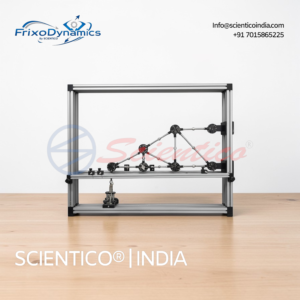
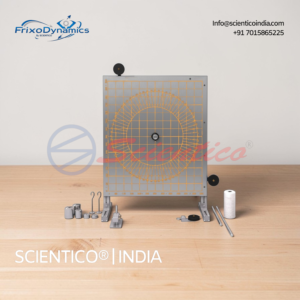
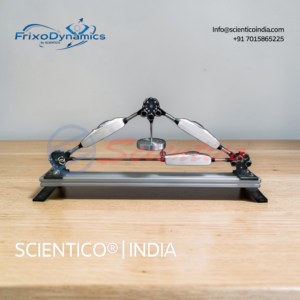
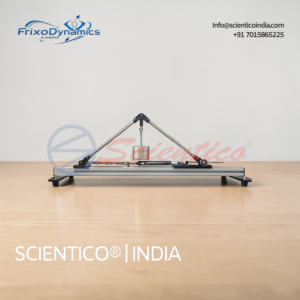
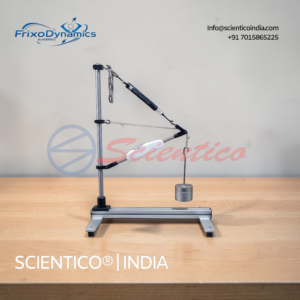
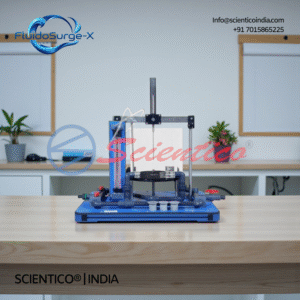
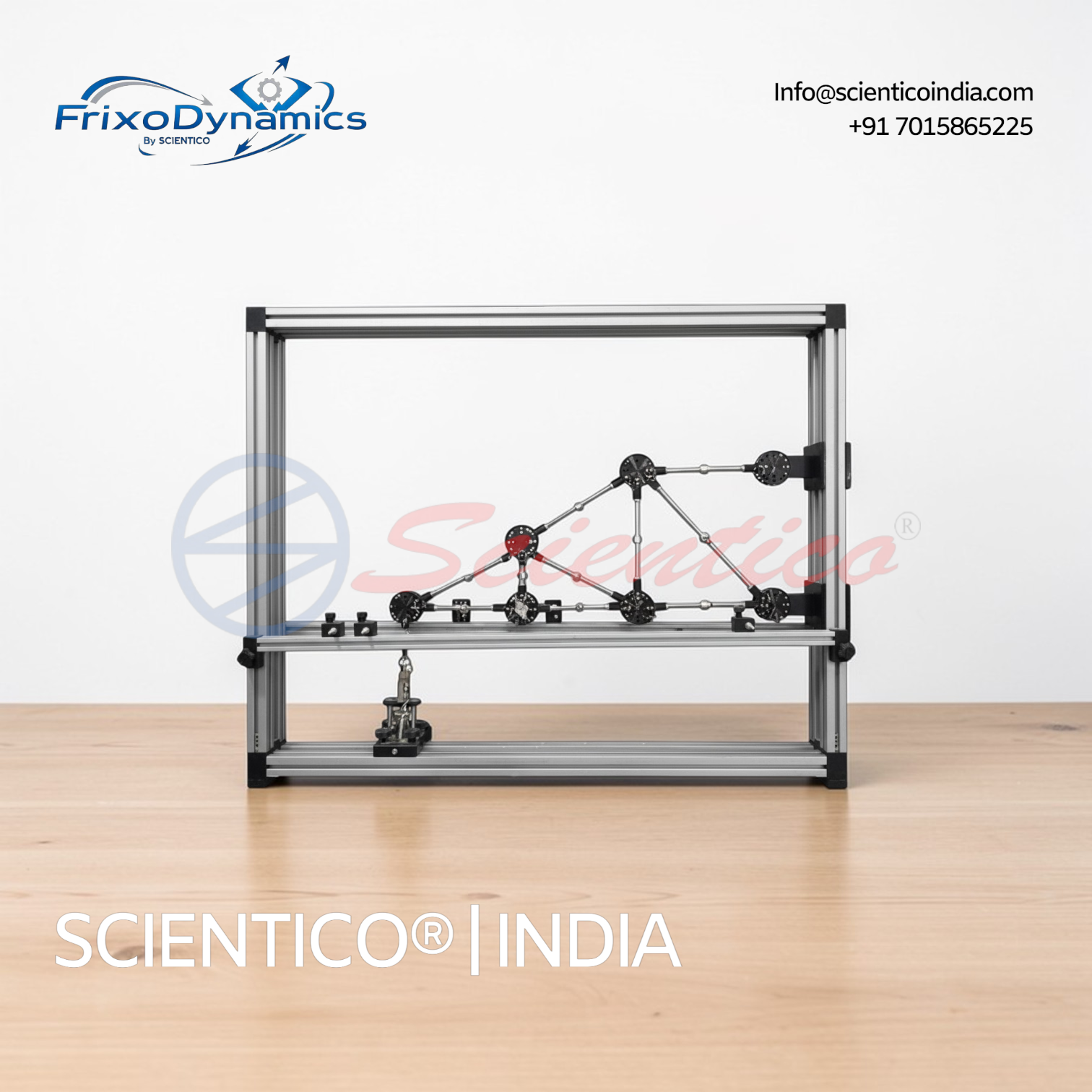
The SCIENTICO FrixoDynamics FX-514 Forces in Truss Apparatus is a fully instrumented structural mechanics unit for the experimental measurement of bar forces in single-plane statically determinate trusses. Bars in six lengths — from 150 mm to 520 mm — are assembled using pin-jointed node discs within a rigid support frame, allowing three distinct truss configurations to be constructed. Each bar carries an individual strain gauge load cell, and all 12 channels are acquired simultaneously by the measurement amplifier and processed by dedicated LabVIEW-based DAQ software, which displays bar forces graphically in real time. A load application device (−500 to +500 N, 0.01 N graduation) applies a controlled external force at any node disc, and its position and direction can be varied to investigate load dependency. Measured results are compared directly against the method of joints and Ritter’s method of sections. All components are housed in a dedicated storage system. Manufactured by SCIENTICO, available for institutional supply and international distribution.

The SCIENTICO FrixoDynamics FX-514 Forces in Truss Apparatus is a fully instrumented structural mechanics unit for the experimental measurement of bar forces in single-plane statically determinate trusses. Bars of six different lengths are connected via pin-jointed node discs, allowing three distinct truss configurations to be assembled within a rigid support frame. Each bar is fitted with a strain gauge load cell, and all force data is acquired simultaneously through a 12-channel measurement amplifier and processed using dedicated DAQ software developed in the National Instruments LabVIEW environment. Results can be compared directly against theoretical values obtained by the method of joints and Ritter’s method of sections. Manufactured by SCIENTICO, the FX-514 is suitable for supply to engineering institutions and distributors worldwide.

Product Overview

A truss is a structural form in which individual straight members — connected only at their ends through pin joints — carry load exclusively as axial tension or compression. Because no moments are transmitted at the nodes, the force in each bar can be determined analytically using equilibrium equations alone, making trusses one of the most tractable structural systems in undergraduate structural analysis. The FX-514 brings this analytical framework into the laboratory, allowing students to physically construct a truss, apply a controlled external force, measure the resulting bar forces instrumentally, and compare those measurements against two established theoretical methods.

The apparatus is assembled in a rigid metallic frame that provides fixed support locations for the truss. Bars are available in six lengths — 150 mm, 259 mm, 300 mm, 397 mm, 424 mm, and 520 mm — and are joined at node discs using pin-install closures that engage quickly and securely without tools. The angular relationships between connected bars — at 30°, 45°, 60°, and 90° — are determined by the choice of bar lengths and node disc positions, with three distinct truss geometries constructible from the standard bar set.

An external force is applied to a selected node disc using the load application device, which incorporates a force gauge with a range of −500 to +500 N and a graduation of 0.01 N. The direction and point of application of this force can be changed by repositioning the device on different node discs, allowing students to investigate how both the magnitude and point of application of the external load affect the distribution of bar forces throughout the truss.

Each bar carries its own strain gauge load cell. All 12 input channels feed simultaneously into the measurement amplifier, and the LabVIEW-based DAQ software acquires, processes, and graphically displays the bar forces in real time. The software supports direct export and comparison of measured values against theoretical calculations, and includes a comprehensive help function. All components are housed in a dedicated storage system and the complete experimental setup is arranged within the frame for clear, orderly use.

Parameter Specification
Model FrixoDynamics FX-514
Bar Lengths 1 x 150 mm, 3 x 259 mm, 7 x 300 mm, 1 x 397 mm, 3 x 424 mm, 1 x 520 mm
Bar Angles 30°, 45°, 60°, 90°
Maximum Bar Force ±500 N per bar
Force Measurement Strain gauge load cell on each bar
Load Application Device Range −500 to +500 N
Load Application Device Graduation 0.01 N
Measurement Amplifier 12 input channels
Node Discs 5 standard node discs, 2 support node discs
Truss Configurations 3 constructible forms
Joint Type Pin joints — frictionless, moment-free
DAQ Software National Instruments LabVIEW environment
Software Compatibility Windows operating system
Storage Dedicated storage system for all components
Scope of Delivery 1 set of bars, 5 node discs, 2 supports with node discs, 1 load application device, 1 set of cables, 1 instructional manual, DAQ software

Key Features

  • Strain gauge load cell on every bar provides simultaneous, independent force measurement across the full truss — no manual repositioning of sensors required
  • 12-channel measurement amplifier acquires all bar forces simultaneously for complete, instantaneous truss force data
  • LabVIEW-based DAQ software displays bar forces graphically, supports data export, and includes a comprehensive help function — compatible with any Windows environment
  • Load application device (−500 to +500 N, 0.01 N graduation) mountable on different node discs for variation of load direction and point of application
  • Six bar lengths and four angular relationships enable construction of three distinct truss geometries within a single apparatus
  • Pin-install node disc closures allow rapid, tool-free bar assembly and reconfiguration
  • Frictionless pin joints transmit no moments, producing ideal truss behaviour directly comparable to analytical methods
  • All components housed in a dedicated storage system and assembled within the support frame for organised, efficient laboratory use
  • Results directly comparable against method of joints and Ritter’s method of sections calculations

Applications

  • Measurement of bar forces in statically determinate single-plane trusses under external loading
  • Investigation of the effect of load direction on bar force distribution
  • Investigation of the effect of load point of application on bar force distribution
  • Comparison of experimental bar force measurements against theoretical values from the method of joints
  • Comparison of experimental results against Ritter’s method of sections
  • Study of tension and compression force distribution across different truss geometries
  • Demonstration of strain gauge load cell principles in structural force measurement
  • Undergraduate and postgraduate laboratory practicals in structural mechanics, statics, and structural analysis

Construction and System Design

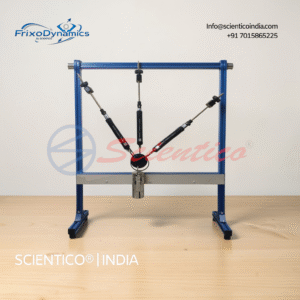
The FX-514 support frame is a rigid metallic structure that provides two fixed support locations corresponding to the truss boundary conditions. The frame geometry is fixed, and the truss is assembled within it by selecting the appropriate bar lengths and connecting them at node discs. Each node disc accepts multiple bars simultaneously through its pin-install closure system, locking each bar end securely at the correct angular position. Five standard node discs and two support node discs are provided.

Each bar is a precision-machined steel member with a strain gauge bonded to its surface. The strain gauge converts axial deformation under tension or compression into an electrical signal proportional to the bar force. All gauge signals are routed via the included cable set to the 12-channel measurement amplifier, which conditions and digitises the signals before passing them to the host computer running the LabVIEW DAQ software.

The software displays all bar forces simultaneously in both numerical and graphical format, allowing students to observe the complete force distribution across the truss in real time as the applied load is varied. The load application device is a manually operated mechanism that applies a controlled compressive or tensile force to the selected node disc, with the magnitude read from the integrated force gauge. Repositioning the device to a different node disc — or changing the angle of force application — requires only a few seconds, enabling a wide range of loading scenarios to be explored within a single laboratory session. All components return to the storage system after use, keeping the apparatus organised between sessions.

Export and Supply Capability

The SCIENTICO FrixoDynamics FX-514 is available for supply to engineering colleges, technical universities, civil and mechanical engineering departments, research institutions, and industrial training centres. SCIENTICO manufactures and exports laboratory equipment to institutions and distributors across multiple regions. Standard packaging is suitable for international shipment. Bulk orders, customised configurations, and institutional procurement enquiries are welcomed. Please contact SCIENTICO directly for pricing, lead times, and shipping terms.

Q1: What is the forces in truss apparatus used for?

The FX-514 is used to measure the axial forces — tension and compression — in the individual bars of a single-plane statically determinate truss under an applied external load. Students construct the truss from the provided bars and node discs, apply a known force using the load application device, and record all bar forces simultaneously via strain gauge sensors and the LabVIEW DAQ software. The measured results are then compared against theoretical values from the method of joints and Ritter’s method of sections.

Q2: What is the method of joints and how does the FX-514 support its verification?

The method of joints is an analytical technique for determining bar forces in a statically determinate truss by applying equilibrium equations at each node in sequence. The FX-514 supports its verification by providing measured bar forces for the same truss configuration and loading, allowing students to compare the experimentally recorded force in each bar against the value calculated analytically. The LabVIEW software facilitates direct side-by-side comparison of measured and theoretical data.

Q3: How many truss configurations can be built with the FX-514?

Three distinct truss geometries can be constructed using the provided bar set. The six bar lengths — 150 mm, 259 mm, 300 mm, 397 mm, 424 mm, and 520 mm — in the quantities supplied allow bars to be combined at angles of 30°, 45°, 60°, and 90° to form different planar truss forms within the support frame. The node disc pin-install system allows configurations to be changed quickly between experiments.

Q4: What software is used with the FX-514, and what are its system requirements?

The FX-514 uses DAQ software developed specifically for this apparatus in the National Instruments LabVIEW environment. The software acquires data from all 12 strain gauge channels simultaneously, displays bar forces graphically in real time, and supports data recording and comparison against theoretical values. It includes a comprehensive help function and is compatible with any Windows operating system.

Q5: What is included in the scope of delivery for the FX-514?

The FX-514 is supplied as a complete experimental kit including: one set of bars (1 x 150 mm, 3 x 259 mm, 7 x 300 mm, 1 x 397 mm, 3 x 424 mm, 1 x 520 mm) each with integrated strain gauge load cell; 5 standard node discs; 2 support node discs; 1 load application device (−500 to +500 N, 0.01 N graduation); 1 set of measurement cables; DAQ software (LabVIEW-based, Windows compatible); and 1 instructional manual covering assembly, experimental procedures, and data analysis guidance.

You may also like

Lorem ipsum dolor sit amet, consectetur adipiscing elit, sed do eiusmod tempor incididunt ut labore et dolore magna aliqua. Ut enim ad minim veniam, quis nostrud exercitation ullamco laboris nisi ut aliquip ex ea commodo consequat.

Testimonials

Lorem ipsum dolor sit amet, consectetur adipiscing elit, sed do eiusmod tempor incididunt ut labore et dolore magna aliqua. Ut enim ad minim veniam, quis nostrud exercitation ullamco laboris nisi ut aliquip ex ea commodo consequat.

Subscribe to our newsletter

Lorem ipsum dolor sit amet, consectetur adipiscing elit, sed do eiusmod tempor incididunt ut labore et dolore magna aliqua.

    Make An Enquiry