Cord Friction Apparatus | FrixoDynamics FX-530

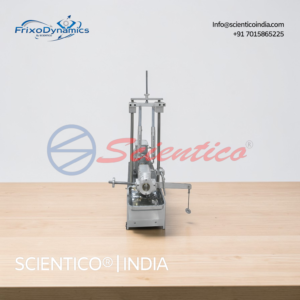
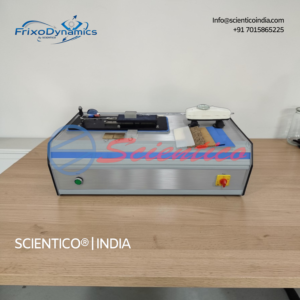
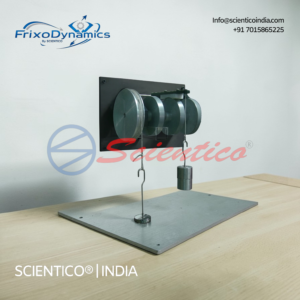
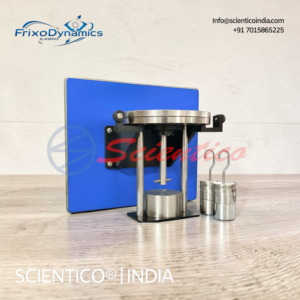
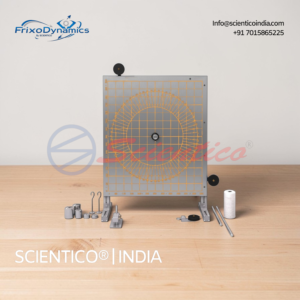
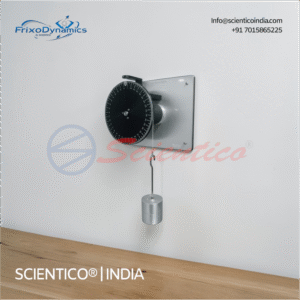
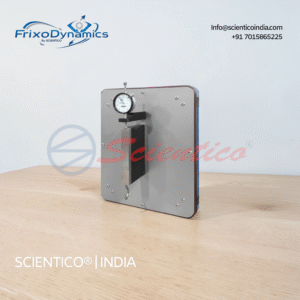
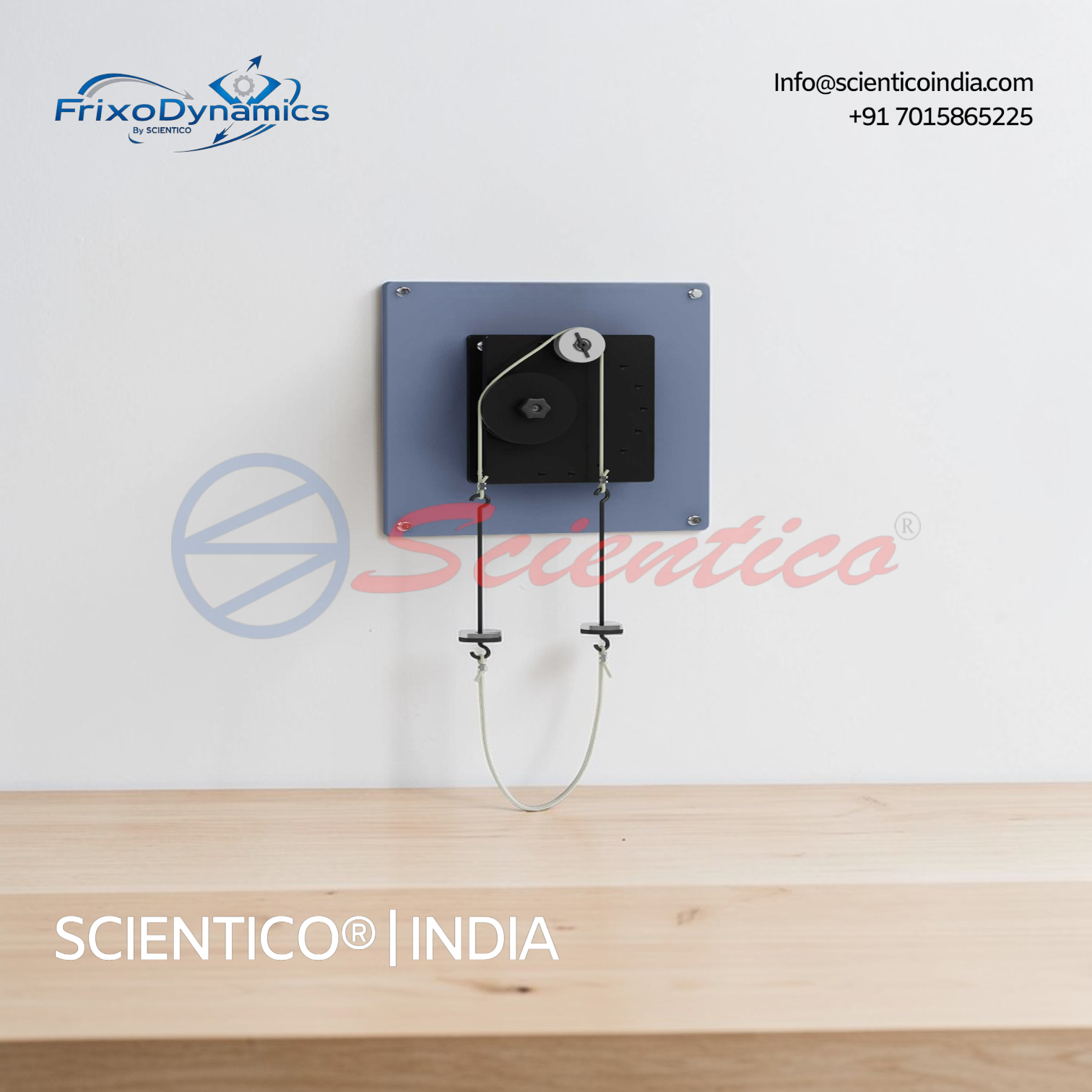
The SCIENTICO FrixoDynamics FX-530 Cord Friction Apparatus is a wall-mounted experimental unit for the investigation of rope friction across four steel pulley profiles — flat rim, 120°, 90°, and 60° V-groove — and across variable lap angles. A continuous cotton rope loop passes over a fixed primary pulley and an interchangeable second pulley, with two load hangers at its lower ends. The onset-of-slip condition is established by incrementally loading one hanger until the rope just slides, yielding the tight-side to slack-side tension ratio from which the coefficient of friction is calculated. The lap angle is varied using alternative bracket mounting positions for the second pulley, and the V-groove angle effect on effective friction is compared by substituting each of the four pulleys in turn. Suitable for undergraduate machine elements, tribology, and mechanical engineering laboratories, the FX-530 is supplied complete with four pulleys, cotton rope, load hangers, weight set, and instructional manual. Manufactured by SCIENTICO, available for institutional supply and international distribution.

The SCIENTICO FrixoDynamics FX-530 Cord Friction Apparatus is a wall-mounted experimental unit for the investigation of friction between a cotton rope and steel pulleys of four different groove profiles — flat rim, 120°, 90°, and 60° V-groove angles. Students determine the coefficient of friction between rope and pulley, investigate the relationship between the tight-side and slack-side belt tensions across a range of lap angles, and compare how the V-groove angle affects the effective friction and tension ratio. The lap angle is varied by using alternative mounting positions for the interchangeable second pulley. A complete loop of cotton rope, two load hangers, and a calibrated weight set are included. Manufactured by SCIENTICO, the FX-530 is suitable for supply to engineering institutions and distributors worldwide.

Product Overview

When a rope or belt passes over a pulley, the ratio of the tensions on the two sides is governed by the rope friction equation — an exponential relationship involving the coefficient of friction and the angle of lap (contact angle). For a rope seated in a V-groove pulley, the effective coefficient of friction is amplified relative to a flat rim pulley because the groove flanks generate a wedging action, increasing the normal force on the rope for the same applied tension. This makes V-groove pulleys significantly more effective at transmitting force without slip, and the degree of this amplification depends directly on the groove angle.

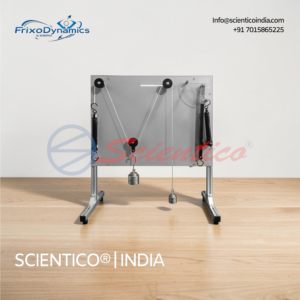
The FX-530 allows students to investigate both of these phenomena — the effect of lap angle on the tension ratio, and the effect of V-groove angle on the effective friction — through systematic, controlled experiments. The apparatus is wall-mounted and consists of a fixed pulley and a second interchangeable pulley. A continuous loop of cotton rope passes over both pulleys with two load hangers at its lower ends. One hanger carries a base load to tension the rope; the other hanger carries an increasing load until the rope just begins to slide over the pulley under test. This identifies the critical tension ratio at the onset of slip, from which the coefficient of friction is calculated.

The lap angle is changed by moving the interchangeable pulley to alternative mounting positions on the wall bracket, altering the geometry of the rope path between the two pulleys. Each of the four pulleys — flat rim, 120°, 90°, and 60° — can be mounted in place of the interchangeable pulley, allowing the effect of groove angle to be investigated independently of the lap angle. By conducting the experiment across combinations of groove angle and lap angle, students build a comprehensive dataset that verifies the rope friction equation and clearly demonstrates the wedging effect of V-groove profiles.

Parameter Specification
Model FrixoDynamics FX-530
Mounting Wall-mounted
Fixed Pulley 1 x fixed steel pulley
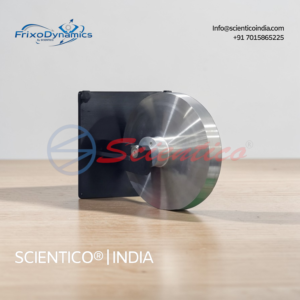
Interchangeable Pulleys 4 — flat rim, 120°, 90°, 60° V-groove
Rope Cotton rope, continuous loop
Load Hangers 2 (one each side of rope loop)
Lap Angle Variation Alternative mounting positions on wall bracket
Experiment Type Tension ratio at onset of slip
Scope of Delivery 1 experimental unit, 4 pulleys, 2 load hangers, 1 set of weights, 1 cotton rope, 1 instructional manual

Key Features

  • Four interchangeable pulleys — flat rim, 120°, 90°, and 60° V-groove — enable direct comparison of groove angle effect on effective friction and belt tension ratio
  • Variable lap angle via alternative pulley mounting positions on the wall bracket — no additional components required
  • Onset-of-slip datum method provides a clear, repeatable experimental criterion for tension ratio determination
  • Cotton rope on steel pulley represents a well-defined, consistent material pairing for friction coefficient determination
  • Wall-mounted fixed configuration ensures stable, repeatable geometry for each experiment setup
  • Continuous rope loop with two load hangers allows independent control of the datum tension and the increasing load side
  • Complete instruction manual includes experimental procedure, typical results, and lecturer guidance
  • Suitable for both student experiments and lecturer-led demonstrations

Applications

  • Determination of the coefficient of friction between a steel pulley and cotton rope for flat and V-groove profiles
  • Investigation of the relationship between lap angle and belt tension ratio
  • Comparison of belt tension ratios across flat rim, 120°, 90°, and 60° V-groove pulley profiles
  • Demonstration of the wedging effect of V-groove pulleys and its influence on effective friction
  • Verification of the rope friction equation for different groove angles and lap angles
  • Undergraduate laboratory practicals in machine elements, tribology, mechanical engineering, and power transmission
  • Supplementary demonstration for courses covering belt drives, rope mechanics, and frictional force transmission

Construction and System Design

The FX-530 is wall-mounted on a bracket that provides both a fixed mounting point for the primary pulley and a series of alternative mounting positions for the interchangeable second pulley. Changing the mounting position of the second pulley alters the geometric relationship between the two pulleys, varying the angle of lap of the rope on the pulley under test. This design allows lap angle variation without any modification to the pulleys themselves or the rope length.

All four pulleys are manufactured from steel with precision-machined groove profiles. The flat rim pulley provides the baseline friction condition, while the three V-groove pulleys — at 60°, 90°, and 120° — produce progressively increasing effective friction due to the wedging action of the groove flanks. The 60° groove produces the greatest wedging effect and therefore the highest effective coefficient of friction; the 120° groove produces the least. Substituting pulleys requires only the removal and replacement of the interchangeable pulley on its mounting.

The cotton rope passes over both pulleys in a continuous loop, with one end of the loop on each side of the primary pulley. A load hanger is attached at each lower end of the loop. The datum condition is established by adding a base load to one hanger, creating a reference slack-side tension. Weights are then added to the other hanger incrementally until the rope just begins to slide over the pulley under test. The two hanger loads at this point represent the tight-side and slack-side tensions, from which the tension ratio and the coefficient of friction are calculated. The experiment is repeatable and the datum can be re-established quickly between runs.

Export and Supply Capability

The SCIENTICO FrixoDynamics FX-530 is available for supply to engineering colleges, technical universities, mechanical engineering departments, research institutions, and industrial training centres. SCIENTICO manufactures and exports laboratory equipment to institutions and distributors across multiple regions. Standard packaging is suitable for international shipment. Bulk orders, customised configurations, and institutional procurement enquiries are welcomed. Please contact SCIENTICO directly for pricing, lead times, and shipping terms.

Q: What is the cord friction apparatus used for?

The FX-530 is used to investigate the friction between a cotton rope and steel pulleys, and to determine how the belt tension ratio at the point of slip depends on the angle of lap and the V-groove angle of the pulley. Students establish the onset-of-slip condition by incrementally loading one side of the rope loop until sliding begins, record the tension ratio, and use the rope friction equation to calculate the coefficient of friction. The experiment is repeated for different groove profiles and lap angles.

Q: Why does the V-groove angle affect the coefficient of friction?

A V-groove pulley grips the rope between its two flanks, creating a wedging action that increases the normal force on the rope beyond what the rope tension alone would produce. This higher normal force generates greater friction for the same rope tension, making the effective coefficient of friction higher than for a flat rim pulley with the same rope and pulley material. The narrower the groove angle, the stronger the wedging effect — so the 60° groove produces a higher effective friction than the 90° or 120° groove.

Q: How is the lap angle varied on the FX-530?

The lap angle is varied by repositioning the interchangeable second pulley to alternative mounting positions on the wall bracket. Each mounting position changes the geometric path of the rope between the two pulleys, altering the angle over which the rope wraps around the primary pulley. This allows a range of lap angles to be tested without modifying the rope, the pulleys, or the load configuration.

Q: How is the onset-of-slip condition identified in the experiment?

The onset-of-slip condition is identified by adding weights to the increasing-load hanger incrementally, in small steps, until the rope just begins to move slowly over the pulley. This is observed visually as the first sustained, slow sliding of the rope. At this point, the loads on both hangers are recorded. The ratio of the higher (tight-side) load to the lower (slack-side or datum) load gives the tension ratio at the onset of slip, from which the coefficient of friction is calculated using the rope friction equation.

Q: What is included in the scope of delivery for the FX-530?

The FX-530 is supplied as a complete experimental kit including: one wall-mounted cord friction experimental unit with fixed primary pulley and adjustable bracket; four interchangeable steel pulleys (flat rim, 120°, 90°, and 60° V-groove); one continuous cotton rope loop; two load hangers; one calibrated weight set; and one comprehensive instructional manual covering experimental procedures, typical results, and theoretical background for both student and lecturer use.

You may also like

Lorem ipsum dolor sit amet, consectetur adipiscing elit, sed do eiusmod tempor incididunt ut labore et dolore magna aliqua. Ut enim ad minim veniam, quis nostrud exercitation ullamco laboris nisi ut aliquip ex ea commodo consequat.

Testimonials

Lorem ipsum dolor sit amet, consectetur adipiscing elit, sed do eiusmod tempor incididunt ut labore et dolore magna aliqua. Ut enim ad minim veniam, quis nostrud exercitation ullamco laboris nisi ut aliquip ex ea commodo consequat.

Subscribe to our newsletter

Lorem ipsum dolor sit amet, consectetur adipiscing elit, sed do eiusmod tempor incididunt ut labore et dolore magna aliqua.

    Make An Enquiry