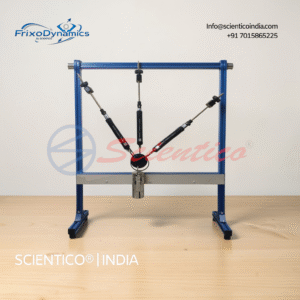
Polygon and Forces Apparatus | FrixoDynamics FX-516

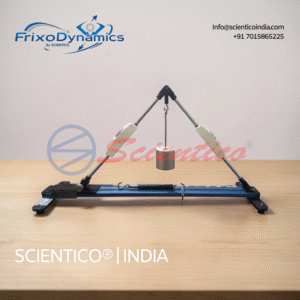
The SCIENTICO FrixoDynamics FX-516 Polygon of Forces Apparatus is a self-contained bench-mounted statics unit for the experimental investigation and graphical verification of coplanar force equilibrium. Up to five calibrated loads are applied via pulleys clamped at adjustable angular positions around a circular disc fitted with a 360° protractor. Equilibrium is confirmed when a central ring centres over the disc’s central pin, and force lines are traced onto paper for construction of the triangle of forces, polygon of forces, or link polygon. Both concurrent and non-concurrent coplanar force systems can be investigated, including forces applied to a circular disc or rectangular lamina. A calibrated weight set with increments down to 0.1 N provides precise load variation. Suitable for undergraduate statics and applied mechanics laboratories, the FX-516 is supplied complete with five pulleys, five weight sets, ring, thread, and instructional manual. Manufactured by SCIENTICO, available for institutional supply and international distribution.

The SCIENTICO FrixoDynamics FX-516 Polygon of Forces Apparatus is a self-contained, bench-mounted unit for the experimental investigation of equilibrium conditions for coplanar force systems. Up to five independently adjustable loads are applied to a circular disc via pulleys mounted at variable angular positions around its perimeter, and the conditions for equilibrium are established by centralising a small ring over the central pin using weighted cords. The lines of force action are recorded graphically by tracing the weighted cords onto paper attached to the disc surface, allowing direct construction and verification of the triangle of forces, polygon of forces, and link polygon. Manufactured by SCIENTICO, the FX-516 is suitable for supply to engineering institutions and distributors worldwide.

Product Overview

The equilibrium of coplanar forces is a foundational topic in statics. A system of coplanar forces is in equilibrium when both the vector sum of all forces and the sum of all moments about any point are zero. The FX-516 provides a direct, physically intuitive demonstration of this principle for both concurrent and non-concurrent force systems, using calibrated dead weights and a rotatable pulley system to establish and vary the force configuration.

The apparatus is built around a horizontal circular disc mounted on three legs above a stable base. A 360° protractor is printed on the disc surface, providing a direct angular reference for each force direction. Up to five pulleys are clamped at chosen positions around the disc perimeter, with each pulley redirecting a weighted cord from the central ring outward over the disc edge and downward to a load hanger. The forces acting on the central ring are therefore defined by the hanging weights and the angular positions of the pulleys.

Equilibrium is achieved when the central ring, pulled by all the concurrent cords, centres itself over the central pin without contacting it. The weighted cords are then traced onto a sheet of paper placed on the disc, recording the exact lines of force action. These lines, together with the known load magnitudes, are used to construct a polygon of forces graphically — closing the polygon confirms equilibrium and verifies the experimental result against the graphical method.

For non-concurrent force systems, the loads are applied at different points around the disc or on a rectangular lamina shape, and the link polygon method is used for graphical verification. The combination of physical force balance and graphical polygon construction gives students a comprehensive understanding of both the analytical and geometric approaches to force equilibrium.

Parameter Specification
Model FrixoDynamics FX-516
Disc Shape Circular
Protractor 360° graduated scale on disc surface
Maximum Simultaneous Loads 5
Pulley Mounting Clamped, adjustable angular position
Force Recording Method Cord tracing on paper attached to disc surface
Equilibrium Indicator Central ring over central pin
Weight Set 10 x 0.1 N, 2 x 0.5 N, 2 x 1 N, 2 x 2 N, 2 x 5 N
Mounting Self-contained, bench-mounted, three-leg base
Scope of Delivery 1 experimental unit, 5 pulleys, 5 sets of weights, 1 ring, 1 thread, 1 instructional manual

Key Features

  • Up to five simultaneously adjustable loads applied via clamped pulleys at variable angular positions around the disc perimeter
  • 360° protractor on disc surface provides direct angular reference for each force direction without additional instruments
  • Central ring and pin equilibrium indicator gives a clear, unambiguous physical confirmation of the balanced force condition
  • Cord tracing method records force lines of action directly onto paper on the disc, enabling immediate graphical polygon construction
  • Supports verification of triangle of forces, polygon of forces, and link polygon for both concurrent and non-concurrent coplanar force systems
  • Calibrated weight set with fine 0.1 N increments for precise load variation
  • Self-contained bench-mounted unit — no wall fixing or power supply required
  • Suitable for both circular disc and rectangular lamina force system investigations

Applications

  • Experimental resolution of concurrent coplanar force systems and verification of equilibrium
  • Graphical verification using the triangle of forces for three concurrent coplanar forces
  • Graphical verification using the polygon of forces for four or more concurrent coplanar forces
  • Graphical verification using the link polygon for non-concurrent coplanar force systems
  • Investigation of force equilibrium applied to a circular disc and a rectangular lamina
  • Comparison of experimental force balance results against graphical polygon constructions
  • Undergraduate laboratory practicals in statics, applied mechanics, and engineering fundamentals
  • Demonstration of resultant force determination and equilibrant identification

Construction and System Design

The FX-516 disc is a flat circular platform mounted horizontally on three legs that raise it above the bench surface, providing clearance for the load hangers to hang freely below the disc perimeter without obstruction. The 360° protractor graduation is printed directly on the disc surface, with clear angular markings that correspond to the cord directions under load. A central pin is positioned at the exact geometric centre of the disc, against which the equilibrium of the central ring is assessed.

Five pulleys are supplied, each mounted on an adjustable clamp that can be positioned at any angular location around the disc edge. The clamp design allows each pulley to be repositioned quickly and fixed securely before weights are applied. Each pulley redirects its cord smoothly from the horizontal plane of the disc downward to the hanging weight set, ensuring that the force applied to the central ring is accurately aligned with the cord direction as read on the protractor.

The central ring is a small loop placed over the central pin before loading begins. As weights are applied to each hanger and the cords pull the ring outward in multiple directions, the ring will centre itself over the pin only when the applied force system is in equilibrium. Once equilibrium is confirmed, a sheet of paper is placed on the disc and the cord lines are traced to record the force directions for graphical analysis. The weight set — ranging from 0.1 N to 5 N — provides sufficient range and resolution to construct a variety of force systems with meaningfully different magnitudes and angular distributions.

Export and Supply Capability

The SCIENTICO FrixoDynamics FX-516 is available for supply to engineering colleges, technical universities, mechanical and civil engineering departments, research institutions, and industrial training centres. SCIENTICO manufactures and exports laboratory equipment to institutions and distributors across multiple regions. Standard packaging is suitable for international shipment. Bulk orders, customised configurations, and institutional procurement enquiries are welcomed. Please contact SCIENTICO directly for pricing, lead times, and shipping terms.

Q1: What is the polygon of forces apparatus used for?

The FX-516 is used to investigate the conditions of equilibrium for coplanar force systems — both concurrent and non-concurrent. Students apply up to five loads via pulleys at adjustable angular positions around a circular disc, establish the equilibrium condition using a central ring, and then trace the force lines onto paper to construct and verify the triangle of forces, polygon of forces, or link polygon graphically. The apparatus bridges the gap between abstract vector analysis and observable physical force balance.

Q2: What is the difference between the triangle of forces, polygon of forces, and link polygon?

The triangle of forces applies to three concurrent coplanar forces in equilibrium, which when drawn to scale as vectors form a closed triangle. The polygon of forces extends this principle to four or more concurrent forces — the vectors form a closed polygon when in equilibrium. The link polygon is a graphical method used for non-concurrent coplanar forces, where the lines of action do not all pass through a single point, and equilibrium involves both force and moment balance.

Q3: How is equilibrium confirmed physically on the FX-516?

Equilibrium is confirmed when the central ring — connected to all weighted cords — centres itself directly over the central pin without making contact with it. At this position, the vector sum of all applied forces is zero, meaning the system is in static equilibrium. The ring provides a clear, immediate physical indicator of the equilibrium condition before the cords are traced for graphical analysis.

Q4: Can both concurrent and non-concurrent force systems be investigated with the FX-516?

Yes. For concurrent force systems, all cords pass through the central ring at a single point, and the triangle or polygon of forces is used for graphical verification. For non-concurrent systems, forces are applied at different points around the disc or on a rectangular lamina, and the link polygon method is applied. The adjustable pulley positions and variable weight combinations provide sufficient flexibility to set up a wide range of both force system types.

Q5: What is included in the scope of delivery for the FX-516? The FX-516 is supplied as a complete experimental kit including: one circular disc experimental unit with 360° protractor, three-leg base, and central pin; five adjustable pulleys; five sets of calibrated weights (10 x 0.1 N, 2 x 0.5 N, 2 x 1 N, 2 x 2 N, 2 x 5 N); one central equilibrium ring; one thread; and one instructional manual covering experimental procedures, graphical construction methods, and sample results.


You may also like

Lorem ipsum dolor sit amet, consectetur adipiscing elit, sed do eiusmod tempor incididunt ut labore et dolore magna aliqua. Ut enim ad minim veniam, quis nostrud exercitation ullamco laboris nisi ut aliquip ex ea commodo consequat.

Testimonials

Lorem ipsum dolor sit amet, consectetur adipiscing elit, sed do eiusmod tempor incididunt ut labore et dolore magna aliqua. Ut enim ad minim veniam, quis nostrud exercitation ullamco laboris nisi ut aliquip ex ea commodo consequat.

Subscribe to our newsletter

Lorem ipsum dolor sit amet, consectetur adipiscing elit, sed do eiusmod tempor incididunt ut labore et dolore magna aliqua.

    Make An Enquiry