Pin-Jointed Frameworks Apparatus | FrixoDynamics FX-531

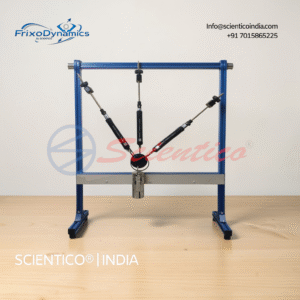
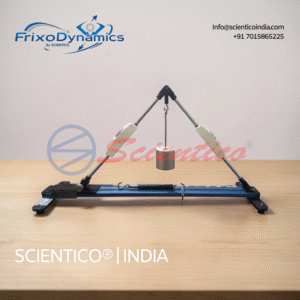
The SCIENTICO FrixoDynamics FX-531 Pin-Jointed Frameworks Apparatus is a fully instrumented structural mechanics unit for the experimental study of member forces, strains, stresses, and deflections in configurable pin-jointed truss structures. Fifteen strain-gauged stainless steel members are assembled using nine universal bosses — accommodating 30°, 45°, and 60° connections — into frameworks including Warren girders and roof trusses, mounted on a Structures Test Frame with pivoting and rolling support conditions. A 0–500 N load cell applies forces at variable angles and positions, a 16-way digital strain bridge displays all member forces simultaneously, and a digital deflection gauge measures node displacement. Bow’s Notation, method of joints, and comparative framework experiments are all supported. Optional LabVIEW-based software adds automatic data acquisition and virtual experiments extending beyond hardware test limits. Suitable for undergraduate and postgraduate structural mechanics and civil engineering laboratories. Manufactured by SCIENTICO, available for institutional supply and international distribution.

The SCIENTICO FrixoDynamics FX-531 Pin-Jointed Frameworks Apparatus is a fully instrumented structural mechanics unit for the experimental investigation of strains, stresses, forces, and deflections in a range of pin-jointed truss configurations, including Warren girder and roof truss forms. Fifteen stainless steel members, each fitted with an individual strain gauge, are assembled using nine universal bosses into a wide variety of statically determinate frameworks mounted on a Structures Test Frame. A 0–500 N load cell applies forces at variable angles, a 16-way digital strain bridge displays member forces simultaneously, and a digital deflection gauge measures structural deflection. Optional LabVIEW-based software extends the experimental programme with virtual experiments and automatic data acquisition. Manufactured by SCIENTICO, the FX-531 is suitable for supply to engineering institutions and distributors worldwide.

Product Overview

Pin-jointed frameworks — also called trusses — are structural systems in which straight members are connected only at their ends through frictionless pin joints, carrying load purely as axial tension or compression. Analysis of these structures using Bow’s Notation, the method of joints, and the method of sections is a core component of undergraduate structural mechanics and civil engineering curricula. The FX-531 brings this analytical framework into the laboratory, allowing students to physically construct multiple framework configurations, apply controlled loads at defined angles, and measure the resulting member forces and structural deflections with a calibrated instrumentation system.

Fifteen stainless steel members of various lengths are each bonded with a strain gauge. The members are assembled by slotting their ends into universal bosses, each of which accommodates member connections at 30°, 45°, or 60° — the standard angular increments required to construct Warren girders, Pratt trusses, roof trusses, and other common framework geometries. Two framework supports are provided: a pivoting support that allows rotation but no translation, and a pivoting and rolling support that allows both rotation and horizontal translation — together replicating the boundary conditions of a simply supported structure.

The 0–500 N load cell is mountable at different positions on the framework and can apply loads at various angles, connected to a Digital Force Display that gives a continuous reading of the applied load magnitude. All 15 member strain gauges feed into a 16-way digital strain bridge, which converts the strain readings to force values and displays them simultaneously — giving the complete member force distribution across the framework at any load condition without manual repositioning of sensors.

A digital deflection gauge measures the vertical or lateral displacement of selected nodes under load. This allows students to investigate not only the force distribution but also the stiffness behaviour of different framework configurations, extending the experimental scope beyond force measurement alone.

Optional LabVIEW-based software provides automatic data acquisition, real-time logging, and graphical display of all member forces and deflections. Virtual experiments within the software simulate the physical tests and additionally offer extended scenarios — higher loads, uniform distributed loads, and alternative framework geometries — that are not achievable with the hardware alone, broadening the learning programme without requiring additional physical equipment.

Parameter Specification
Model FrixoDynamics FX-531
Mounting Structures Test Frame
Members 15 stainless steel members, various lengths, each with strain gauge
Bosses 9 universal bosses — member connections at 30°, 45°, or 60°
Supports 1 pivoting support, 1 pivoting and rolling support
Load Cell Range 0 – 500 N
Load Application Variable angle, mountable at different node positions
Force Display Digital Force Display unit
Strain Measurement 16-way digital strain bridge
Deflection Measurement Digital deflection gauge
Framework Types Warren girder, roof truss, and other configurable forms
Software Optional — LabVIEW-based, Windows compatible
Optional Add-on Automatic Data Acquisition Unit
Scope of Delivery 1 experimental unit, 1 instructional manual

Key Features

  • 15 stainless steel members each fitted with an individual strain gauge — full member force distribution measured simultaneously via 16-way digital strain bridge without sensor repositioning
  • 9 universal bosses accepting member connections at 30°, 45°, and 60° — enabling construction of Warren girder, roof truss, Pratt truss, and other standard framework configurations
  • 0–500 N load cell with Digital Force Display, mountable at different nodes and at variable angles for comprehensive load application flexibility
  • Digital deflection gauge for structural node displacement measurement alongside member force data
  • Two boundary condition supports — pivoting, and pivoting-and-rolling — correctly replicating simply supported structural conditions
  • Optional LabVIEW-based software provides automatic data acquisition, real-time logging, and virtual experiments extending beyond hardware test limits
  • Supports Bow’s Notation analysis, method of joints, method of sections, and comparative framework experiments
  • Instructional manual includes sample experiment results and full experimental procedures

Applications

  • Experimental investigation of member forces in statically determinate pin-jointed frameworks
  • Study of strains, stresses, and deflections in Warren girder and roof truss configurations
  • Application and verification of Bow’s Notation for graphical framework force analysis
  • Comparison of force distributions across different framework geometries under the same applied load
  • Investigation of the effect of load angle and load point of application on member force distribution
  • Measurement of structural deflection and investigation of framework stiffness
  • Undergraduate and postgraduate laboratory practicals in structural mechanics, structural analysis, civil engineering, and mechanical engineering
  • Extended virtual experiments on higher loads, uniform loads, and non-standard geometries using optional LabVIEW software

Construction and System Design

The FX-531 mounts on a Structures Test Frame that provides a rigid, stable reference for the framework assembly and load application. The stainless steel members are precision-manufactured to defined lengths, with strain gauges bonded to each member and pre-wired to a multi-way connector for rapid connection to the 16-way digital strain bridge. Member assembly is achieved by slotting the machined ends into the universal bosses, which accept up to three members simultaneously at angles of 30°, 45°, or 60°. The boss design ensures consistent, repeatable joint geometry across all framework configurations.

The pivoting support fixes one end of the framework against both horizontal and vertical translation while allowing rotation, replicating a pinned support. The pivoting and rolling support allows horizontal translation in addition to rotation, replicating a roller support. Together, these two supports correctly define the statically determinate boundary conditions needed for frameworks that are analysable by equilibrium methods alone.

The load cell is connected to its mounting boss at the chosen node and angle before the experiment begins. The Digital Force Display gives a real-time reading of the applied load throughout the test. As load is increased incrementally, all 16 strain bridge channels update simultaneously, giving the full member force map at each load level. The digital deflection gauge is positioned at the node of interest and gives a continuous displacement reading as load is applied.

For users requiring permanent data recording and extended experimental capability, the optional Automatic Data Acquisition Unit connects directly to the strain bridge and force display, logging all channels simultaneously to the LabVIEW software on a connected Windows computer. The software presents member forces and deflections in both tabular and graphical formats, and the virtual experiment module allows students to explore load cases beyond the capacity of the physical hardware.

Export and Supply Capability

The SCIENTICO FrixoDynamics FX-531 is available for supply to engineering colleges, technical universities, civil and mechanical engineering departments, research institutions, and industrial training centres. SCIENTICO manufactures and exports laboratory equipment to institutions and distributors across multiple regions. Standard packaging is suitable for international shipment. Bulk orders, customised configurations, optional software and data acquisition units, and institutional procurement enquiries are welcomed. Please contact SCIENTICO directly for pricing, lead times, and shipping terms.

Q1: What is the pin-jointed frameworks apparatus used for in engineering education?

The FX-531 is used to investigate the distribution of forces, strains, and deflections in pin-jointed truss structures — including Warren girders and roof trusses — under controlled applied loads. Students construct the framework from stainless steel members and universal bosses, apply a known force using the load cell, and read member forces simultaneously from the 16-way digital strain bridge. Results are compared against analytical predictions from Bow’s Notation, the method of joints, and the method of sections.

Q2: What is Bow’s Notation, and how does the FX-531 support its application?

Bow’s Notation is a systematic graphical method for labelling and analysing forces in a pin-jointed framework. Each region between force lines is assigned a letter, and the force in each member is represented as the vector between the two letter labels on either side of it in the force diagram. The FX-531 supports Bow’s Notation by providing measurable member forces and a defined framework geometry, allowing students to construct the force diagram from the experimental data and verify its closure against the measured member force values.

Q3: How many framework configurations can be built with the FX-531?

The FX-531 supports a wide range of configurations using 15 members of various lengths and 9 universal bosses accommodating connections at 30°, 45°, and 60°. Standard configurations documented in the instructional manual include the Warren girder and roof truss forms. The flexibility of the boss and member system allows additional configurations to be constructed, and the optional LabVIEW software extends the available test geometries further through virtual experiment modules.

Q4: What does the optional LabVIEW software add to the FX-531 experimental programme?

The optional LabVIEW-based software provides automatic data acquisition from all strain gauge and force display channels simultaneously, with real-time graphical display and data logging on any Windows computer. Beyond data acquisition, the software includes a virtual experiment module that simulates the physical tests and extends the available scenarios to include higher load levels, uniform distributed loads, and alternative framework geometries that cannot be replicated with the physical hardware alone — broadening the experimental programme without additional equipment.

Q5: What is included in the standard scope of delivery for the FX-531?

The standard FX-531 delivery includes: one pin-jointed frameworks experimental unit comprising the Structures Test Frame, 15 strain-gauged stainless steel members, 9 universal bosses, 2 framework supports (pivoting and pivoting-and-rolling), 0–500 N load cell, Digital Force Display, 16-way digital strain bridge, and digital deflection gauge; and one comprehensive instructional manual with sample results and experimental procedures. Optional items — LabVIEW software and Automatic Data Acquisition Unit — are available separately.


You may also like

Lorem ipsum dolor sit amet, consectetur adipiscing elit, sed do eiusmod tempor incididunt ut labore et dolore magna aliqua. Ut enim ad minim veniam, quis nostrud exercitation ullamco laboris nisi ut aliquip ex ea commodo consequat.

Testimonials

Lorem ipsum dolor sit amet, consectetur adipiscing elit, sed do eiusmod tempor incididunt ut labore et dolore magna aliqua. Ut enim ad minim veniam, quis nostrud exercitation ullamco laboris nisi ut aliquip ex ea commodo consequat.

Subscribe to our newsletter

Lorem ipsum dolor sit amet, consectetur adipiscing elit, sed do eiusmod tempor incididunt ut labore et dolore magna aliqua.

    Make An Enquiry