















Rolling Disc on Inclined Plane | FrixoDynamics FX-506

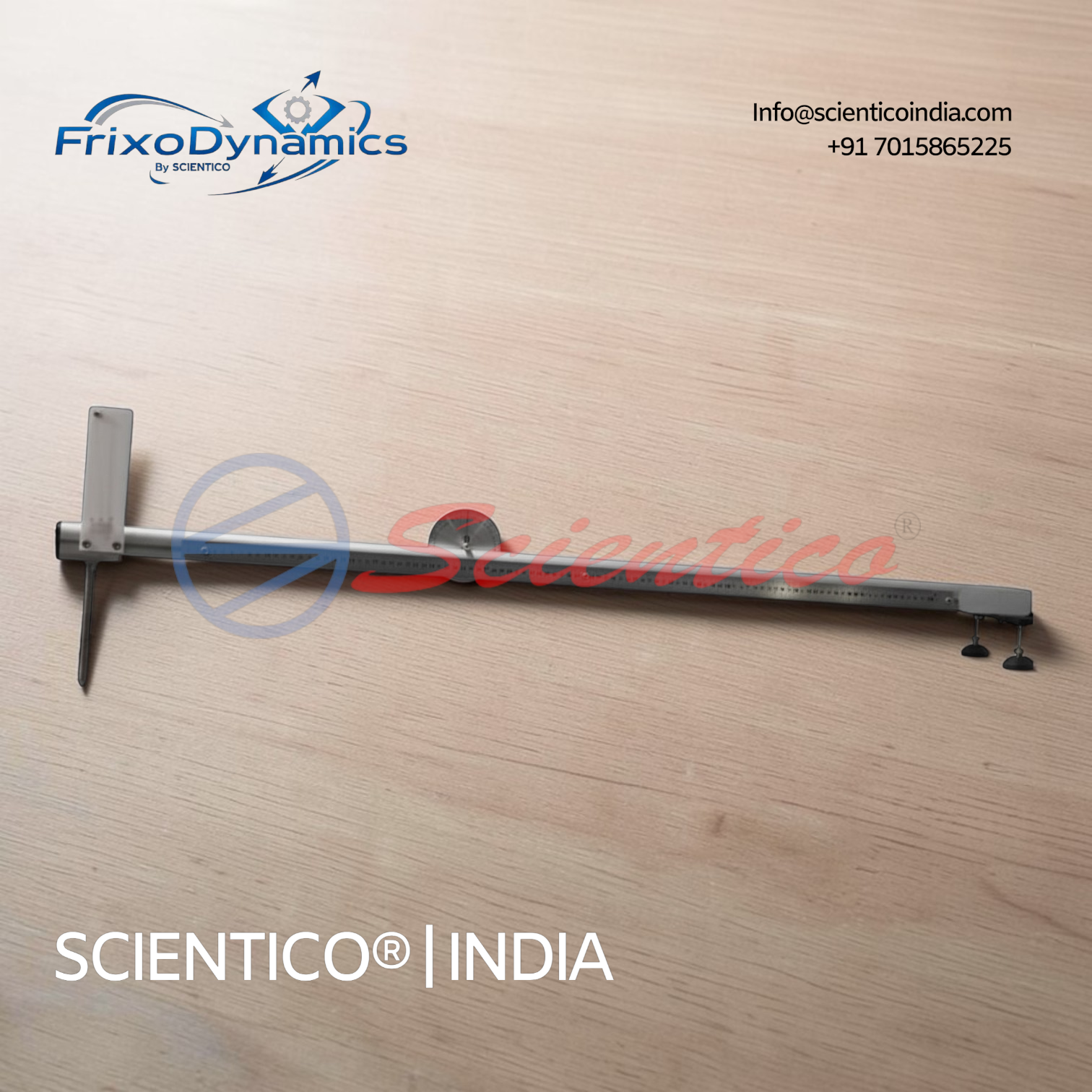
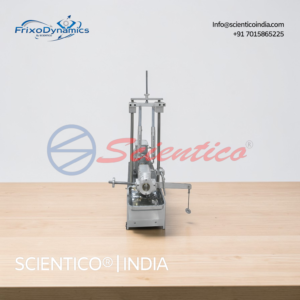
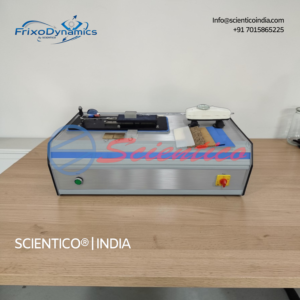
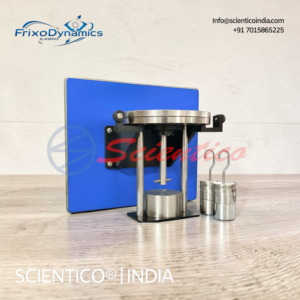
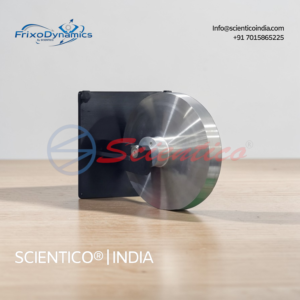
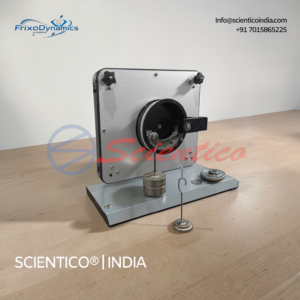
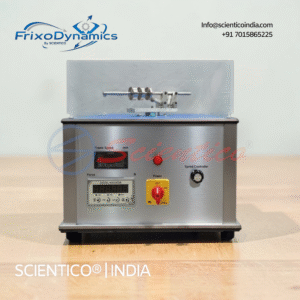
The SCIENTICO FrixoDynamics FX-506 Rolling Disc on Inclined Plane is a bench-top dynamics apparatus for the experimental determination of moment of inertia through both rolling and pendulum test methods. Two steel discs — 380 g at 70 mm diameter and 650 g at 100 mm diameter — are rolled down a precision-aligned inclined track of up to 1000 mm, with inclination adjustable from 0° to 10° and confirmed by a built-in inclinometer. Integrated spirit levels, a three-point support system, and self-centering conical disc pins ensure consistent, repeatable experimental conditions. The unit covers a broad range of rotational dynamics experiments including the law of gravity on an inclined plane, influence of mass on acceleration, and proof of the law of falling bodies. Suitable for undergraduate and postgraduate mechanical engineering and physics laboratories, the FX-506 is supplied complete with stopwatch, lock pin, and instructional manual. Manufactured by SCIENTICO, available for institutional supply and international distribution.
The SCIENTICO FrixoDynamics FX-506 Rolling Disc on Inclined Plane is a precision bench-top apparatus for the experimental investigation of rotational dynamics, moment of inertia, and the laws governing motion on an inclined surface. The unit accommodates discs of two different masses and diameters, which are rolled down a carefully aligned inclined track to measure acceleration, travel distance, and rolling time. A built-in inclinometer, integrated spirit levels, and a 1000 mm ruler ensure accurate and repeatable experimental setup. A separate pendulum block allows moment of inertia to also be determined through a swinging test, giving students two independent experimental methods for the same physical quantity. Manufactured by SCIENTICO, the FX-506 is suitable for supply to engineering institutions and distributors worldwide.

Product Overview

The FX-506 operates on the principle that a disc rolling down an inclined plane converts potential energy into both translational and rotational kinetic energy. The ratio between these two forms of energy depends on the disc’s moment of inertia, making rolling experiments a direct and practical method for its determination. By measuring the time taken for a disc to travel a known distance down the inclined track, students can calculate the angular acceleration and derive the mass moment of inertia from first principles.

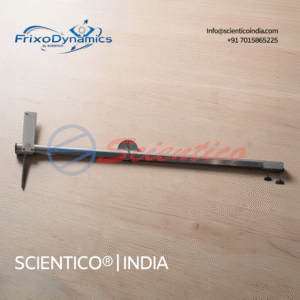
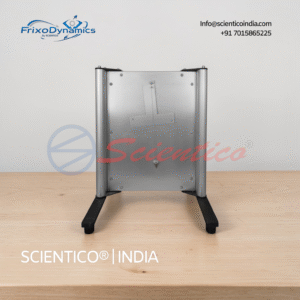
The inclined plane is mounted on a rigid metal carrier with a three-point support, allowing precise levelling via two integrated spirit levels and three adjustment bolts. The angle of inclination is set using a dedicated adjustment bolt and confirmed on the built-in inclinometer, which operates on the plumb line principle for reliable angular reading without additional instruments. The 1000 mm ruler integrated into the track surface provides a direct measurement reference for travel distance without the need for separate measuring tools.

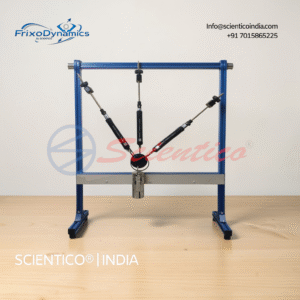
Each disc is fitted with self-centering conical pins on the rotary axis, ensuring consistent starting position and straight-line rolling along the track. The inclusion of a separate pendulum block extends the experimental scope: by swinging the disc as a physical pendulum, students can independently determine its moment of inertia and compare the result against the rolling test, reinforcing the concept through two distinct methodologies.

Parameter Specification
Model FrixoDynamics FX-506
Roll Track Length Maximum 1000 mm
Angle of Inclination 0° – 10°
Disc 1 — Mass / Diameter 380 g / 70 mm
Disc 2 — Mass / Diameter 650 g / 100 mm
Rotary Axis Diameter 10 mm
Distance to Centre of Gravity 10 mm
Alignment Two integrated spirit levels, three-point support with adjustment bolts
Angle Measurement Built-in inclinometer (plumb line principle)
Distance Measurement 1000 mm integrated ruler
Disc Centering Self-centering conical pins
Scope of Delivery 1 experimental unit, 2 discs, 1 stopwatch, 1 lock pin, 1 instructional manual

Key Features

  • Two discs of differing mass (380 g and 650 g) and diameter (70 mm and 100 mm) for comparative moment of inertia experiments
  • Built-in inclinometer using the plumb line principle for direct, instrument-free angle reading
  • Two integrated spirit levels and three-point support with adjustment bolts for precise, repeatable track alignment
  • 1000 mm ruler integrated directly into the inclined track for immediate distance measurement
  • Self-centering conical pins on each disc ensure consistent starting position and straight-line rolling
  • Separate pendulum block enables independent determination of moment of inertia by swinging test
  • Angle of inclination adjustable from 0° to 10° via a single adjustment bolt
  • Compact bench-top design suitable for standard laboratory benches

Applications

  • Demonstration of the law of gravity acting on a body on an inclined plane
  • Investigation of the influence of mass on the acceleration of a rolling body
  • Determination of the moment of inertia of rotating masses by rolling test
  • Determination of the moment of inertia of rotating masses by pendulum test
  • Study of the influence of moment of inertia on angular acceleration
  • Investigation of inertia in rotational motion
  • Experimental proof of the law of falling bodies
  • Comparative experiments using discs of different mass and diameter
  • Undergraduate laboratory practicals in dynamics, rotational mechanics, and engineering physics

Construction and System Design

The FX-506 is built on a rigid metal carrier that forms both the structural base and the inclined track surface. The three-point support system, combined with two integrated spirit levels, allows the track to be levelled precisely on any standard bench surface before the angle of inclination is applied. Inclination is set by turning the dedicated adjustment bolt, with the built-in inclinometer providing a continuous angular readout based on the plumb line principle — eliminating the need for a separate protractor or angle gauge.

The track surface incorporates a 1000 mm ruler printed or engraved directly along its length, giving an immediate distance reference for timing experiments. The two discs — 70 mm diameter at 380 g and 100 mm diameter at 650 g — are manufactured from steel and each fitted with a 10 mm rotary axis carrying self-centering conical pins. These pins engage with the track edges to ensure the disc starts from a consistent, centred position on each trial.

For pendulum-based moment of inertia determination, the pendulum block is attached to the disc assembly and the system is allowed to oscillate freely. The period of oscillation is recorded using the included stopwatch, and the moment of inertia is calculated from the pendulum equation. The lock pin is used to hold the disc in a fixed starting position before each rolling trial, ensuring a clean, consistent release.

Export and Supply Capability

The SCIENTICO FrixoDynamics FX-506 is available for supply to engineering colleges, technical universities, mechanical engineering and physics departments, research institutions, and industrial training centres. SCIENTICO manufactures and exports laboratory equipment to institutions and distributors across multiple regions. Standard packaging is suitable for international shipment. Bulk orders, customised configurations, and institutional procurement enquiries are welcomed. Please contact SCIENTICO directly for pricing, lead times, and shipping terms.


Q1: What is the rolling disc on inclined plane apparatus used for?

The FX-506 is used to study rotational dynamics and determine the moment of inertia of disc-shaped rotating masses. By rolling discs of known mass and diameter down a precisely inclined track and measuring travel time over a set distance, students calculate angular acceleration and derive the mass moment of inertia experimentally. The unit also supports pendulum-based moment of inertia determination as an independent verification method.

Q2: What is the moment of inertia, and how is it determined using the FX-506?

The moment of inertia is a measure of a body’s resistance to angular acceleration about a given axis — the rotational equivalent of mass in linear motion. Using the FX-506, it is determined by two methods: first, by measuring the time for a disc to roll a known distance down the inclined plane and applying the equations of rotational dynamics; and second, by attaching the pendulum block and measuring the period of oscillation of the disc-pendulum system.

Q3: Why does the FX-506 include two discs of different mass and diameter?

The two discs — 380 g at 70 mm diameter and 650 g at 100 mm diameter — allow students to conduct comparative experiments. Since the moment of inertia depends on both the mass and the distribution of that mass relative to the axis of rotation, using discs of different geometry allows students to observe how these parameters independently affect rolling acceleration and angular momentum.

Q4: How is the angle of inclination set and verified on the FX-506?

The angle of inclination is adjusted by turning a dedicated adjustment bolt on the metal carrier frame. The resulting angle is read directly from the built-in inclinometer, which operates on the plumb line principle — a suspended pointer aligns with a graduated scale to indicate the angle without requiring any external measuring instrument. Two integrated spirit levels confirm that the track is laterally level before the inclination is applied.

Q5: What is included in the scope of delivery for the FX-506?

The FX-506 is supplied as a complete experimental kit including: one inclined plane experimental unit with built-in inclinometer, spirit levels, and integrated 1000 mm ruler; two steel discs (70 mm / 380 g and 100 mm / 650 g) with self-centering conical pins; one stopwatch for time measurement; one lock pin for controlled disc release; and one instructional manual covering experimental procedures and data recording guidance.

You may also like

Lorem ipsum dolor sit amet, consectetur adipiscing elit, sed do eiusmod tempor incididunt ut labore et dolore magna aliqua. Ut enim ad minim veniam, quis nostrud exercitation ullamco laboris nisi ut aliquip ex ea commodo consequat.

Testimonials

Lorem ipsum dolor sit amet, consectetur adipiscing elit, sed do eiusmod tempor incididunt ut labore et dolore magna aliqua. Ut enim ad minim veniam, quis nostrud exercitation ullamco laboris nisi ut aliquip ex ea commodo consequat.

Subscribe to our newsletter

Lorem ipsum dolor sit amet, consectetur adipiscing elit, sed do eiusmod tempor incididunt ut labore et dolore magna aliqua.

    Make An Enquiry