Clutch Plate Friction Apparatus | FrixoDynamics FX-523
The SCIENTICO Clutch Plate Friction Apparatus is a bench-top experimental unit for the investigation of friction in flat disc clutch systems. Made by Scientico India, ISO 9001:2015 certified, and supplied with a calibration certificate and operation manual.
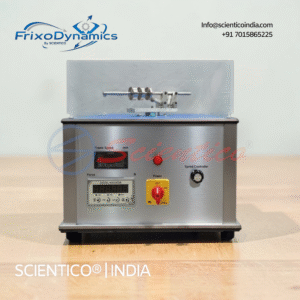
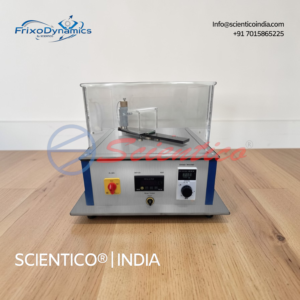
The SCIENTICO FrixoDynamics FX-523 Clutch Plate Friction Apparatus is a bench-top experimental unit for the investigation of friction in flat disc clutch systems. Using a set of four friction discs of different geometries and surface materials, students apply a controlled axial load to a clutch plate pressed against a leather disc and measure the torque transmitted at the point of slip. The apparatus supports comparison of different clutch plate geometries, solid disc, clutch lining, loose friction disc, and ring disc, and allows the influence of contact area and surface material on transmitted torque to be studied directly. Manufactured by SCIENTICO, the FX-523 is suitable for supply to engineering institutions and distributors worldwide.
Product Overview
A clutch is a mechanical device that connects and disconnects a driven component from a driving component without stopping the prime mover. In a flat disc clutch, torque is transmitted through friction between two axially loaded disc surfaces. The torque capacity of the clutch depends on the coefficient of friction between the contact surfaces, the axial clamping load, and the effective radius of the contact area. When the applied torque exceeds the friction capacity of the clutch, the disc surfaces slip relative to each other, defining the maximum transmittable torque at that clamping load.
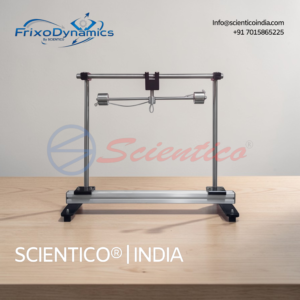
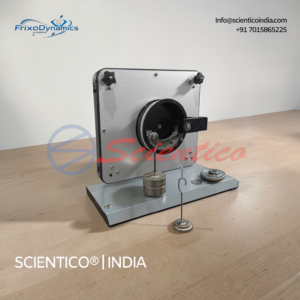
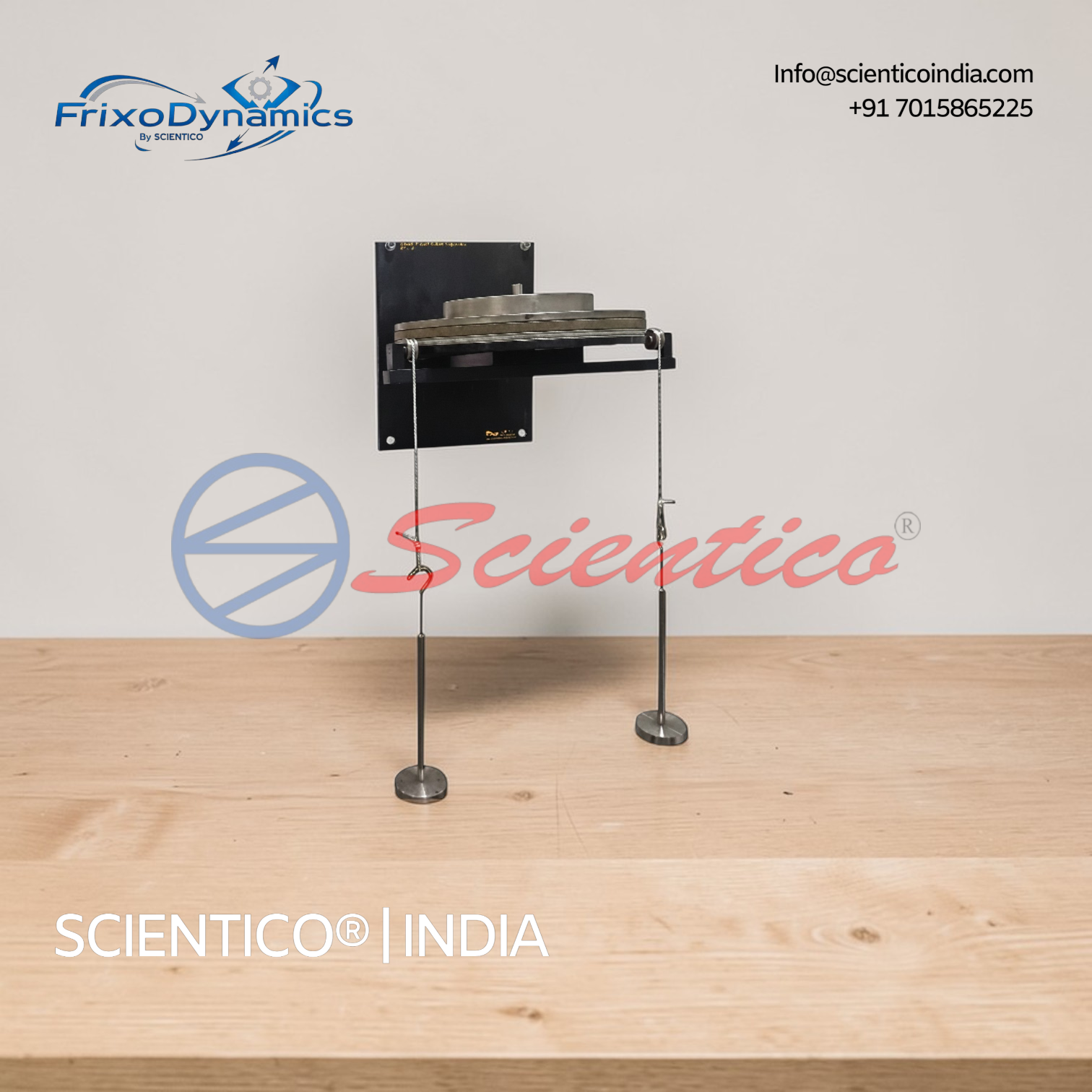
The FX-523 demonstrates this operating principle through a directly observable and measurable laboratory setup. A flat leather disc is mounted as the driving surface. The clutch plate, one of four interchangeable friction discs, is pressed against the leather disc face by a loading arm system acting through a thrust bearing, which applies a controlled axial clamping force without transmitting torque to the loading system. The clutch plate is connected to an effort pulley via screws. Two load cords are wound around a pair of 25 mm diameter pulleys, and dead weights are applied to generate torque on the effort pulley. The torque is increased incrementally until the clutch plate slips against the leather disc, establishing the maximum friction torque at that clamping load.
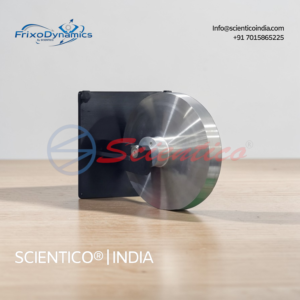
Four friction discs are provided, each of 250 mm outer diameter but with different geometries and surface characteristics: a galvanised steel solid disc, a clutch lining disc, a loose friction disc, and a ring disc with a 150 mm inner diameter. The ring disc eliminates the central contact area, reducing the effective friction radius and contact area relative to the solid discs, allowing students to compare how contact geometry affects the torque capacity for the same clamping load and surface material. Two calculation methods for predicting clutch torque capacity, the uniform pressure theory and the uniform wear theory, can be compared against the experimental results, reinforcing analytical understanding alongside the practical measurements.
Request Specifications & Pricing
model-specific, ISO 9001:2015 compliant. Supplied to universities and institutions in 30+ countries.
WhatsApp: +91 701-586-5225 | Email: [email protected]
View Quality Certifications | FAQ, Shipping, Warranty, Lead Time
| Parameter | Specification |
|---|---|
| Model | FrixoDynamics FX-523 |
| Driving Surface | Flat leather disc |
| Friction Disc Outer Diameter | 250 mm (all discs) |
| Galvanised Steel Disc | Diameter 250 mm |
| Clutch Lining Disc | Diameter 250 mm |
| Loose Friction Disc | Diameter 250 mm |
| Ring Disc | Outer diameter 250 mm, inner diameter 150 mm |
| Effort Pulley Diameter | 25 mm (2 pulleys) |
| Axial Load Application | Loading arm system via thrust bearing |
| Torque Application | Dead weights on two load cords |
| Weight Set | 2 x 1 N hangers, 8 x 5 N, 6 x 2 N, 4 x 1 N |
| Additional Weights | 2 x 30 N |
| Scope of Delivery | 1 experimental unit, 4 friction discs, 2 additional weights, 2 sets of weights, 1 thread, 1 instructional manual |
Key Features
- Four interchangeable friction discs, galvanised steel, clutch lining, loose friction disc, and ring disc, for direct comparison of surface material and contact geometry effects on clutch torque capacity
- Ring disc (outer 250 mm, inner 150 mm) enables comparison of full-face and annular contact area configurations under identical clamping loads
- Loading arm system acting through a thrust bearing applies axial clamping force cleanly without introducing torque into the loading mechanism
- Two 25 mm diameter effort pulleys with dual load cords for stable, symmetric torque application to the clutch plate
- Two additional 30 N weights extend the axial clamping load range for higher torque capacity experiments
- Supports comparison of experimental results against both uniform pressure and uniform wear theoretical calculation methods
- Compact bench-top design, self-contained, no power supply required
- Fine-increment weight set allows precise incremental torque loading to accurately identify the slip threshold
Applications
- Investigation of the friction behaviour of flat disc clutch plates under axial clamping load
- Determination of the maximum transmittable torque as a function of clamping load for different disc materials
- Comparison of clutch torque capacity for full-face disc and ring disc contact geometries
- Comparison of experimental clutch torque results against uniform pressure and uniform wear theoretical predictions
- Investigation of the effect of friction disc surface material on clutch plate torque transmission
- Study of the relationship between axial load, contact area, and friction torque in flat clutch systems
- Undergraduate laboratory practicals in machine elements, tribology, mechanical engineering design, and power transmission
Construction and System Design
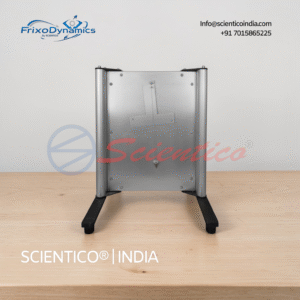
The FX-523 is mounted on a rigid base that supports the clutch assembly, loading arm, and pulley system. The flat leather disc is fixed as the driving surface against which each interchangeable clutch plate is pressed. The clutch plate is bolted to the effort pulley assembly using screws, ensuring that any torque applied to the effort pulley is transmitted directly to the clutch plate at the disc interface.
The loading arm applies axial force to the clutch plate through a thrust bearing. The thrust bearing isolates the axial clamping load from the rotational torque path, ensuring that the clamping force is transmitted cleanly to the disc interface without the loading arm resisting or contributing to the torque measurement. The axial load is controlled by adding calibrated dead weights to the loading arm, with the two additional 30 N weights extending the load range for experiments requiring higher clamping forces.
Two load cords are wound around the pair of 25 mm effort pulleys and connected to separate weight hangers. Adding weights to both hangers simultaneously applies a balanced torque to the effort pulley and therefore to the clutch plate. Weights are added in increments until the clutch plate just begins to slip against the leather disc, identifying the maximum friction torque at that clamping load and disc material combination. This procedure is repeated for each of the four friction discs and at multiple clamping load levels, generating a dataset for both material comparison and theoretical verification.
Export and Supply Capability
The SCIENTICO FrixoDynamics FX-523 is available for supply to engineering colleges, technical universities, mechanical engineering departments, research institutions, and industrial training centres. SCIENTICO manufactures and exports laboratory equipment to institutions and distributors across multiple regions. Standard packaging is suitable for international shipment. Bulk orders, customised configurations, and institutional procurement enquiries are welcomed. Please contact SCIENTICO directly for pricing, lead times, and shipping terms.
Q1: What is the clutch plate friction apparatus used for in engineering education?
The FX-523 is used to investigate the friction behaviour of flat disc clutch plates under controlled axial clamping loads. Students apply incremental torque to a clutch plate pressed against a leather disc and identify the slip threshold, the maximum torque the clutch can transmit at that clamping load. By repeating the experiment with four different friction disc types and at multiple clamping loads, students study how disc material, contact geometry, and clamping force each affect clutch torque capacity.
Q2: What is the difference between the solid disc and the ring disc provided with the FX-523?
The solid friction discs have a full 250 mm diameter contact face, maximising the contact area and the effective friction radius. The ring disc has the same 250 mm outer diameter but a 150 mm inner diameter, removing the central contact area. Since the inner region of a disc contributes less moment arm per unit area, the ring disc geometry is more efficient in terms of torque per unit contact force, and the comparison between the two directly illustrates the difference between uniform pressure and uniform wear contact assumptions.
Q3: What are the uniform pressure and uniform wear theories, and how does the FX-523 support their comparison?
The uniform pressure theory assumes that the contact pressure is equal across the entire disc face, which is more applicable to new or rigid clutch surfaces. The uniform wear theory assumes that wear rate is uniform across the face, leading to a non-uniform pressure distribution that is more applicable to bedded-in surfaces. Both theories yield different predictions for the friction torque at a given clamping load. The FX-523 allows experimental torque values to be compared against both theoretical predictions, helping students identify which theory better represents the measured behaviour for each disc type.
Q4: How is the axial clamping load applied without affecting the torque measurement on the FX-523?
The axial clamping load is applied through a loading arm system acting via a thrust bearing. The thrust bearing transmits the axial force from the loading arm to the clutch plate while allowing the plate to rotate freely, so the loading arm does not resist or contribute to the rotational torque at the disc interface. This separation of the axial loading path from the torque path ensures that the measured effort weight corresponds only to the friction torque at the clutch disc faces.
Q5: What is included in the scope of delivery for the FX-523?
The FX-523 is supplied as a complete experimental kit including: one clutch plate friction experimental unit with leather driving disc, loading arm, thrust bearing, and dual effort pulleys; four friction discs (galvanised steel 250 mm, clutch lining 250 mm, loose friction disc 250 mm, ring disc 250 mm outer/150 mm inner); two additional 30 N weights; two sets of calibrated weights (2 x 1 N hangers, 8 x 5 N, 6 x 2 N, 4 x 1 N); one thread; and one instructional manual covering experimental procedures, calculation method comparisons, and data recording guidance.
Need Assistance? We're Here to Help!
Connect with our team for product specifications, pricing, and customized solutions for your institution or project.